Future State Modeling: A Practical Framework
Future state modeling defines the capabilities, workflows, systems, and decisions needed to move from current operations toward a clear, shared target state.

Future state modeling is the process of creating a structured representation of how an organization should operate after improvement. It defines desired capabilities, workflows, technologies, knowledge systems, and decision processes, then connects them to current gaps and required changes. Its purpose is to provide direction, not predict the future perfectly.
Without a target state, transformation can become a collection of disconnected initiatives competing for attention and resources. A shared model aligns stakeholders around where the organization is going, why the destination matters, and how proposed changes contribute. The video above walks through the core ideas.
What is future state modeling?
Future state modeling describes the capabilities, systems, practices, and relationships an organization wants to develop. It translates a broad ambition into an operating model that teams can evaluate, communicate, and use to guide change.
Unlike a forecast, the model does not claim to know exactly what will happen. It establishes an intentional direction while allowing adaptation as circumstances, evidence, and technologies change.
For example, an organization moving toward AI-native research might define how it will manage evidence, structure knowledge, evaluate outputs, run research workflows, and assign human responsibilities. Together, these elements describe a coherent destination rather than a list of isolated technology projects.
How do you build a future state model?
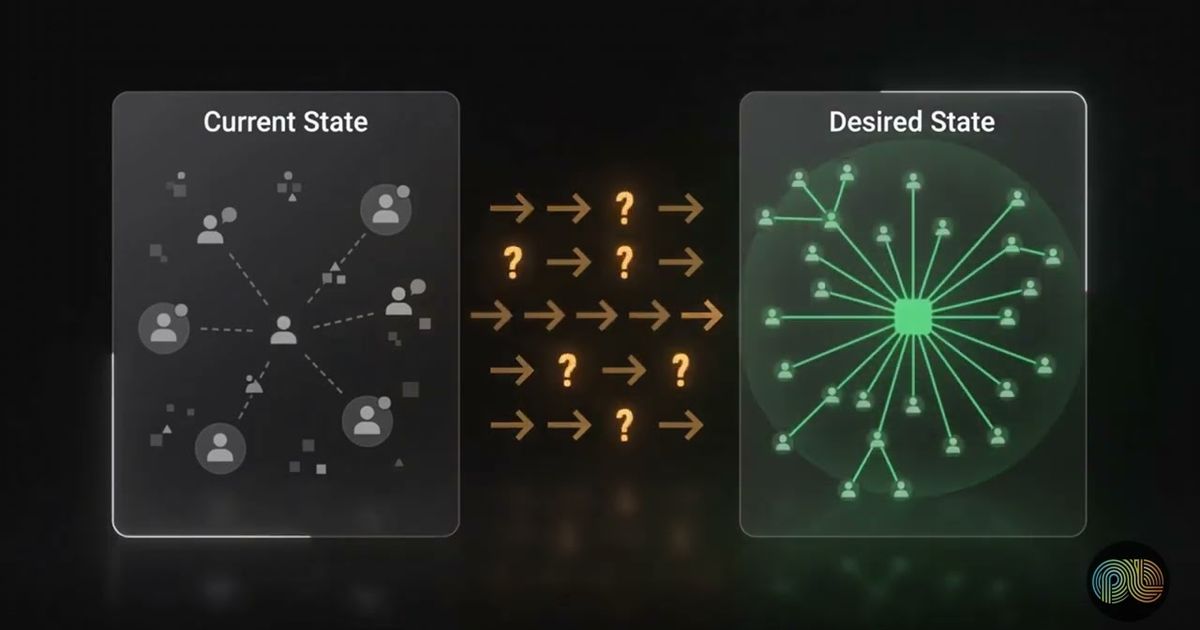
Start with the current state, define desired outcomes, identify capability gaps, and specify the changes needed to close them. This sequence keeps the future state connected to evidence rather than aspiration alone.
- Assess the current state. Document existing capabilities, workflows, technologies, decision processes, constraints, and recurring problems. A disciplined current state assessment provides the baseline.
- Define desired outcomes. State what the organization should be able to achieve and why it matters.
- Identify capability gaps. Determine which capabilities are missing, fragmented, inconsistent, or difficult to scale.
- Plan the transition. Sequence changes, dependencies, ownership, and realistic stages.
The model defines the destination, while the transition plan describes a feasible route. Teams should revisit both as implementation creates new evidence and reveals practical constraints.

What should a useful future state model include?
A useful model covers the interconnected parts of how work gets done. Its structure should be broad enough to expose dependencies between operational, technical, and strategic changes.
Core areas commonly include:
- Capabilities: What the organization must be able to do reliably.
- Workflows: How work, evidence, approvals, and decisions should move.
- Technology: Which technical functions must support the capabilities.
- Knowledge systems: How information should be structured, preserved, found, and reused.
- Evaluation practices: How quality, progress, and outcomes will be assessed.
- Human roles: Where people provide expertise, context, judgment, oversight, and approval.
These areas should form one connected model. Changing a research workflow may also require new evidence structures, governance practices, evaluation methods, and role definitions. Treating each area independently can recreate the disconnected initiatives the model is meant to prevent.
Why should future state models focus on capabilities?
Capability-based models remain useful when products and technologies change. They describe what the organization needs to accomplish rather than locking its transformation to one tool, vendor, or implementation.
A tool-specific target state can become obsolete as technology evolves. Capabilities and principles such as evidence traceability, reusable knowledge, effective governance, and continuous learning are more durable. An AI-native research architecture, for example, should be evaluated by the operating capabilities it supports rather than by its collection of applications.
Technology still matters, but implementation choices should follow from desired capabilities. This separation lets teams replace tools without losing their strategic direction.

How can AI support future state modeling?
AI can analyze patterns, explore possible capability combinations, and visualize relationships across areas of transformation. It can make complex models easier to examine, but it should not determine the desired future independently.
Teams can use AI to organize current-state evidence, surface recurring gaps, compare alternatives, and explore how one change may affect other parts of the model. These applications support synthesis and scenario exploration rather than replace strategic accountability.
Human judgment remains essential because target-state decisions require organizations to balance ambition, feasibility, priorities, and context. People must decide which outcomes matter, what trade-offs are acceptable, and how responsibilities should change.
Key takeaways
- Future state modeling defines how an organization wants to operate after improvement.
- A strong model begins with current-state evidence and identifies capability gaps.
- Capabilities provide a more adaptable target than specific tools or vendors.
- AI can support analysis and exploration, but people must make strategic decisions.
- A realistic transition plan turns an abstract vision into coordinated change.
How PulseLake helps
PulseLake keeps objectives, methodology, evidence, and decisions in a persistent study context, helping teams connect current-state findings with future capability choices. Its research knowledge graph, cross-study search, simulation, agents, governance, and workflow automation can support evidence-based modeling while researchers retain judgment and approvals. To discuss your future research operating model, talk to our team.
Frequently asked questions
How detailed should a future state model be?
A future state model should clarify desired capabilities, dependencies, decision processes, and operating principles without prescribing every technical configuration. Excessive detail can make it brittle, while vague statements provide little guidance. More specific requirements and implementation designs can sit beneath the core model.
What is the difference between a strategic vision and a future state model?
A strategic vision expresses broad direction and aspiration. A future state model translates that vision into a structured description of the capabilities, workflows, technologies, knowledge systems, practices, and human roles needed to operate differently. It therefore provides a practical basis for identifying gaps and coordinating initiatives.
Who should participate in defining the target state?
Participants should include people who set strategic priorities, understand current operations, manage relevant systems, perform the work, and will be accountable for implementation. Broad participation exposes dependencies and practical constraints. Clear decision ownership is still necessary to resolve competing preferences and approve the final direction.