How to analyse thousands of open-ended responses with AI: a method with validation checks
A practical workflow for AI-assisted coding of open-ended responses, including codebooks, held-out evaluation and reproducible counts.
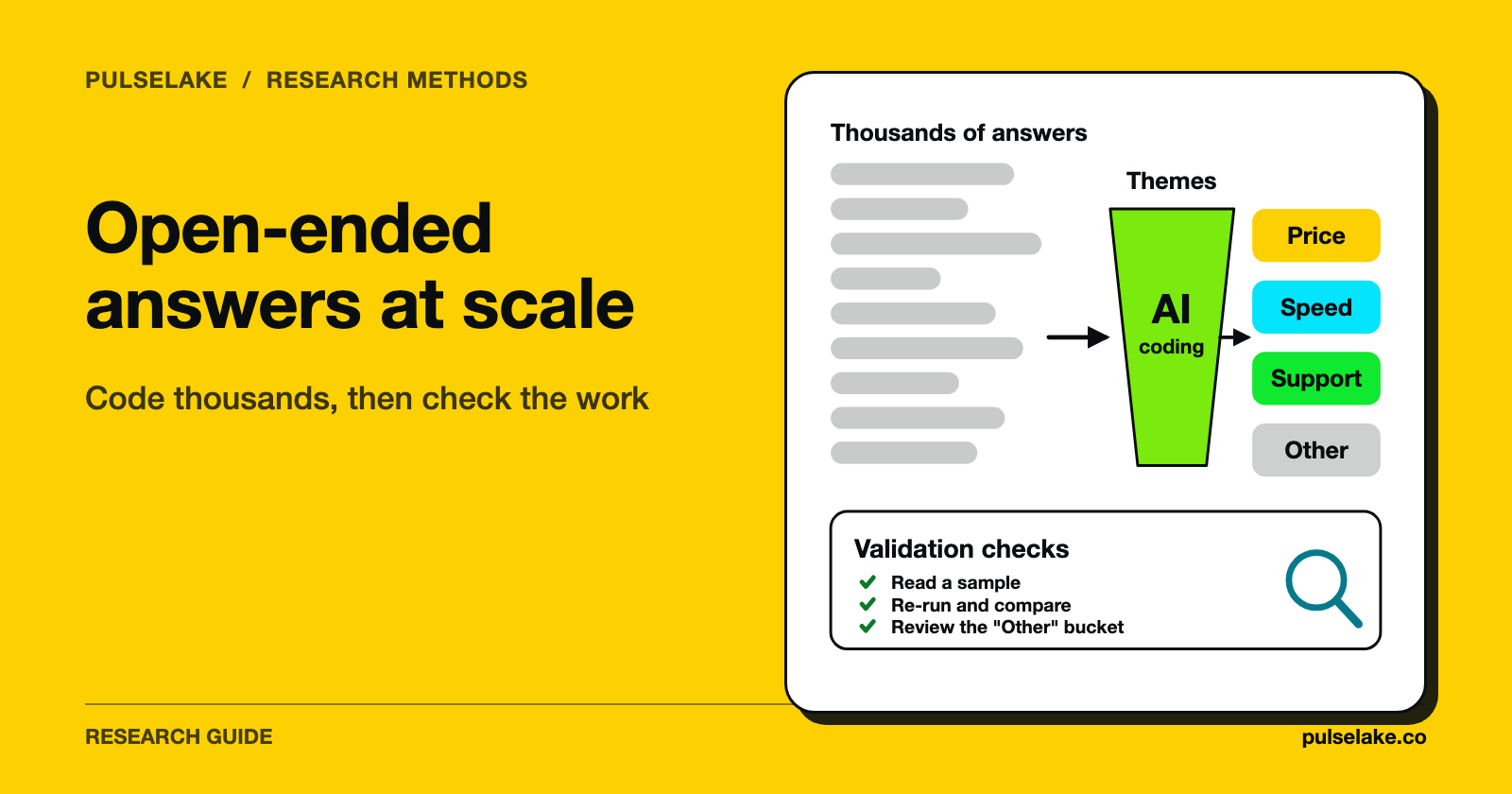
To analyse open-ended responses with AI, define the research question, build a coding scheme people can review, evaluate it on held-out responses, and calculate results from the coded dataset. Keep every theme tied to its source text. The method below shows how to validate the work. It doesn't claim any particular model or accuracy level has already been validated.
Got a big file? The temptation is to ask for a summary right away. You'll get a decent first impression, and you still won't know what was counted, what was missed, or whether the categories mean what your team thinks they mean.

Define the decision and the unit of analysis
Start with what the comments are for. A team chasing checkout problems needs different categories from a team measuring brand associations, even when both datasets are full of the word “easy.”
Then pick the unit. Respondents, individual answers, or passages inside answers? Can one answer earn several codes? Whatever you choose decides how you'll read every percentage and comparison later.
Keep a stable response identifier and the original text. Split a response into passages? Keep the link to its parent record. Lose it and later aggregation can count one person several times without anyone noticing.
Prepare the data without erasing meaning
Remove records only under documented rules. Empty responses, duplicates and test submissions may each need different treatment, and a log of the exclusions lets another analyst rebuild the final dataset.
A short answer may only make sense next to the question it answered, so hold on to language, question wording and the relevant collection context. Translation can help. Keep the original anyway, and note how it was translated.
Before any text goes to an external service, apply your project's approved handling of personal information. The right workflow depends on the data and the permissions you have. A handy upload box doesn't mean the upload is allowed.
Read a varied subset before defining themes
Sample answers from different segments, time periods and lengths. The goal is the full range, including issues a frequent-word approach would sail past.
AI can suggest candidate themes if that helps, but a researcher still looks at the passages underneath. A broad label like “service” can hide quite different causes: waiting time, staff knowledge, a complaint nobody resolved.
Keep an uncertainty category. Forcing every response into a confident label makes the output tidy and less honest, and we think that trade is the biggest quiet risk in AI coding. Ambiguous records also make useful raw material for the next review round.
Write a codebook someone else can use
Give every code a definition, an inclusion rule, an exclusion rule and an example. Where codes overlap, say when multiple coding is allowed.
A fictional illustration for a delivery study:
| Code | Include | Exclude |
|---|---|---|
| Late arrival | The item arrived after the expected time | A complaint only about tracking information |
| Tracking uncertainty | The person could not determine shipment status | A late arrival with no tracking concern |
| Damaged item | The item was described as physically damaged | Dislike of the product's appearance |
| Unclear | The meaning cannot be established from the response | A clear negative comment that lacks strong emotion |
Take a comment like “It arrived late and the tracking never updated.” It can carry both the first and second codes. That's the scheme doing its job, not a duplicate to clean out.
Separate development from evaluation
One set of responses refines the codebook; a separate held-out set evaluates the process you end up with. Does the team keep tweaking the instructions after looking at the same evaluation examples? Then those examples have quietly become development data.
Qualified reviewers set the reference coding and settle disagreements. Human agreement isn't automatic ground truth, though. When reviewers disagree, it can point to a fuzzy definition or a genuinely mixed response.
Score each category on its own, since an overall figure can hide poor handling of an uncommon issue that really matters. Decide up front which errors hurt the business decision most, and which categories need manual review.
Inspect errors before scaling the run
Look at false positives, missed cases and whatever landed in the uncertainty category. Where's the fault: the codebook, missing context, language handling, or the model's reading?
Never make performance look better by quietly dropping the hard records. If a type of response can't be handled reliably, send it to manual review, or narrow what the output is approved for.
Write down the model, instructions, codebook and processing settings. Reproducibility matters most when the work runs in batches and a later batch ends up on a different configuration.
Calculate from records, not generated prose
Accepted the coding? Now calculate counts and proportions with an explicit data process. Python with pandas grouping operations or R can support reproducible aggregation. Clear definitions and kept code matter more than which language you use.
A hypothetical study: 40 of 200 respondents mention late delivery. That's 20% of those respondents. Some of them also mention tracking, so total topic mentions can exceed the number of people, and the report shouldn't call those extra mentions additional respondents.
Put the denominator rules right beside the results. Is the base everyone who completed the study, everyone shown the question, or everyone who gave a usable answer? Say which.
Interpret patterns in context
Frequency isn't importance. A rare issue can carry real consequences, while a common phrase can be too vague to act on. Read representative and contradictory passages before you recommend anything.
Compare segments only when the data supports it. Differences in who answered, who saw the question or when it was collected can create patterns that need more digging.
Handle quotations with care. Choose text that accurately illustrates the theme, keep the context that matters, don't tidy up a quote, and don't blend several participants into one invented statement.
What should the final report disclose?
The research question, data source, exclusions, coding scheme, the model-assisted steps and the review process. Describe the important error patterns and any categories you handled by hand.
Keep the coded dataset, the codebook version and the calculation process with the report, so a later reviewer can reproduce the numbers and check the evidence behind any claim.
And when the dataset changes or the model gets upgraded, check whether the earlier validation still holds. One evaluation isn't a permanent licence to use the method on every future study.
Which tools can support AI analysis of open-ended responses?
NVivo, ATLAS.ti and MAXQDA are qualitative-analysis tools to consider. Thematic is relevant to feedback analysis, and broader research platforms such as Qualtrics may connect analysis to collection.
PulseLake is a research operating system that connects study design and evidence collection with structured analysis, interpretation and reporting. Its research frameworks organise questions and measures into dimensions and sub-dimensions. That structure gives the evidence a shared meaning, so you can use it for analysis beyond a single response or survey.
In qualitative work the link that matters runs between the source evidence and the concepts you're analysing. A dimension-based framework can make the intended interpretation explicit, though coding quality and reliability still need their own review.
Whoever the supplier is, ask them to show source retrieval, code revision and export on your own material. A list of AI features doesn't prove the workflow supports the validation you need.
Frequently asked questions
How many responses should humans review?
It depends on how varied the data is, how often each category appears, and how costly errors would be. No single count validates every dataset or method, so design the review around those three things.
Can one response have multiple themes?
Yes, if your codebook allows it. Keep respondent counts separate from theme mentions, and explain how the percentages are calculated.
Is a high overall accuracy score enough?
No. Check performance by category and by relevant segment, especially for uncommon issues that matter to the decision. The kinds of errors tell you more than the aggregate score.
Can the AI write the final recommendation?
It can help draft the wording. A researcher should check the evidence and the reasoning, and the recommendation has to stay within what the study and its validation can support.