How to Test a Product Concept Before Launch on a Small Budget
Plan a small-budget concept study with a clear decision, focused prototype, relevant participants and a practical analysis process.
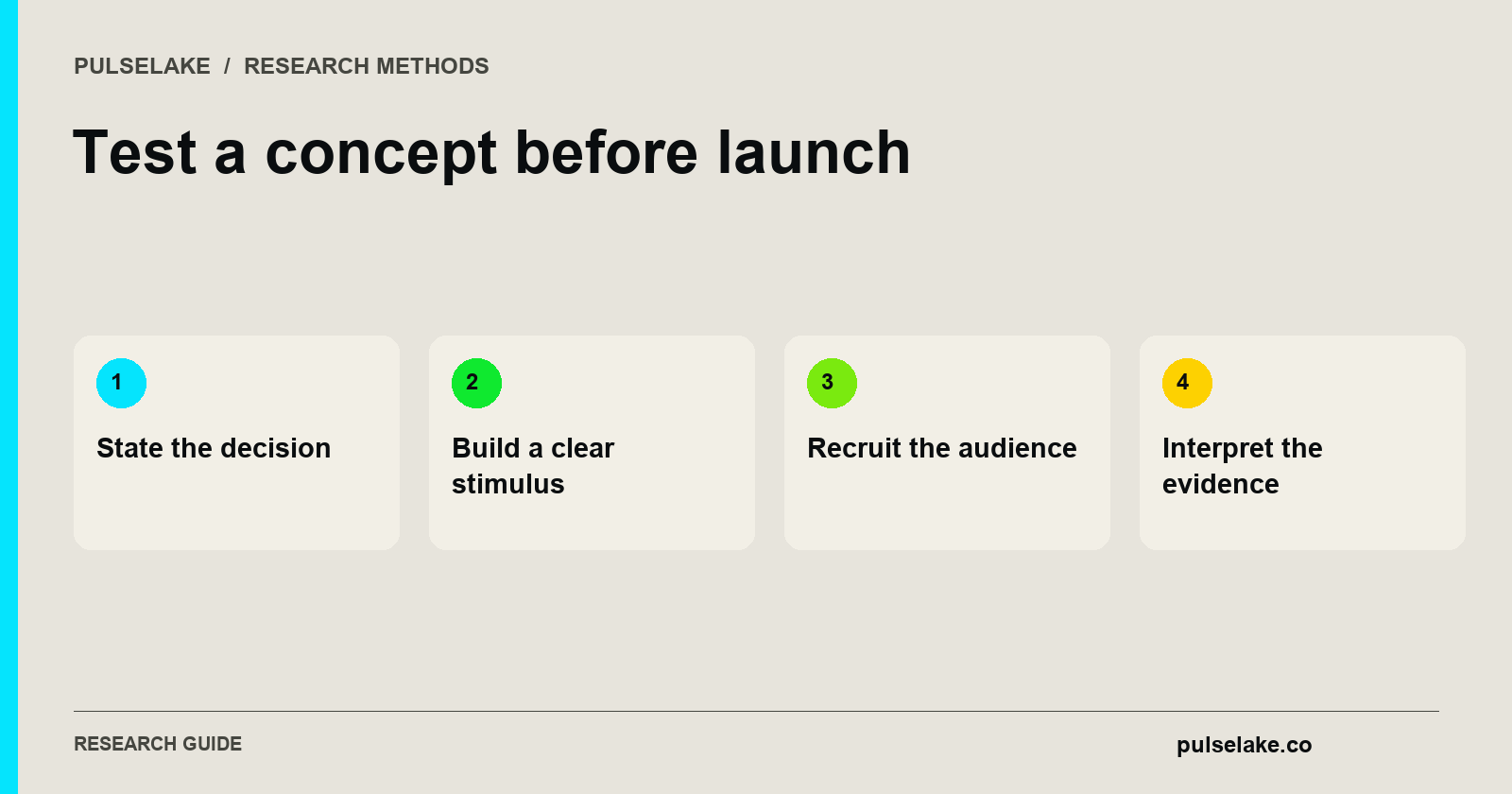
To test a product concept on a small budget, identify the decision you need to make, build a simple concept description or prototype, recruit relevant participants, and use a focused interview or survey to investigate the largest uncertainty. A landing-page experiment can add behavioral evidence, while synthetic personas can help explore hypotheses before human validation.
Concept testing can expose misunderstandings and weak assumptions before you commit to development. The appropriate effort depends on the decision, the cost of being wrong, and what evidence you already have.
Disclosure: We make PulseLake, an AI-native operating system for market research. This guide describes ways to scope a small concept test; it does not report a PulseLake cost benchmark or customer outcome.

Core Metrics of Concept Testing
Before launching into any testing methodology, you need to know what you are actually trying to measure. You are not just asking, "Do you like this?" You are looking for specific psychological and behavioral indicators of market viability. Industry leaders in survey research, such as Qualtrics, emphasize a standard set of metrics for evaluating product concepts:
- Purchase Intent: The likelihood that a respondent would actually buy the product if it were available today at the stated price. Stated intent is not a sales forecast.
- Uniqueness (or Differentiation): How different is your concept from products already available on the market? A product can be well-liked but fail because it is too similar to an established competitor.
- Believability: Does the target audience believe the claims you are making about the product's benefits and features?
- Relevance (or Need): Does the concept solve a genuine, painful problem that the target audience currently experiences?
- Perceived Value: Does the audience feel the proposed price is fair for the value delivered?
Choose the measures that match your decision, and record what a small or selectively recruited sample cannot establish.
4 Budget-Friendly Concept Testing Methods
When traditional research agencies are out of the budget, you can deploy the following four methodologies. They can be used individually or stacked together for a more robust validation process.
1. "Fake Door" Ad Testing (Facebook/Meta & LinkedIn)
An ad or landing-page experiment can measure observable interest in a message. Clicks and waitlist registrations are not purchases and should not be treated as proof of willingness to pay.
- How it works: You create realistic digital advertisements for your proposed product. If you have a B2C concept, use Facebook/Meta ads to target specific consumer demographics and interests. If you have a B2B concept, use LinkedIn ads to target specific job titles, industries, and company sizes.
- The Destination: The ad directs users to a simple, optimized landing page that explains the product, shows a pricing tier, and includes a "Buy Now" or "Start Free Trial" button.
- The Reveal: When the user clicks the button, they are shown a message explaining that the product is currently in development and invited to join a waitlist.
- Why it works on a budget: You only need to spend a small amount on ad inventory to generate statistically significant click-through rates (CTR) and conversion rates. This measures behavioral intent rather than stated intent, which is often far more accurate. You aren't asking people if they would buy; you are measuring how many people actually tried to buy.
2. Clickable Prototypes & Mockups
Sometimes a concept is too complex to explain with just a landing page or a text description. You need users to see and feel the experience.
- How it works: Instead of paying engineers to build a minimum viable product (MVP), use design tools like Figma to create high-fidelity, clickable prototypes. Figma allows you to link screens together so it feels like a real, working application or product interface.
- The Execution: You can recruit a small number of target users (often 5 to 10 is enough to spot major concept flaws) and observe them interacting with the prototype over a video call.
- Why it works on a budget: It costs nothing but time to build a prototype if you have basic design skills. Testing with a handful of users in moderated sessions gives you deep qualitative insights into whether the concept makes sense, how users navigate it, and where the value proposition falls flat.
3. Lean Surveys and Questionnaires
Surveys remain a staple of concept testing because they allow you to gather quantitative data rapidly. Platforms like SurveyMonkey and Typeform are frequently used to deploy these lean tests.
- How it works: You present your product concept (using text, an image, or a short video) to a targeted panel of respondents and ask them a series of standardized questions measuring the core metrics mentioned above (Purchase Intent, Uniqueness, etc.).
- Survey Design: SurveyMonkey research often highlights the importance of choosing the right survey design. Monadic testing (showing one concept to one group in isolation) is often the cleanest method, avoiding the bias of comparative testing (asking users to rank multiple concepts).
- Why it works on a budget: Self-serve survey platforms are highly cost-effective. You can build the survey yourself and purchase responses from consumer panels incrementally. To ensure you are asking the right things, you can use existing templates and proven methodologies. For help designing your instrument, see our guide covering concept testing questions.
4. Synthetic and AI-Led Research
Synthetic exploration and AI-led interviews are different methods and produce different kinds of evidence.
- How it works: Using platforms like PulseLake, you can deploy synthetic research. This involves creating explicit, versioned synthetic personas based on your target audience's demographics, psychographics, and known pain points. You can then "interview" these personas or run your survey instrument against a synthetic population to get immediate feedback on your concept.
- AI-Led Interviews: Once you refine the concept synthetically, you can use AI interviewers to conduct deep, qualitative conversations with real human participants at scale. The AI follows a protocol but probes adaptively, giving you qualitative depth at the price of a quantitative survey.
- Why it works on a budget: Synthetic research allows you to iterate on your concept dozens of times before ever paying for a human respondent. It is the ultimate lean testing tool. While synthetic data does not replace human validation before a final launch, it acts as a powerful, low-cost filter to ensure you only test your strongest ideas with real people. If you are curious about the validity of this approach, read more about how accurate synthetic respondents are.
Comparison of Lean Concept Testing Methods
Step-by-Step Budget Concept Testing Workflow
To maximize a small budget, you need a disciplined process. Do not rush straight to buying ads or sending surveys. Follow this sequential workflow.
Step 1: Define the Concept Clearly
Your concept must be easy to understand. Write a "concept statement" that includes:
- The Target Audience: Who is this for?
- The Problem: What pain point are you solving?
- The Solution: What is the product and how does it work?
- The Benefit: What is the primary value the user gets?
- The Price: What will it cost?
If you cannot articulate this in a single, clear paragraph, your concept is not ready to test.
Step 2: Run a Synthetic Baseline (Optional but Recommended)
If using synthetic personas, ask them to identify possible ambiguities or alternative interpretations of the concept. Treat responses as hypotheses to investigate with humans, not purchase-intent measurements or evidence of market demand. Include model use and review time in the budget.
Step 3: Choose Your Primary Validation Method
Select the method that best fits your immediate risk.
- If your biggest risk is "Will people engage with this offer?", consider a transparent landing-page experiment.
- If your biggest risk is "Do people understand how this works?", build a Figma prototype and run moderated sessions.
- If your biggest risk is "Which of these three features is most important?", run a lean survey.
If you are trying to understand how this fits into your broader financial planning, you may want to review how much market research costs across different methodologies.
Step 4: Keep the Test Focused
Keep each question tied to a decision. Pilot the instrument for comprehension, respondent burden and completion time, then remove questions whose answers would not affect your next step.
Step 5: Analyze and Iterate
Compare observed patterns with the hypotheses specified before testing. High ad clicks with few pricing-page visits can have several explanations, including message mismatch, navigation problems or audience selection. Follow up rather than assigning one cause from a single metric.
Common Pitfalls to Avoid
When testing on a budget, certain mistakes can completely invalidate your data:
- Testing with Friends and Family: They will lie to you to protect your feelings. Their feedback is worse than useless; it is misleading. Always test with impartial members of your actual target market.
- Asking Leading Questions: Do not ask, "Don't you think this feature is great?" Instead, ask neutrally, "How would you describe the usefulness of this feature?"
- Ignoring the "Why": Quantitative data tells you what is happening (e.g., low purchase intent). Qualitative data tells you why it is happening. Always include open-ended questions in surveys or conduct follow-up interviews to understand the context behind the numbers.
- Hiding the Price: Include a price when evaluating reactions to a priced offer. If the price is undecided, distinguish unpriced concept appeal from a later pricing study.
Conclusion
Testing a product concept before launch does not require a six-figure research budget. By combining lean methodologies like fake door ad testing, clickable prototypes, and focused surveys with modern AI and synthetic research capabilities, teams of any size can gather rigorous, decision-ready data. The goal is not to eliminate all risk, but to reduce the risk of failure to an acceptable level before committing heavy engineering and marketing resources to a launch.
How PulseLake connects evidence to analysis
PulseLake is a research operating system that connects study design and evidence collection with structured analysis, interpretation and reporting. Its research frameworks organise questions and measures into dimensions and sub-dimensions. That structure gives the evidence a shared meaning and makes it usable for analysis beyond an individual response or survey.
A small concept study can begin with explicit dimensions such as relevance and clarity. These are illustrative choices, not required PulseLake defaults. Defining the framework helps the team connect each question to an analytical purpose.
Frequently Asked Questions
How many people do I need for a valid concept test?
Choose sample size from the decision, audience diversity and research method. A small qualitative round can expose problems worth investigating, but no universal participant count guarantees that a fixed share of issues will be found. Quantitative estimates require a design-specific assessment of precision, subgroup needs and recruitment limitations.
What is the difference between monadic and sequential monadic testing?
In a monadic test, a respondent sees only one product concept and evaluates it in isolation. In a sequential monadic test, a respondent evaluates multiple concepts one after the other. Monadic testing is generally preferred because it provides cleaner data without the bias of comparison, though it can be more expensive as it requires a larger overall sample size to test multiple ideas.
Can I test a concept without an existing audience?
Yes. You do not need a massive email list to test a concept. You can use platforms like Facebook/Meta or LinkedIn to run highly targeted ads to a relevant target audience, driving them to a landing page or survey. You can also purchase targeted responses through panel providers integrated with survey platforms.
How do I test a B2B product concept on a budget?
B2B testing often requires more specialized audiences, making standard survey panels expensive. Lean methods for B2B include running LinkedIn ads targeting specific job titles, reaching out to prospects directly for short 15-minute concept interviews, or utilizing AI platforms to run specialized synthetic B2B personas before investing in human expert networks.
Is synthetic data reliable for concept testing?
Synthetic data is highly reliable for initial ideation, pressure-testing hypotheses, and refining survey instruments before deployment. It acts as an accelerator and a low-cost filter. However, it should not entirely replace human testing for final validation, particularly for measuring actual purchase intent and emotional resonance prior to a major launch.
Further reading
See SurveyMonkey market research for a survey-platform example and PulseLake concept-testing questions for instrument planning.