Best online panels and respondent marketplaces in 2026, and when to add synthetic respondents
Compare research panels and respondent marketplaces, with screening, quality and clear boundaries for synthetic respondents.
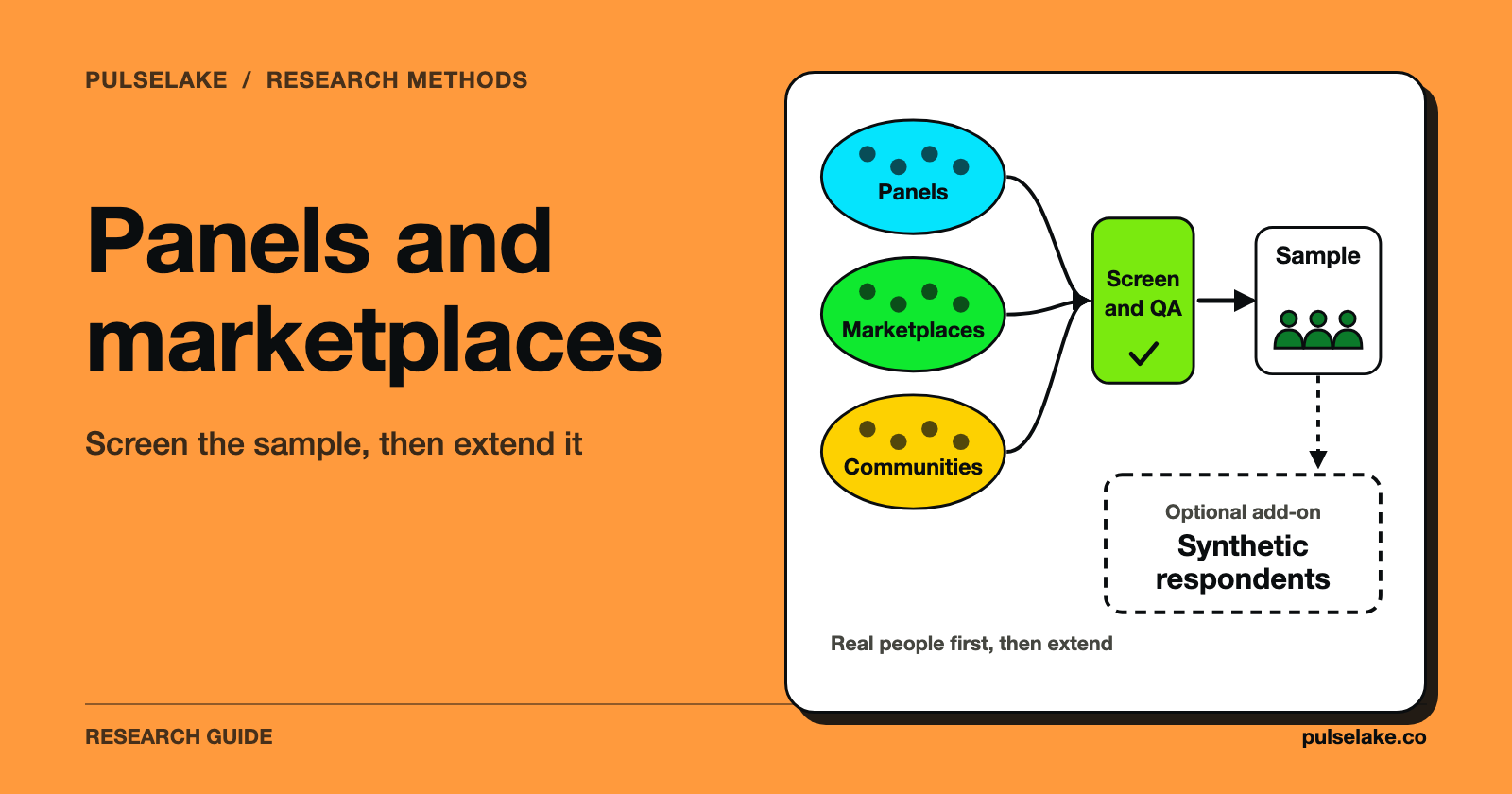
Which online panel or respondent marketplace is best? The one that can reach your audience through a recruitment and quality process you can explain to someone else. Prolific, Cint, Dynata, Toluna, SurveyMonkey Audience, Attest, Qualtrics, Pollfish, Respondent and YouGov are all worth investigating for different studies. Synthetic respondents are a separate tool, and nobody should count them as recruited people.
Begin with who you need to reach, and set the advertised reach aside. A huge network helps only if it holds people who meet your criteria and can be recruited under a proper process.

What is the difference between a panel and a marketplace?
Suppliers throw both words around loosely, so treat them as prompts for a question rather than definitions.
A panel is a pool of people who've agreed to take part in research under a supplier's arrangements. A marketplace may connect you to participants directly, or to several sample sources at once. Whichever label is on the quote, ask how your actual study will be sourced.
Watch for bundles. Many platforms also sell questionnaire software, analysis and managed services, so split those lines out in the proposal. Buying access to respondents doesn't automatically buy you a complete research design or a reviewed report.
And write the source down accurately in your methodology section. A supplier's name alone won't do; readers need to know how participants were reached, screened and included.
Which online panels and marketplaces should you investigate?
| Supplier | Useful starting point | Key question |
|---|---|---|
| Prolific | Participant recruitment for studies | Does the available population fit the eligibility criteria? |
| Cint | Research sample marketplace | Which sources contribute to the achieved sample? |
| Dynata | First-party data and research sampling | How are target attributes and quality checked? |
| Toluna | Consumer research and audiences | What audience and service scope is available? |
| SurveyMonkey Audience | Audience access connected to surveys | How do targeting and questionnaire requirements interact? |
| Attest | Consumer research | Can the market and audience definition be supported? |
| Qualtrics | Research programmes with audience requirements | Which recruitment services are included? |
| Pollfish | Survey research and audience sourcing | What recruitment and exclusion rules apply? |
| Respondent | Recruitment for research participants | How will specialised eligibility be verified? |
| YouGov | Panel-based research and data | Which product and sample design fit the question? |
Think of that as a buying shortlist. It isn't an independent ranking of sample quality, and you'll have to judge quality for your specific study.
Where does YouGov fit?
Don't line YouGov up against a participant marketplace until you know what you're buying. It offers research and data products, so the first call is whether you want a new study, access to existing data, or some other service.
Those are different purchases, even when one organisation sells all of them. With existing data, check the question definitions, the population and the collection period. With a commissioned study, pin down the sample design and the deliverables.
A familiar brand doesn't make every estimate right for every decision. Match the methodology to the claim your report will make.
How should Cint, Dynata and Toluna be assessed?
Think of Cint, Dynata and Toluna as part of a wider sampling conversation. Three things to understand: the source mix, how eligibility works, and what the achieved sample ends up looking like.
Where do respondents come from? How is duplicate participation managed? Ask for plain answers. When several sources feed one study, find out how that's documented, and whether the blend shifts during fieldwork.
Feasibility comes before the deadline. Narrow eligibility, tough quotas or a long instrument can each slow delivery. We'd trust a plan that spells out those trade-offs over one promising that every target is equally easy to reach.
When should Prolific or Respondent be considered?
Reach for Prolific or Respondent when finding the participants is the core of the job. Arrive with your exact screening criteria, the participation task and the commitment you'll be asking for.
Specialised audiences are harder than they look. Self-reported attributes and verifiable ones aren't the same thing. A job title on its own may not prove someone holds buying responsibility, or has ever used the workflow you're studying.
Then ask the dull questions. Who handles scheduling, no-shows, exclusions and participant payment? The answers shape your workload and the participant's experience, particularly for interviews or tasks longer than a short survey.
When is an integrated survey-and-audience workflow useful?
When your team wants collection and audience sourcing handled together, take a look at SurveyMonkey, Attest, Qualtrics and Pollfish.
The convenience is real. The research design still needs your eyes, though. Before launch, confirm targeting, screening, question format and quality rules. Then ask a blunt question: what happens if the available sample can't fill a subgroup you planned for?
Partial and excluded responses need a written policy. Dropping inconvenient answers after you've seen the result distorts a study just as badly as waving through poor-quality records unchecked.
What should the screening questionnaire establish?
Only eligibility and any grouping you'll need later. Nothing more.
Screens that reveal too much invite people to guess the "right" answers, and unnecessary personal questions just add burden. Test each question against the actual decision. Say the study is about purchase approval: the screen has to establish approval responsibility, and employment in the right department doesn't cover that. For a study about recent product use, spell out what counts as recent and what counts as use.
Pilot it with suitable participants before committing the full fieldwork budget. You're hunting for confusing wording, device problems and paths nobody expected.
How should sample quality be reviewed?
Use a documented set of checks that suits the task. Inconsistent eligibility answers, duplicate records, implausible patterns and signs that someone didn't really engage with the instrument are the usual suspects.
There's no single speed threshold or attention question that makes a complete quality system. A fast response can be perfectly valid; a slow one can still be poor. Look at the context, then apply your rules consistently.
When you report the achieved sample, report its limitations too. Quotas can balance the characteristics you chose, but they don't prove that every unmeasured characteristic matches the target population.
When should synthetic respondents be added?
Before human fieldwork, never in place of it.
Synthetic respondents suit rehearsing an instrument, exploring assumptions and generating hypotheses. Their outputs can flag unclear concepts or response options you forgot. Our rule of thumb: synthetic respondents for speed and early direction, real respondents for validation.
The line you shouldn't cross is quietly using generated answers to fill missing human quotas. More model outputs aren't more recruited people. Don't present their count as a human sample size, and don't use it to imply conventional sampling precision.
PulseLake is a research operating system that connects study design and evidence collection with structured analysis, interpretation and reporting. Its research frameworks organise questions and measures into dimensions and sub-dimensions, which gives the evidence a shared meaning and makes it usable beyond a single response or survey. Recruitment gets you participants; the framework is what lets you make sense of what they say. PulseLake connects that framework to analysis and keeps human and simulated evidence conceptually separate.
What should the budget include?
Itemise it: software, recruitment, incentives, screening, replacements, managed services and analysis. After that, ask how low incidence, longer participation or specialised verification would change the proposal.
Leave room for the work after collection. A full response file isn't a defensible finding, because somebody still has to assess quality, calculate results and explain what the sample can't tell you.
Choose the supplier whose proposed process fits the study and can be documented. The cheapest completed response is rarely the cheapest route to a decision you can use.
Frequently asked questions
Does a large panel guarantee a representative sample?
No. Representativeness comes from coverage, recruitment, selection, response and analysis, and size alone covers none of those. Judge the achieved sample against the claim the study is meant to support.
Can synthetic responses fill a human quota?
They shouldn't be presented as human respondents. Any model-based augmentation needs explicit labelling, a suitable method and validation for the intended use.
What should a recruitment brief include?
The target population, eligibility rules, geography, participation task, required subgroups, timing and quality process. Add any verification or scheduling requirements too, so suppliers can quote accurately.
How should suppliers be compared?
Hand every supplier the same study brief. Ask each for the recruitment method, quality rules, source transparency, responsibilities and complete cost, and compare the process as well as the quote.