Can AI personas replace survey panels? What research means for buyers
Where synthetic respondents can help with early research, why human panels still matter, and how to evaluate the evidence before making decisions.
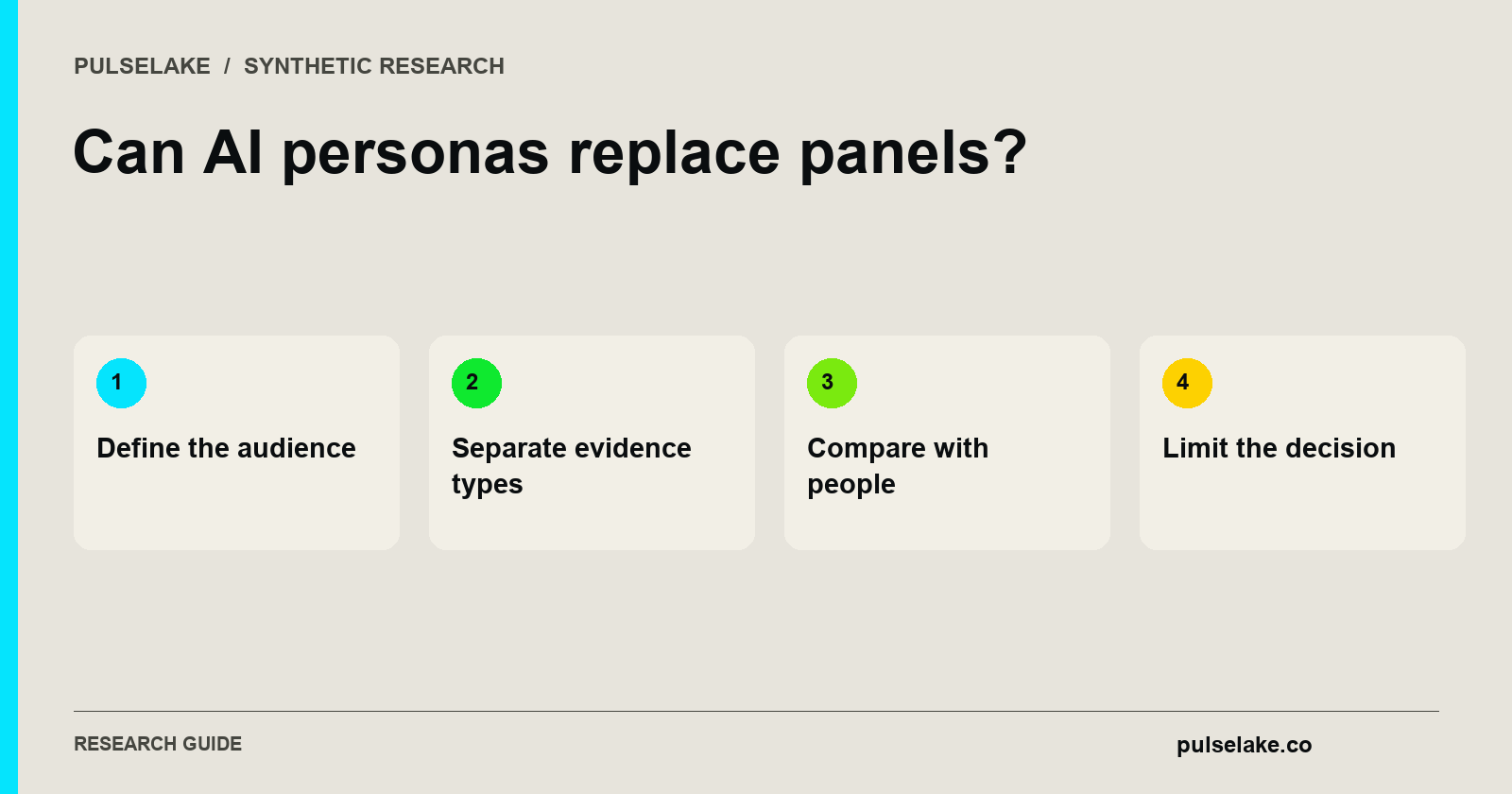
No—AI personas cannot replace human survey panels for measuring public opinion, sizing markets, or making go/no-go product launch and pricing decisions. However, they are effective upstream for stress-testing questionnaires, exploring early hypotheses, and narrowing down candidate concepts before you field a study with real people. Independent 2026 research from the Pew Research Center and academic benchmarks in Political Analysis show that while synthetic respondents often approximate broad historical averages, they miss human survey results by an average of 12.4 percentage points, compress variance, rely on subgroup stereotypes, and struggle to forecast reactions to novel concepts outside their training data.
Disclosure: We make PulseLake, an AI-native operating system for market research and insights. This guide synthesizes independent academic and industry studies alongside each organization's published findings as of October 2026.
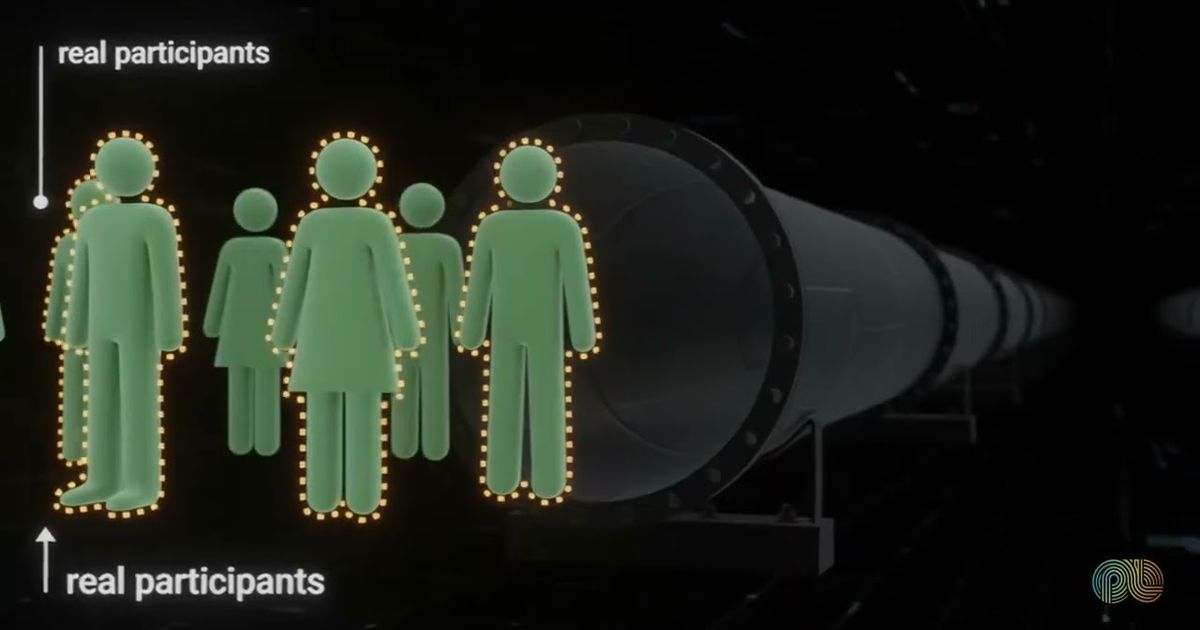
Watch: Synthetic Respondents and Their Limits (2:03)
Research teams are turning to synthetic respondents largely for speed: they promise faster exploration before committing time and budget to fielding a study with real participants. Understanding where that speed is genuinely useful—and where it introduces statistical and commercial risk—requires looking closely at how synthetic panels behave when benchmarked against human ground truth.

What does published research establish?
Pew Research Center's September 2026 study compared synthetic answers with three human survey waves and found that its tested approach was not an adequate replacement for public-opinion polling. The result is evidence about that design and use, rather than a universal accuracy score for all products.
NORC's discussion and research in Political Analysis provide further context for evaluating synthetic survey methods. Examine the population, task and validation design before applying a finding to a commercial decision.
Why do AI personas miss real human survey results? Five documented failure modes
When evaluating whether an AI persona can stand in for a human panelist, average top-line correlation is often misleading. A synthetic sample can match a 50% top-line human average while misrepresenting who holds that opinion, how strongly they hold it, and how variables relate to one another. Research published through 2026 highlights five specific failure modes.
1. The backcasting vs. forecasting trap
Large language models predict plausible text based on patterns in their pre-training and post-training corpora. When you ask an AI persona about an established brand, a past election, or a product category with years of online reviews, the model is effectively retrieving and interpolating existing knowledge—a process known as backcasting.
In a benchmark published by Dig Insights (reviewed as of October 2026), researchers tested 500 synthetic moviegoer personas across 30 films from 2018, 2019, and 2023. For the 2018 and 2019 films—whose marketing campaigns, reviews, and box office outcomes were inside the LLM's training window—synthetic interest correlated with actual box office performance at $r = 0.85$. However, for the 2023 films outside the model's training cutoff, correlation fell to $r = 0.50$. Once sequels and remakes of older franchises were removed, correlation on truly novel films dropped to $r = 0.30$.
2. Variance compression and missing tails
Real human populations contain contrarians, edge cases, and passionate critics. Synthetic respondents consistently regress toward the center of the scale. Both NORC at the University of Chicago and Pew Research Center found that LLMs avoid extreme scale options.
Similarly, in the Cambridge Political Analysis study by Bisbee et al., the standard deviation of synthetic affective polarization scores was 16.1, roughly half the 31.4 standard deviation observed in human ANES data. If a researcher used that synthetic variance to run a statistical power calculation for a subsequent human study, they would underestimate the required human sample size by nearly an order of magnitude (concluding that $n = 33$ was sufficient for 99% statistical power).
3. Subgroup stereotyping and hyper-consistency
When conditioned on demographic or partisan attributes, LLMs frequently turn modest group tendencies into near-unanimous caricatures. In Pew's September 2026 digital twins study, even though each AI persona was anchored to a real individual's demographic profile and prior political typology answers, the model relied heavily on stereotypes:
As NORC's September 2026 methodological brief notes, synthetic respondents also exhibit artificially high internal consistency across related questions, erasing the competing priorities and ambivalence that characterize real consumers.
4. Over-certainty and encyclopedic knowledge bias
Because foundation models are trained to be helpful assistants that retrieve correct facts, AI personas struggle to simulate human ignorance, confusion, or low engagement. In Pew's 2026 tests:
- Human survey takers were roughly four times as likely as AI personas to select "not sure" or decline to express an opinion.
- On factual knowledge questions, 98% of synthetic respondents correctly identified a First Amendment right (compared with 52% of human panelists), and 99% correctly identified NATO's central focus (compared with 56% of humans).
For market researchers, this means synthetic personas will routinely overstate category awareness, comprehension of technical product jargon, and recall of brand claims.
5. Broken covariate relationships and model sensitivity
In market and social research, teams rarely care only about a single question's mean; they run crosstabs, key driver analyses, and regressions to understand what drives behavior. Bisbee et al. (2024) demonstrated that when researchers regressed synthetic feeling thermometer scores on standard demographic and political covariates, 48% of the estimated regression coefficients differed statistically significantly ($p < 0.05$) from the human ANES benchmark—and among those significant differences, 32% reversed the sign of the relationship entirely.
Furthermore, synthetic results depend heavily on which foundation model you choose and when you run the query. Bisbee et al. found that repeating identical prompts across April, June, and July 2023 produced statistically different distributions due to silent updates in closed-source models. Pew Research Center (2026) likewise found that swapping underlying models systematically altered substantive conclusions: OpenAI's GPT-5.1 portrayed the U.S. public as holding more extreme opinions than reality, whereas Anthropic's Claude Opus 4.6 portrayed the public as more middle-of-the-road.
What is the difference between synthetic personas, synthetic panels, and digital twins?
Buyers evaluating AI research tools frequently encounter three overlapping terms. As industry analyses from Outset and SYMAR (both reviewed as of October 2026) point out, how a synthetic respondent is constructed determines what it can and cannot do:
- Prompt-based synthetic personas: Generic AI profiles created by prompting an LLM with a few demographic or role descriptors (for example, "You are a 38-year-old suburban parent who shops at warehouse clubs"). Without grounding in empirical study data, these personas reflect whatever stereotypes exist in the base model's training weights.
- Structured synthetic panels: A modeled population of synthetic respondents designed to reflect joint distributions of needs, constraints, and category experience across a target market, rather than duplicating a single averaged persona 100 times.
- Digital twins: Synthetic profiles anchored 1-to-1 to a specific real person's past survey responses, interview transcripts, or behavioral history—such as the ATP-conditioned models tested by Pew Research Center. Grounding a digital twin in individual-level data improves alignment on topics closely related to the conditioning data, but as Pew's 12.4-point error rate shows, even 1-to-1 digital twins drift significantly when asked about new topics or current events.
For a deeper breakdown of how these architectures differ in practice, see our guide on synthetic personas vs. digital twins.
When can AI personas supplement a survey panel (and when must humans lead)?
Synthetic respondents are useful for exploration, preparation, and improving a research instrument before real participants are involved. As Lakmoos AI (reviewed as of October 2026) frames it, AI panels work best when they "replace the silence" during early stages where teams would otherwise do no testing at all—such as dry-running a questionnaire or screening rough ideas before fielding a human survey.
Where AI actually fits in the research workflow covers other places automation supports research without replacing human judgment.
However, decisions with real consequences for product roadmaps, pricing, or capital allocation still require genuine human evidence. AI as a research assistant instead of a decision maker covers why AI-generated output should support researcher judgment rather than replace it.
The table below outlines which research mode fits each stage of the insights lifecycle.
How should research teams validate synthetic personas against human data?
Treating synthetic findings as hypotheses rather than conclusions requires a structured validation workflow. Both NORC at the University of Chicago and Psychology & Marketing (Sarstedt et al., 2024) emphasize that synthetic systems depend on high-quality human data at every stage—to ground personas, calibrate outputs, and audit subgroup bias.
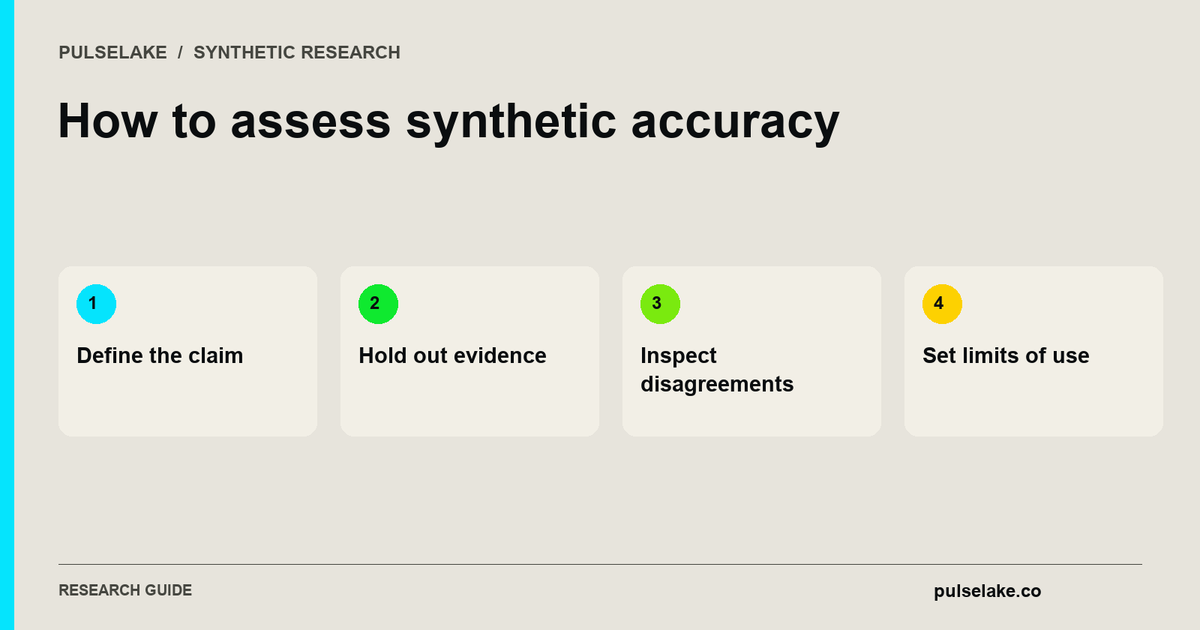
A practical four-step validation workflow looks like this:
- Ground personas in explicit, versioned provenance: Document the exact conditioning inputs (prior human survey waves, qualitative transcripts, demographic distributions, and foundation model version) used to build your synthetic population. Never treat an unversioned prompt as a reproducible panel.
- Run upstream synthetic pre-tests to sharpen the instrument: Use synthetic personas to pressure-test question wording, identify candidate themes, and formulate explicit hypotheses about how segments might diverge.
- Field the core study with real participants: Collect human evidence through a traditional survey panel or conversational AI-led interviews with real participants.
- Compute question-level and subgroup error benchmarks: Compare the synthetic predictions against the human results across full response distributions—not just top-line means. For more detail on validation metrics, read our guides on how accurate synthetic respondents are and synthetic data validation.
Illustrative calculation: Measuring Average Absolute Error
To avoid being misled by aggregate correlation, Pew Research Center (2026) evaluates synthetic accuracy using Average Absolute Error across all response options on a question.
Illustrative calculation (based on Pew Research Center's published formula):
Suppose you field a 3-option product concept question ("Would buy immediately," "Might buy later," "Would not buy") to both a human panel and a synthetic cohort:
- Option A (Would buy immediately): Human = 25%, Synthetic = 40% $
ightarrow |25 - 40| = 15$ points - Option B (Might buy later): Human = 50%, Synthetic = 55% $
ightarrow |50 - 55| = 5$ points - Option C (Would not buy): Human = 25%, Synthetic = 5% $
ightarrow |25 - 5| = 20$ points
$$
\text{Average Absolute Error} = \frac{15 + 5 + 20}{3} = 13.3\text{ percentage points}
$$
Tracking this metric across overall samples and key demographic cuts reveals immediately whether your synthetic personas are compressing the "Would not buy" tail or exaggerating positive purchase intent.
Where PulseLake fits (and when to use a standalone panel)
Most research tools force teams to choose between disconnected point solutions: a standalone synthetic persona generator that never touches real respondents, or a traditional survey tool where prior institutional knowledge is lost after every project.
PulseLake is a research operating system that connects study design and evidence collection with structured analysis, interpretation and reporting. Its research frameworks organise questions and measures into dimensions and sub-dimensions. That structure gives the evidence a shared meaning and makes it usable for analysis beyond an individual response or survey.
For human and synthetic studies, the analytical framework makes the concepts being compared explicit. Researchers still need to distinguish simulated answers from observed human evidence; a shared framework does not establish that they are interchangeable.
- Synthetic research: Explicit, versioned synthetic personas and populations for testing instruments, concepts, and hypotheses, with clear provenance showing how each persona was built and a defined path into human validation.
- Simulation: Scenario models grounded in prior evidence and explicit assumptions to explore what could happen under alternative conditions and identify what to test next.
- AI-led interviews: Conversational and avatar-based AI interviewers that follow a protocol, probe adaptively, and conduct interviews with real human participants, turning each conversation into structured evidence.
- Traditional research: Surveys, qualitative research, assessments, panels, and advanced methods—keeping objectives, methodology, evidence, and decisions connected in a single research knowledge graph, paired with a calculation mode that computes answers against study data rather than generating them.
When PulseLake is the right fit:
PulseLake fits internal insights teams, market research firms, and consulting practices that want to use versioned synthetic personas for upstream instrument design and scenario exploration, validate those hypotheses through AI-led human interviews or traditional surveys within the same workspace, and preserve institutional knowledge across studies.
When you should pick something else:
If you do not need an end-to-end research operating system, knowledge graph, or hybrid synthetic-to-human workflow—and simply need to purchase raw, nationally representative probability sample for a standalone public opinion poll or census benchmark—you should work directly with an established probability-based human panel provider (such as NORC's AmeriSpeak) or a dedicated respondent marketplace.
Talk to our team or get started with a workspace to see how synthetic exploration and human validation work together in one study context.
All trademarks belong to their respective owners. If you represent an organization cited in this guide and would like to submit an updated study link or correction, please reach us at hello@pulselake.co.
Frequently asked questions
Can personas replace a human pilot?
They can help rehearse wording and assumptions. A human pilot is still needed to observe actual comprehension and participation.
Does a plausible answer prove accuracy?
No. Evaluate the output against suitable human evidence for the intended question and audience.
Should generated records count as participants?
No. Report generated outputs and recruited people separately.
When should validation be repeated?
Review it when the model, source evidence, audience, instrument or intended use changes.