Synthetic respondents in 2026: how they work, how to validate them, and which tools offer them
Compare synthetic research platforms by method, validation, data requirements and the decisions they can reasonably support.
Last reviewed: October 13, 2026
Synthetic respondents are AI-simulated research participants conditioned on demographic, behavioral, or historical study data to answer surveys, test concepts, and pressure-test discussion guides before human fieldwork begins. Validating them requires benchmarking synthetic distributions against held-out human samples using statistical divergence tests, checking for prompt-framing sycophancy, and confirming key findings with real participants. In 2026, the primary tools offering synthetic respondents include Qualtrics (best for U.S. general population survey panels inside Qualtrics XM), Fairgen (best for statistical sample boosting and panel-derived digital twins), Evidenza (best for hard-to-reach B2B buying centers), Lakmoos (best for private neuro-symbolic AI panels), and PulseLake (best for teams connecting versioned synthetic personas directly to human validation and a persistent research knowledge graph).
Disclosure: We make PulseLake. This guide reflects our assessment of the synthetic research landscape and links directly to each vendor's public documentation as of October 2026. If you represent a vendor listed here and wish to update a factual detail, please contact our team.

What are synthetic respondents (and how do they differ from generic chatbots)?
Synthetic respondents are AI systems built to simulate how a specific type of research participant or target population might answer survey questions, evaluate a product concept, or respond in a qualitative interview. Unlike a generic chatbot prompted in a consumer interface, research-grade synthetic respondents are constrained by explicit demographic attributes, behavioral priors, or empirical data from prior studies.
They are not real people and do not possess lived human experience. Instead, they generate plausible responses based on patterns learned from training corpora and study context. Because buyers and vendors in 2026 often use the phrase "synthetic respondents" to describe very different underlying technologies, it helps to separate five distinct approaches documented in current industry literature, including the Qualtrics Synthetic Data FAQ and CleverX's 2026 Market Research Guide:
- Uncalibrated LLM prompt wrappers: Generic language models given a short role-play prompt (for example, "Act as a 38-year-old CFO evaluating expense software"). These are fast for brainstorming but prone to stereotyping and sycophancy.
- Data-grounded synthetic personas: Explicit, versioned persona profiles conditioned on prior primary research, qualitative transcripts, CRM segments, or behavioral tables.
- Simulated individual-level survey panels: Purpose-built or fine-tuned models that generate row-by-row quantitative datasets matching census or panel quotas.
- Statistical sample augmentation (boosting and imputation): Machine learning models trained on seed human responses from a live study to boost low-incidence sub-segments or impute missing answers.
- Customer digital twins: Virtual representations calibrated to mirror a specific real individual's historical survey responses and behavioral profile. See our explainer on synthetic personas vs. digital twins for a closer comparison.
How do synthetic respondents work in 2026?
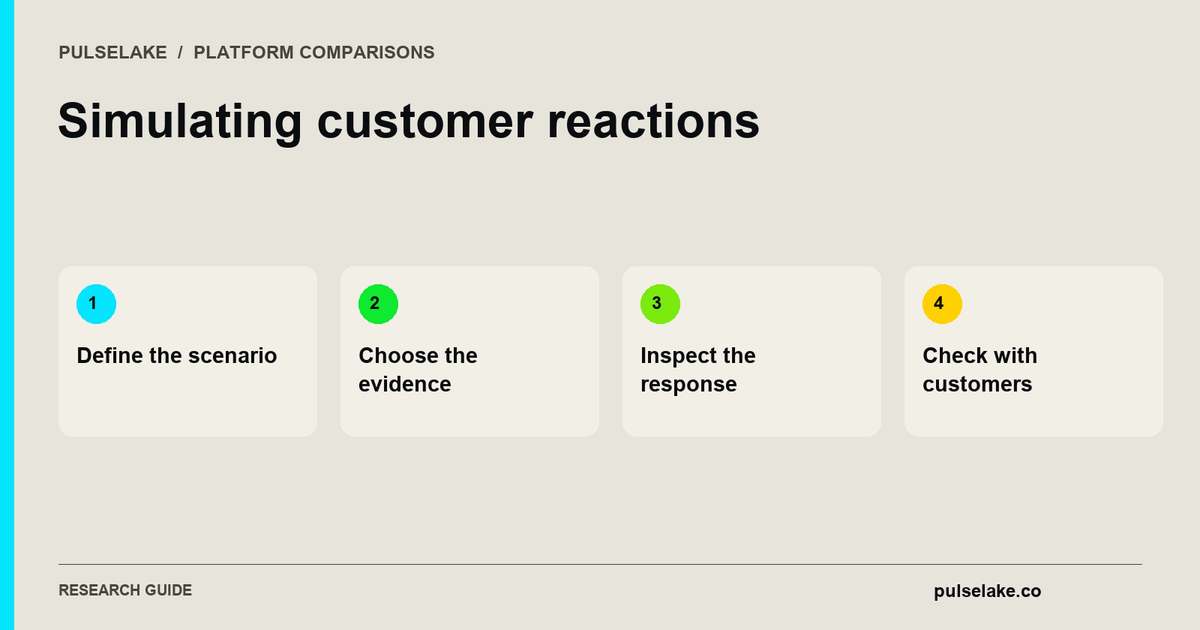
Modern synthetic respondent platforms operate through a four-stage pipeline that moves from empirical grounding to traceable output:
1. Grounding and data curation
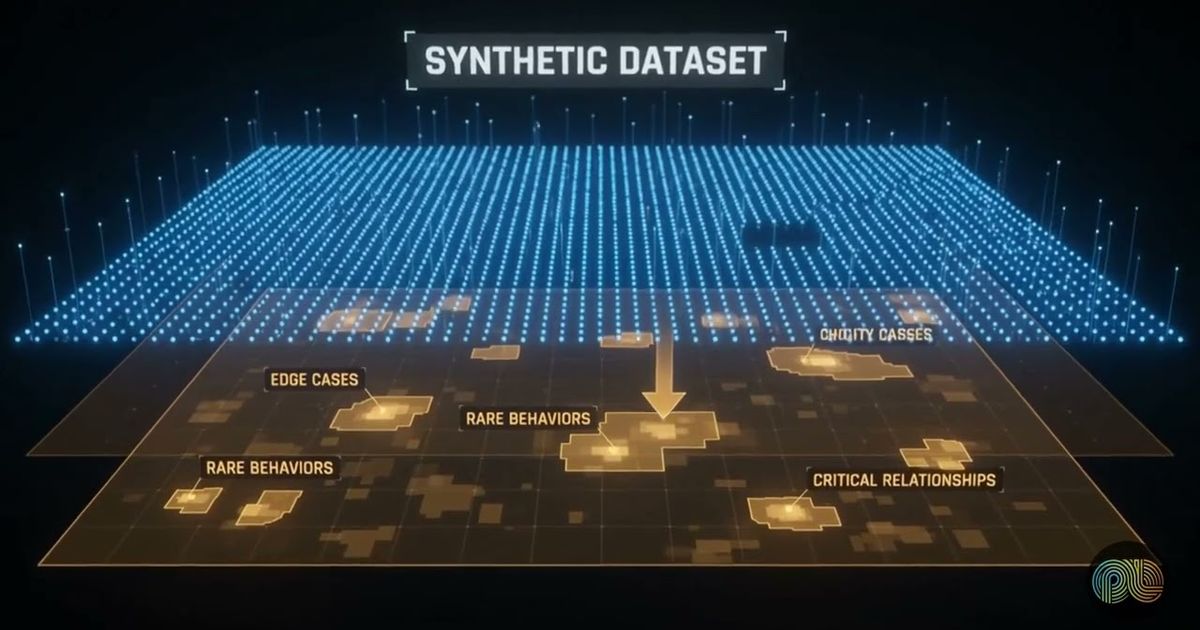
Rather than relying solely on raw internet pre-training, research platforms anchor models in empirical baselines. Depending on the tool, this grounding layer may include national census distributions, licensed panel datasets, historical tracking studies, or an organization's own repository of qualitative interviews and quantitative tables.
2. Persona and population conditioning
To prevent every simulated respondent from converging on the same "average" answer, platforms construct populations with controlled variance. Some systems use fine-tuned language models with demographic quota matrices, while others—such as Lakmoos—combine machine learning with symbolic behavioral rules (neuro-symbolic AI) to model constraints like household budget limits or B2B procurement roles. Platforms mentioned in SYMAR's 2026 evaluation guide also maintain persistent persona memory so a synthetic cohort remains consistent across multi-round follow-ups.
3. Instrument execution
Researchers deploy either a structured quantitative questionnaire (Likert scales, rankings, multiple choice) or a semi-structured discussion guide. In quantitative runs, the system samples across the conditioned population to produce individual-level response rows. In qualitative runs, an interviewer agent probes the synthetic persona adaptively.
4. Aggregation, provenance, and lineage
Finally, responses are aggregated into cross-tabs, theme clusters, or scenario simulations. In an enterprise research workflow, each synthetic response should carry metadata recording which persona version, prompt protocol, and grounding dataset produced it—preventing teams from confusing simulated hypotheses with verified human evidence.
Where do synthetic respondents work well—and where do they fail?
Research teams turn to synthetic respondents primarily for speed and coverage when recruiting human participants is slow or expensive. However, knowing where simulation adds value and where it introduces unacceptable risk is essential.
Reasonable uses for synthetic respondents
- Instrument and questionnaire pre-testing: Catching ambiguous wording, double-barreled questions, or broken routing logic before paying for a human panel.
- Early-stage concept and message screening: Exploring a wide set of rough value propositions or ad variations to narrow down the top two or three candidates for human testing.
- Low-incidence and hard-to-reach exploration: Generating initial hypotheses for niche B2B roles (such as hospital CIOs or institutional treasury leads) before committing recruitment budgets.
- Discussion guide preparation: Pressure-testing interview protocols and identifying candidate themes to investigate in live qualitative sessions. Where AI actually fits in the research workflow covers other places automation supports research preparation.
Core limits and failure modes
The fundamental limit is that synthetic outputs are statistical projections of past data, not genuine human evidence. Across industry evaluations in 2026, four failure modes stand out:
- Sycophancy and positivity bias: Language models are trained to be helpful and agreeable. Without strict calibration, synthetic respondents frequently overrate new product concepts and express higher purchase intent than real buyers.
- Absence of human cognitive load and fatigue: Real participants get bored, satisfice on long grid questions, or abandon confusing surveys. Synthetic respondents will dutifully complete a 60-question survey without showing fatigue, masking severe instrument design flaws.
- Blind spots on novel cultural or category shifts: Because models extrapolate from historical training data, they struggle to predict how people will react to genuinely disruptive products, sudden macroeconomic shocks, or emerging cultural norms.
- Lived emotional and sensory nuance: Decisions driven by personal history, physical usability, or sensitive community experiences cannot be simulated reliably.
Synthetic respondents should never be the sole basis for high-consequence decisions—such as final pricing commitments or a product launch go/no-go call. AI as a research assistant instead of a decision maker explains why AI-generated output must support researcher judgment rather than replace it.
How should researchers validate synthetic respondents?
Validating synthetic insights means comparing them systematically against real participant data and measuring where the two align or diverge. For a deeper technical breakdown, see our guides on synthetic data validation and how accurate synthetic respondents are.
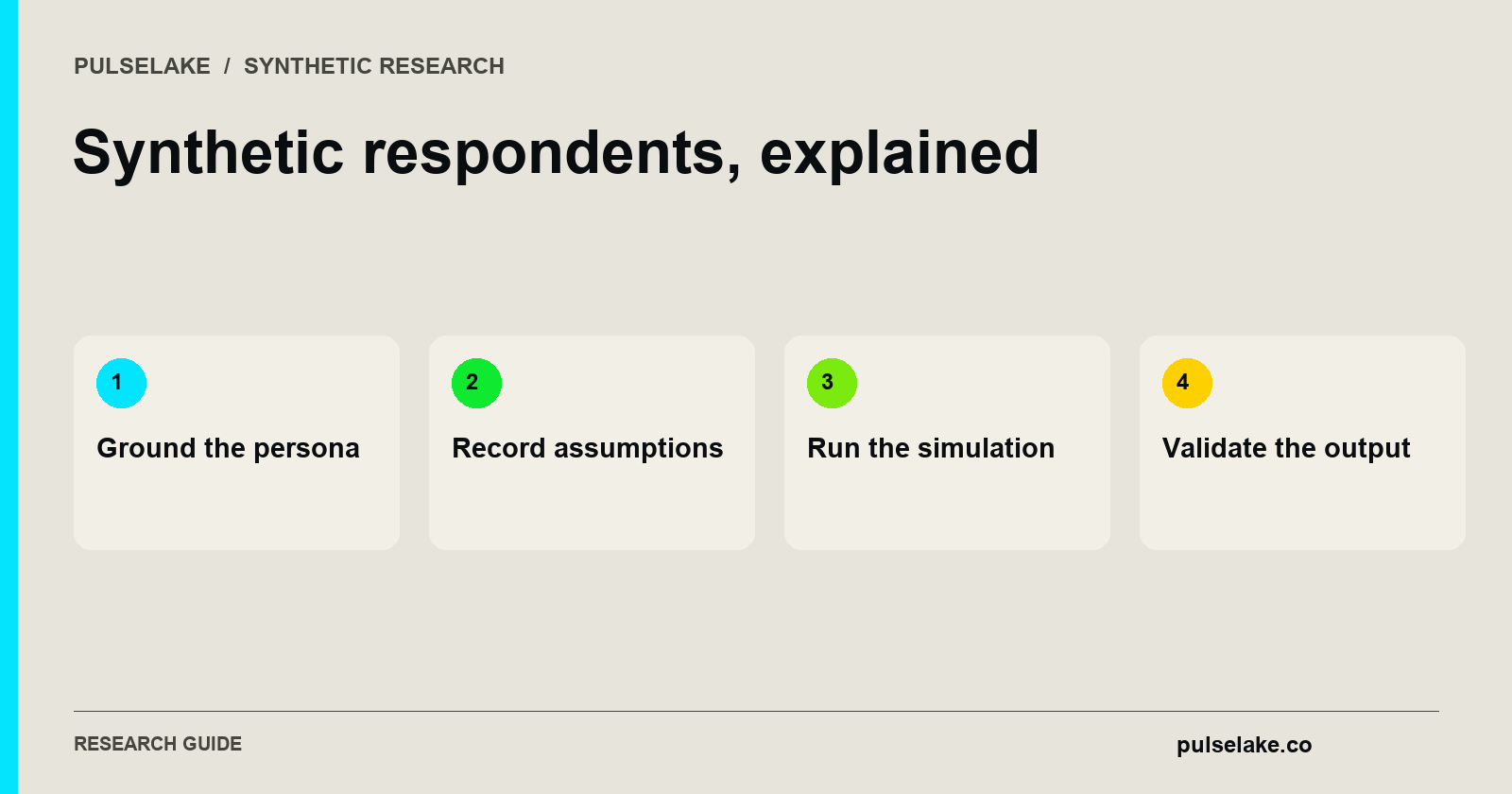
A rigorous 2026 validation workflow uses four checks:
- Holdout and parallel human benchmarking: Run the exact same survey instrument across both the synthetic cohort and a verified human sample (or hold out a segment of recent human fieldwork) to compare top-box scores, rank orders, and open-ended themes.
- Statistical distribution and correlation checks: Rather than looking only at mean averages—which can mask collapsed variance—check whether the synthetic data preserves the shape and inter-item relationships of human data. For example, Qualtrics documents using the Kolmogorov–Smirnov (K-S) test to compare marginal distributions, correlation matrix analysis to verify that variable relationships hold, and divergence measures across demographic breaks.
- Prompt-framing and reversal stress tests: Test whether reversing a scale or phrasing a concept negatively flips the synthetic persona's response logically, or whether the model exhibits acquiescence bias.
- Privacy and non-memorization verification: When models are grounded in proprietary customer records or past surveys, run re-identification checks to verify that synthetic responses do not replay verbatim PII or memorize single individuals.
Illustrative validation protocol: parallel concept screen and human calibration
Note: The following workflow is an illustrative protocol showing how research teams structure a staged synthetic-to-human validation study inside a persistent study environment.

- Condition personas with provenance: The team defines explicit, versioned synthetic personas grounded in prior category studies stored in the workspace.
- Synthetic screening run: The team tests six early product concepts with the synthetic population to identify comprehension issues and rank initial appeal.
- Reversal check: Every scale question is run in both standard and reverse-coded order; items showing high framing sensitivity are rewritten.
- Human validation wave: The top two concepts and the cleaned questionnaire are fielded to real human participants via traditional surveys or AI-moderated interviews within the same study context.
- Lineage comparison: Using calculation mode against the study data, the team compares synthetic predictions against human outcomes, logging where the persona model tracked reality and updating the persona version for future waves.
Which tools offer synthetic respondents in 2026?
To identify the core platforms in this category, we reviewed the tools named across five major AI search engines (ChatGPT, Gemini, Perplexity, Google AI Mode, and Claude) for the question "What are synthetic respondents and which tools offer them?" Every vendor named by three or more engines is compared below alongside PulseLake, using verified facts from each company's public documentation as of October 2026.
How should suppliers be evaluated?
Ask Qualtrics, Fairgen, Evidenza and Lakmoos to identify the specific product and method being proposed. Their approaches are not interchangeable: modelled audiences and augmentation of an observed dataset create different validation questions. Confirm current availability and commercial scope directly.
Request the source inputs, relevant human comparison, limitations and supported use. A general product claim does not establish accuracy for a new audience or question. PulseLake's relevant fit is connecting explicit synthetic exploration with human research and persistent study context.
Where PulseLake fits (and when to choose another tool)
Choosing the right synthetic respondent approach depends on where your research bottleneck sits:
- Choose Qualtrics if your organization is already locked into an enterprise Qualtrics XM contract, your studies focus on English-speaking U.S. general population consumers, and you want simulated survey rows inside your existing distribution tab.
- Evaluate Fairgen for its documented data-augmentation offering and confirm suitability for the dataset and decision.
- Evaluate Evidenza when considering a synthetic research service, and confirm the current scope and turnaround directly.
- Choose Lakmoos if your primary goal is commissioning a custom neuro-symbolic AI panel trained on your private CRM and historical survey exports.
- Choose PulseLake if you want one connected system where explicit, versioned synthetic personas help you design better instruments and explore scenarios—and where you can immediately validate those hypotheses with real participants via traditional surveys or AI-led interviews, preserve institutional knowledge in a research graph, and automate PowerPoint and dashboard delivery.
You can explore how synthetic and human research modes work together on the PulseLake homepage, review common platform questions in our FAQ, or get started with a workspace.
All trademarks belong to their respective owners.
How PulseLake connects evidence to analysis
PulseLake is a research operating system that connects study design and evidence collection with structured analysis, interpretation and reporting. Its research frameworks organise questions and measures into dimensions and sub-dimensions. That structure gives the evidence a shared meaning and makes it usable for analysis beyond an individual response or survey.
The same analytical dimensions can frame a simulation and a later human study, while their evidence sources remain distinct. Validation asks whether the results agree for the intended decision, rather than whether generated answers sound plausible.
Frequently asked questions
What is a synthetic respondent?
A simulated participant that generates answers under a defined set of inputs and assumptions.
Can synthetic answers establish purchase demand?
Not by themselves. A consequential demand claim needs suitable observed evidence and a defensible method.
What should a study retain?
Keep the persona inputs, instrument, model configuration, outputs and validation evidence together.
What is the first supplier question?
Ask which observed evidence supports the proposed use and what the validation does not cover.