Best AI tools for simulating customer reactions in 2026
Choose tools for simulating customer reactions by research task, evidence quality and the need for validation with real participants.
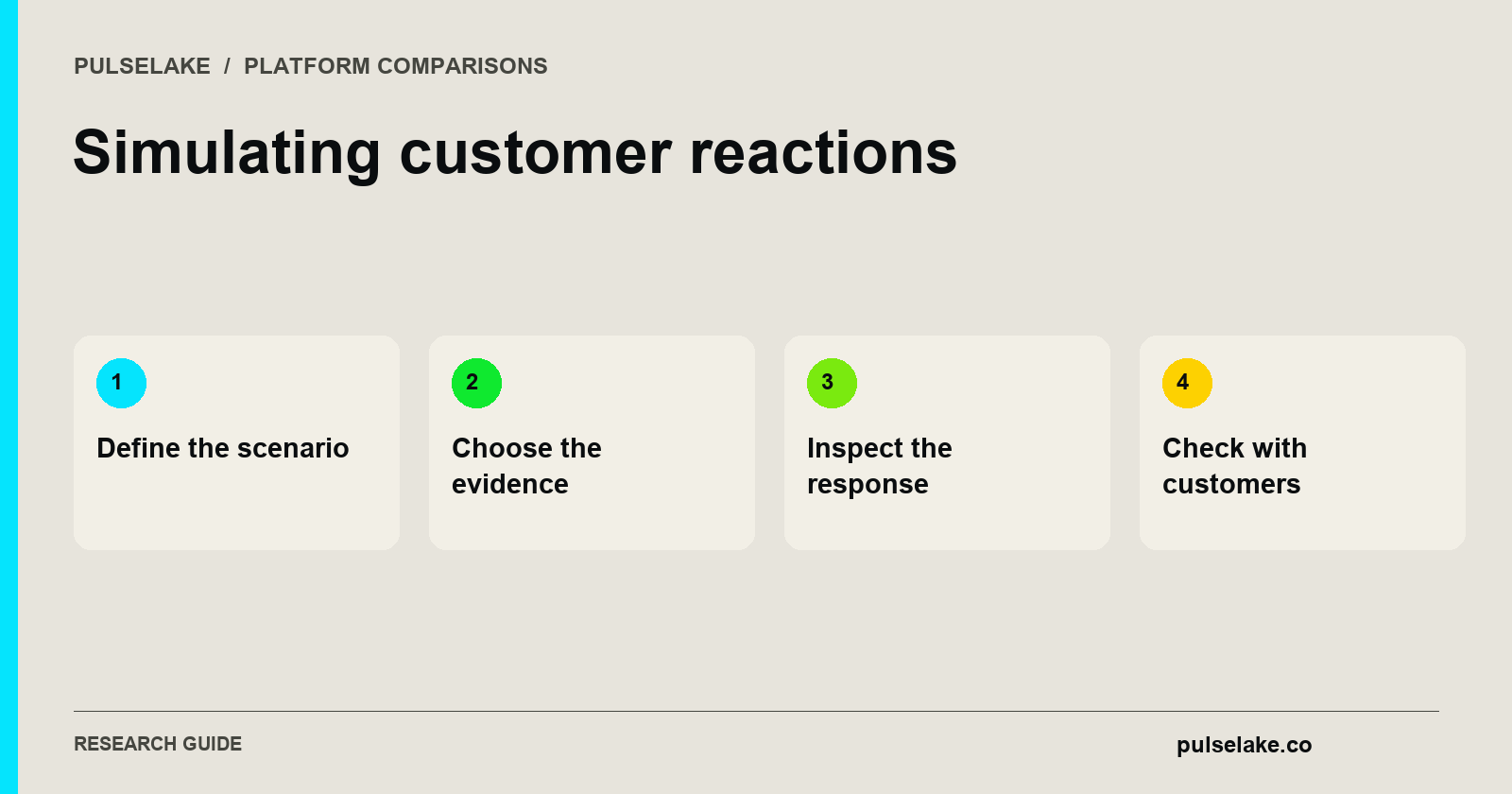
Choosing an AI tool for simulating customer reactions in 2026 depends on whether you are testing user interfaces, exploring early qualitative hypotheses, modeling population-level opinion shifts, or running an end-to-end insight operation. Minds suits prototype and UI reaction testing, Synthetic Users fits early-stage qualitative problem discovery, Artificial Societies and Aaru model population behavior and social influence, Lakmoos provides neuro-symbolic synthetic panels for regulated enterprises, and PulseLake is built for internal insights teams, market research firms, and consulting practices that want versioned synthetic personas, scenario simulation, AI-led interviews, and human validation connected inside one persistent research operating system.
Disclosure: We make PulseLake. This comparison reflects our assessment and links to each vendor's public documentation.

How does customer reaction simulation work (and why do generic ChatGPT prompts fall short)?
Single-prompt roleplay in a general-purpose LLM like ChatGPT struggles with three structural problems in market research: sycophancy (agreeing too readily with the user's premise), mode collapse (giving homogeneous answers across diverse demographics), and a lack of traceability back to empirical evidence.
Dedicated customer reaction simulators address these limits through four distinct architectural approaches:
- Independent synthetic personas and audiences: Platforms that generate structured profiles—grounded in psychographic frameworks like OCEAN personality traits, behavioral attributes, or uploaded first-party documents—and query each persona independently across surveys, interviews, or visual stimuli.
- Networked and outcome-grounded population simulations: Multi-agent systems where personas interact to model word-of-mouth influence, or where models are trained on behavioral signals and neuro-symbolic logic rather than text generation alone.
- AI-moderated human research and participant digital twins: Platforms that use conversational AI interviewers to probe real human participants, or construct 1-to-1 digital twins from transcripts of interviewed customers. (See our explainer on synthetic personas vs. digital twins.)
- Connected research operating systems: Platforms that combine synthetic personas and scenario simulations with traditional surveys, live AI-led interviews, and an organizational knowledge graph so simulated hypotheses can be traced and validated against human evidence in the same study context.
How do AI customer simulation tools compare?
Platform profiles: How do the leading tools differ?
Minds: Best for UX, prototype screens, and mixed-method synthetic studies
Minds centers on persistent AI personas and reusable target Audiences powered by its PRISM reasoning and source-modeling engine (Minds platform guide). It supports qualitative interviewing and structured quantitative methods—including rating scales, MaxDiff, and Kano analysis—alongside visual stimuli such as ad creatives, landing pages, and Figma prototype screens.
- Pricing & limitations: Offers pay-as-you-go per response, monthly per-user, and enterprise plans. Simulated personas evaluate visual flows as presented rather than executing live interactive browser tasks, simulated attention heatmaps are model estimates rather than optical eye-tracking, and human recruitment requires an external panel.
Synthetic Users: Best for early-stage qualitative discovery interviews
Synthetic Users provides a multi-agent research environment for problem exploration, concept testing, and qualitative interviews. Personas are shaped with OCEAN personality dimensions to reduce LLM agreeableness and can be grounded in proprietary documents via retrieval-augmented generation (RAG).
- Pricing & limitations: Sold as annual token pools with unlimited collaborative seats. Designed for qualitative thematic discovery rather than statistical distributions, advising teams to pair synthetic exploration with organic human validation.
Artificial Societies: Best for decisions shaped by social influence
Artificial Societies simulates interconnected networks of 12 to 3,500 personas that communicate and influence one another (Artificial Societies guide). Grounded in public and client observational data, it models how a message, policy change, or product announcement propagates through a community.
- Pricing & limitations: Custom pricing on request. Requires existing observations to calibrate the community and is not designed for granular UI usability testing.
Aaru: Best for outcome-grounded behavioral scenario planning
Aaru builds multi-agent behavior simulations grounded in demographic distributions, behavioral signals, and measurable outcomes across product, pricing, and packaging scenarios. On its public site, Aaru highlights a benchmark across 2,993 survey questions reporting a mean Total Variation Distance (TVD) of 7.62% and a Mean Absolute Error (MAE) of 3.53%.
- Pricing & limitations: Enterprise pricing on request; no public self-serve tier for small-batch qualitative interviews.
Lakmoos: Best for neuro-symbolic AI survey panels in regulated industries
Lakmoos uses a hybrid neuro-symbolic AI architecture combining machine learning, behavioral science rules, and structured logic (Lakmoos AI panels overview). It builds private reasoning models and synthetic panels for banking, automotive, energy, and telecommunications.
- Pricing & limitations: Monthly subscription tiers and pilot-based enterprise licensing. Built for structured survey panels rather than self-serve UX prototype critiques.
Delve AI: Best for personas and twins from first-party analytics and CRM
Delve AI connects to Google Analytics, Search Console, CRM systems, and social audience data to generate segment personas and digital twins that teams query via 1-on-1 chats, focus groups, and creative evaluations.
- Pricing & limitations: Tiered monthly subscriptions, per-user credit packages, and a free basic persona tier. Teams entering new markets without historical first-party traffic data will have less grounding.
SYMAR: Best for rapid self-serve synthetic focus groups and creative evaluation
SYMAR (by OpinioAI International) provides a self-serve workspace for personas equipped with persistent "Synthetic Memory." Marketers can run synthetic surveys, focus groups, 1-on-1 interviews, and creative evaluations for ad copy, packaging, and video concepts.
- Pricing & limitations: Credit-based monthly subscriptions. SYMAR recommends synthetic research for the initial 90% of iteration and human panels for the final 10% of validation; formal validation benchmarks were not verified on its main product page.
Qualtrics Synthetic Panels: Best for extending existing Qualtrics survey workflows
Qualtrics offers Synthetic Panels powered by its Edge Audiences model, trained on anonymized and validated human survey responses, allowing researchers to blend human and synthetic responses in existing workflows.
- Pricing & limitations: Custom enterprise licensing and subscription credits via an Account Executive. Standard documentation notes the baseline panel is modeled on the US General Population in English.
Outset and Remesh: Best for AI-moderated human reactions and 1-to-1 participant twins
When teams want AI speed with real human respondents:
- Outset: Outset conducts AI-moderated video, audio, and text interviews with real participants across 40+ languages via 25+ panel integrations, supports synthetic guide pre-testing, and builds "Outset Digital Twins" from completed human interviews.
- Remesh: Remesh enables live synchronous and asynchronous guided conversations with hundreds of real customers simultaneously, clustering open-ended reactions and quantifying voting in real time.
Both use custom enterprise pricing and suit teams with the budget and timeline for human fieldwork. (See our guide on what an AI-moderated interview is and how it works.)
PulseLake: Best for connecting synthetic personas, scenario simulation, and human validation in one OS
PulseLake is the AI-native operating system for market research and insight professionals—connecting the execution, intelligence, and delivery layers inside one persistent study context. It provides four integrated research modes sharing the same ontology, governance, lineage, and research knowledge graph:
- Synthetic research: Explicit, versioned synthetic personas and populations for testing instruments, concepts, and hypotheses, with clear provenance and a path into human validation.
- Simulation: Scenario models grounded in prior evidence and explicit assumptions to explore alternative conditions and identify what to test next.
- AI-led interviews: Conversational and avatar-based AI interviewers that probe adaptively with real participants, turning conversations into structured evidence.
- Traditional research: Surveys, qualitative research, assessments, panels, and advanced methods (such as MaxDiff vs. conjoint analysis or Gabor-Granger vs. Van Westendorp).
PulseLake pairs specialized AI agents with a calculation mode that computes answers against study data rather than generating them, alongside dashboards, automated PowerPoint reporting, client workspaces, and scheduled monitoring. While public pricing and MCP server documentation are not yet verified in public documentation, teams can explore capabilities and calculators via the Resources page.
How to evaluate simulation accuracy and run a hybrid workflow
As highlighted in Artificial Societies' evaluation methodology and our guide on how accurate synthetic respondents are, buyers should separate vendor accuracy claims into three metrics:
- Qualitative theme recall: What proportion of core themes from human discovery interviews also appear in synthetic transcripts—useful for early brainstorming and concept testing questions.
- Distributional overlap (TVD / MAE): How closely a synthetic panel's percentage breakdown across rating-scale or multi-choice questions matches a human panel.
- Within-persona consistency: Whether a versioned persona maintains coherent preferences across related trade-off questions over time.
Practical 4-step hybrid workflow
Rather than choosing between purely synthetic outputs and traditional fieldwork alone, insights teams can use a staged workflow (see synthetic data validation and synthetic respondents and their limits):
- Step 1 — Ground Personas: Use prior studies from your research knowledge graph to define explicit, versioned synthetic personas.
- Step 2 — Stress-Test Instruments: Test concepts and survey wording with synthetic populations.
- Step 3 — Model Scenarios: Run scenario simulations under explicit assumptions to identify what to test next.
- Step 4 — Validate with Humans: Transition into AI-led interviews or traditional panel surveys within the same study context.
Where does PulseLake fit—and who should pick another tool?
- Choose PulseLake if: You are part of an internal insights team, market research firm, or consulting practice that wants versioned synthetic personas and scenario simulation connected to AI-led interviews, traditional research, a research knowledge graph, and delivery outputs. Explore workspaces via our Get started page or Contact page.
- Choose Minds or Synthetic Users if: You want a standalone tool for prototype screen critiques or early qualitative discovery interviews.
- Choose Artificial Societies or Aaru if: Your focus is macro population forecasting or modeling social network opinion shifts.
- Choose Delve AI or SYMAR if: You want a credit-based tool to generate personas from Google Analytics or run self-serve ad copy focus groups.
All trademarks belong to their respective owners.
How PulseLake connects evidence to analysis
PulseLake is a research operating system that connects study design and evidence collection with structured analysis, interpretation and reporting. Its research frameworks organise questions and measures into dimensions and sub-dimensions. That structure gives the evidence a shared meaning and makes it usable for analysis beyond an individual response or survey.
A reaction becomes more useful when it is organised around the concepts being investigated. Researchers can define those dimensions before comparing results and retain the distinction between simulated reactions and observations.
Frequently asked questions
Which simulation tool is best?
Choose around the task, source grounding and validation requirements. A product demonstration is not a comparative accuracy benchmark.
Can simulations replace customer interviews?
They can help prepare questions and explore hypotheses, but do not create observed customer testimony.
What should be compared across tools?
Use the same brief and inspect assumptions, source evidence, output stability and the work needed to validate findings.
How should results be labelled?
Identify them as simulated outputs and keep them separate from responses collected from people.