Market research platforms that work with AI agents and MCP (2026)
Compare market research tools for AI agent workflows, including MCP connections, permissions, evidence retrieval and human review.
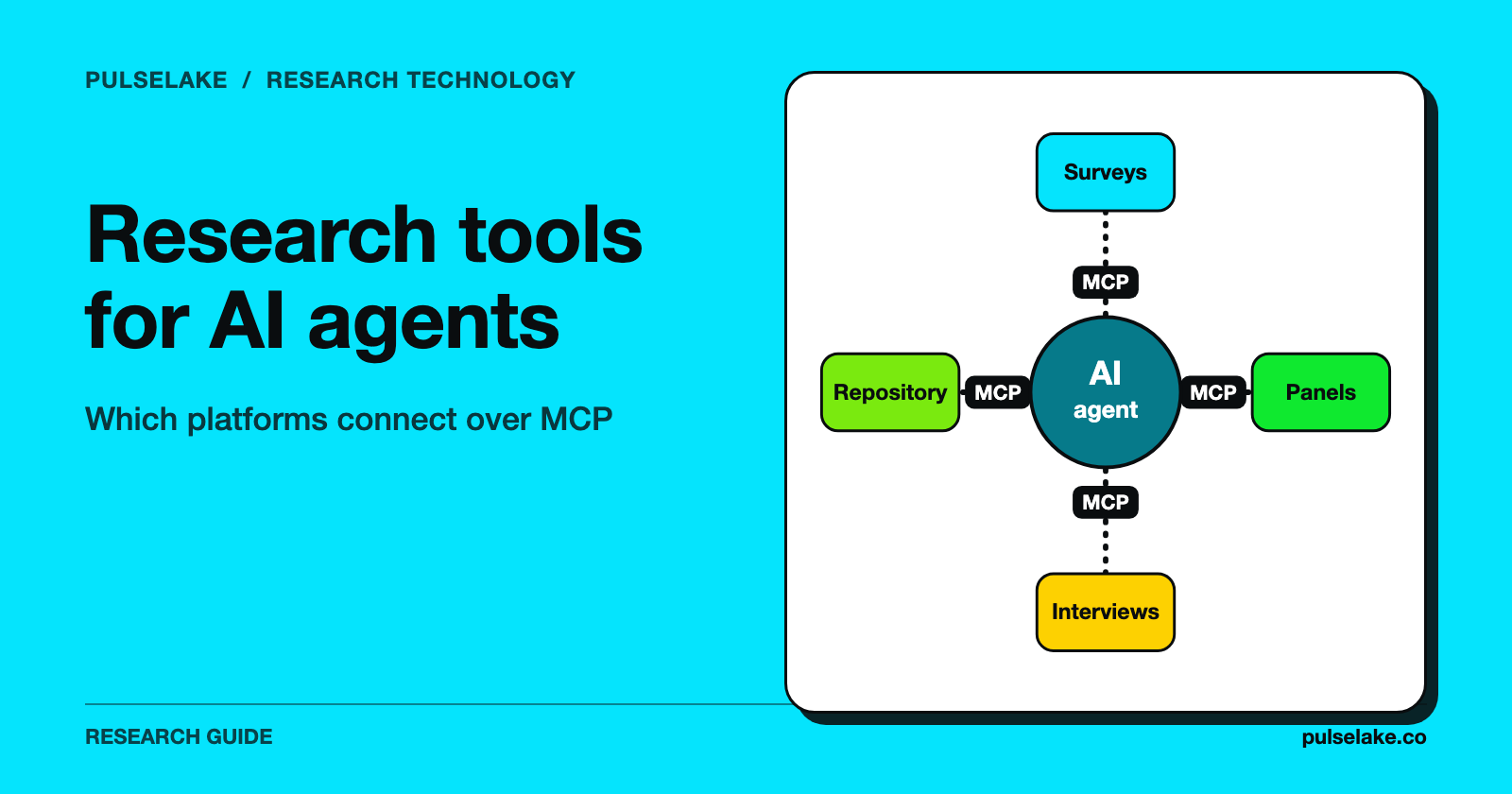
Which market research platforms work with AI agents and MCP? The ones with documented Model Context Protocol (MCP) servers, LLM connectors or native AI agent workflows include User Intuition, Voicepanel, Listen Labs, Dovetail, Minds, Market Logic DeepSights, SurveyMonkey, Qualtrics, Rival Technologies and PulseLake. They don't all do the same job, though.
If you want to commission AI-moderated interviews from Claude, ChatGPT or Cursor, User Intuition, Voicepanel and Listen Labs offer primary fieldwork MCP servers. Dovetail and Market Logic DeepSights give you tools to query existing research repositories and syndicated intelligence. Minds runs synthetic audience simulations over remote MCP. SurveyMonkey and Qualtrics support quantitative surveys and API-driven agent workflows. PulseLake provides an integrated research platform spanning human and synthetic modes.
Disclosure: We make PulseLake. This comparison reflects our assessment of publicly available documentation and links to each vendor's verified materials. We evaluate vendors based on their supported workflows, architectural approach, and documented limitations.

How MCP and AI agents fit into market research workflows
The first split buyers make is between generic web-scraping servers and platforms that actually connect AI agents to respondent data, study creation or research repositories. Among the second group, we see five architectural categories:
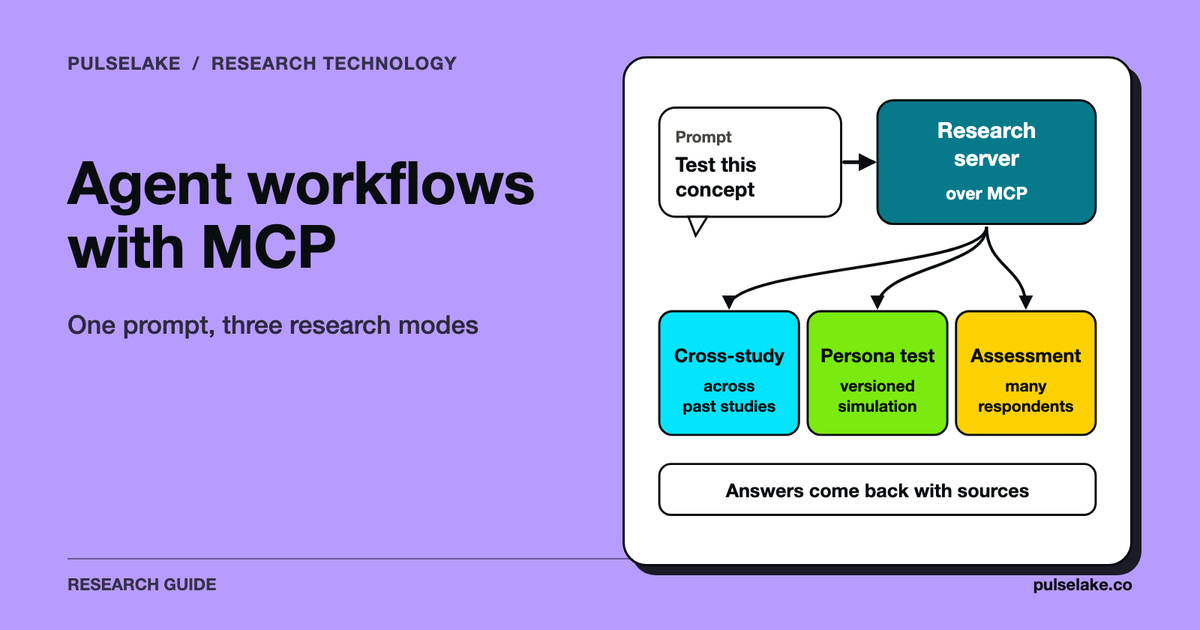
- Qualitative and multi-modal fieldwork MCPs (User Intuition, Voicepanel, Listen Labs): These let assistants draft discussion guides, configure participant screeners, manage recruitment feasibility and retrieve cited transcripts straight from a chat interface.
- Quantitative survey and XM connectors (SurveyMonkey, Qualtrics, Rival Technologies): These provide ways to create questionnaires, generate collector links, summarize quantitative results, or call standard API endpoints mapped to MCP tools.
- Synthetic simulation MCPs (Minds): These let researchers build synthetic personas from a foundational brief and run directional multi-question, MaxDiff or conjoint tasks entirely by prompt.
- Repository and enterprise intelligence MCPs (Dovetail, Market Logic DeepSights): These let external agents query historical transcripts, insight documents and licensed syndicated reports securely, under user-level permissions, without altering the underlying data.
- AI-native research operating systems (PulseLake): These embed specialized agents inside a persistent study context and research knowledge graph, spanning quantitative surveys, AI-led interviews, synthetic personas and simulations.
Comparison of platforms with MCP and AI agents
| Platform | Primary Category | MCP / Agent Connection | Best For | Key Limitation |
|---|---|---|---|---|
| User Intuition | AI-moderated qualitative | Hosted HTTP MCP & local stdio | Commissioning voice/video interviews via Claude/ChatGPT | One country per panel launch; low incidence requires manual setup |
| Voicepanel | Multi-modal feedback | Remote HTTP MCP | Mixing voice, video, screen tasks, and surveys | Panel distributions drafted via MCP must be manually published via web app |
| Listen Labs | AI-moderated interviews | Stateless HTTP MCP & Research Agent | AI-led video/voice interviews and highlight reels | Scoped strictly to qualitative interviews rather than quantitative workflows |
| Dovetail | Repository & intelligence | Hosted HTTP MCP & local stdio server | Searching, tagging, and synthesizing existing transcripts | Does not field primary studies; manual authentication for hosted endpoint |
| Minds | Synthetic simulation | Remote HTTP MCP | Synthetic persona exploration and MaxDiff/conjoint | Strictly synthetic; cannot establish statistical representativeness |
| Market Logic DeepSights | Enterprise intelligence | DeepSights MCP | Routing internal research and syndicated sources | Built for knowledge retrieval rather than executing primary fieldwork |
| SurveyMonkey | Quantitative web surveys | Official LLM Connectors | Building and summarizing web surveys inside LLMs | US-hosted accounts only; unavailable to HIPAA or sensitive data accounts |
| Qualtrics | Enterprise XM | JSON API-mapped MCP servers | Engineering teams building custom agents against APIs | Exposes low-level REST endpoints rather than curated research workflows |
| Rival Technologies | Insight communities | Rival MCP connector | Brands running mobile-first insight communities | Public server endpoints and self-serve setup docs are unverified |
| PulseLake | Integrated research OS | Built-in specialized AI agents | Insights teams running mixed human and synthetic research | Public MCP setup details have not been verified in external documentation |
1. User Intuition
Best for: Teams commissioning AI-moderated voice or video interviews with real participants and querying past study reports.
User Intuition offers hosted and local MCP endpoints. Agents can draft studies, refine discussion guides and estimate recruitment feasibility. When interviews across its participant panel finish, agents pull back structured JSON findings linked to verbatim quotes.
Limitations: According to its MCP guide, each launch covers a single country, and audiences below 10% incidence need a manual feasibility request. BYOP (bring-your-own-participant) invitations cap at 100 emails per batch without CRM sync.
2. Voicepanel
Best for: Product and UX teams combining AI-moderated voice interviews, screen-shared tasks, video and rating scales.
Voicepanel's MCP documentation describes a remote HTTP MCP server with read and write tools across setup, stimulus upload, distribution and analysis. Assistants can load screener rules, generate studies and run AI design critiques from the interface.
Limitations: Panel publishing isn't fully enabled over MCP. An assistant can draft a panel configuration, but a person has to publish it in the Voicepanel web app. Non-interactive script runs also need an earlier interactive browser sign-in.
3. Listen Labs
Best for: Teams running AI-moderated video and voice interviews that want ChatGPT, Claude and Codex connectors.
Listen Labs provides a stateless HTTP MCP server. Authorized users can view studies, read transcripts, create studies and launch recruitment. Its internal Research Agent compiles video highlight reels, runs cohort comparisons and builds slide decks.
Limitations: The connector sticks closely to AI-moderated interviews. It doesn't cover traditional survey programming or synthetic audience simulation.
4. Dovetail
Best for: Teams storing interview transcripts and usability recordings that want AI agents to search their repository.
Dovetail's developer documentation offers an MCP endpoint to search workspaces, inspect project highlights, read documents and list recurring themes across scattered qualitative feedback channels.
Limitations: Dovetail is a repository workspace. It doesn't recruit participants or field primary studies. Its hosted endpoint lacks OAuth DCR, so you handle Bearer tokens manually in tools like Cursor or Copilot Studio.
5. Minds
Best for: Agencies building synthetic personas to run exploratory message tests, MaxDiff or conjoint simulations.
Minds runs a remote HTTP MCP server that lets LLMs work with synthetic Audiences, Studies, MaxDiff arrays and Conjoint setups to surface directional findings.
Limitations: Minds is purely synthetic. As Minds states in its guide, outputs give directional hypotheses but can't establish statistical representativeness or replace human validation for high-stakes decisions.
6. Market Logic DeepSights
Best for: Enterprise insights teams feeding proprietary libraries and licensed syndicated data into AI assistants.
DeepSights MCP checks user entitlements and returns cited answers across modes for answering market questions, stress-testing briefs and handing concept checks to automated personas.
Limitations: It works strictly as an enterprise knowledge hub, not a self-serve primary fieldwork tool. Public endpoint URLs or tool schemas aren't openly verifiable on its public site.
7. SurveyMonkey
Best for: Teams running quantitative web surveys that want to draft questionnaires and summarize responses.
SurveyMonkey's LLM Connectors provide read-only tools for searching surveys and generating summaries, plus write tools for generating survey plans and collector links right in the chat window.
Limitations: LLM Connectors are restricted to US-hosted accounts and are completely unavailable to HIPAA-enabled Enterprise accounts or accounts with Enhanced Sensitive Data Protection enabled.
8. Qualtrics
Best for: Enterprises standardized on Qualtrics with engineering teams building custom agents.
Qualtrics' API documentation points to MCP servers mapped directly to its JSON-based APIs, working alongside its native Experience Agents.
Limitations: The strict 1-to-1 mapping to REST API endpoints means custom technical configuration before the experience feels smooth, and legacy non-JSON APIs aren't supported.
9. Rival Technologies
Best for: Consumer brands using Rival insight communities that want to ground internal AI assistants in conversational data.
Rival Technologies announced Rival MCP as a two-way connection linking its mobile-first platform and the Emerging Consumer Index to enterprise AI tools.
Limitations: Rival MCP was announced in customer pilot mode. Public server endpoints, tool schemas and self-serve setup documentation are currently unverified.
10. PulseLake
Best for: Internal insights teams and consultancies that need one operating system to deploy specialized research agents across human and synthetic studies.
PulseLake runs an AI-native research architecture across three layers that share a single persistent study context. Its Execution Layer conducts traditional research, AI-led conversational interviews and synthetic simulation. Its Intelligence Layer uses a calculation mode to compute quantitative answers against study data, instead of generating them probabilistically. Its Delivery Layer supports reporting, with researchers keeping judgment and approvals.
Limitations: PulseLake's public MCP setup details have not been verified and are not yet published in external facing documentation.
Example AI agent workflows for market research
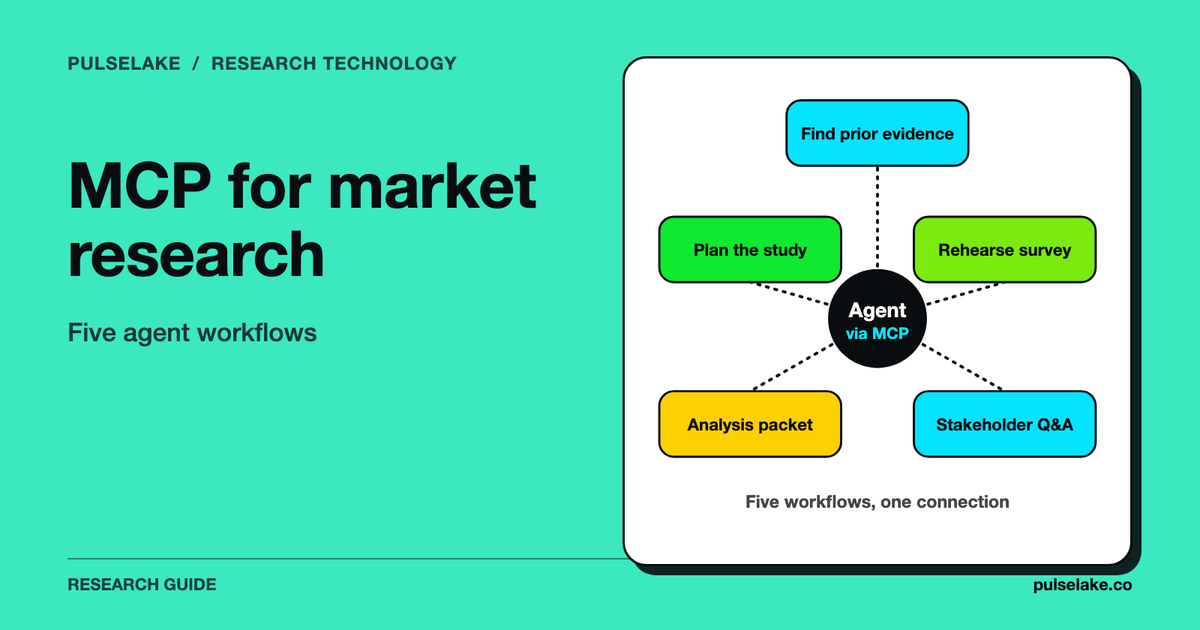
If you're automating market research with AI and MCP, put human review pipelines in front of anything that launches fieldwork. We'd treat that as non-negotiable. Good workflows keep the drafting phase apart from the execution phase, so budget and brand reputation stay protected.
- Repository check: "Search our workspace for studies from the past 6 months mentioning 'onboarding drop-off.' Summarize recurring objections with quotes and source links, and list unanswered questions before we design a new study."
- Usability study with approval gate: "Draft a 10-minute study plan to test checkout abandonment with a screener for frequent shoppers. Run a study design review to flag question issues, and stop for my approval before creating any distribution."
- Synthetic exploration to human validation: "Create a draft study plan for our B2B finance persona to test three value claims and wait for confirmation. Once directional results finish, draft a live interview guide to validate the top claims and run a dry-run panel feasibility check."
That last prompt shows the order we'd always use: synthetic for speed and early direction, real respondents for validation. For more on workflow design, see our resources on AI Research Orchestration, AI Research Governance, and Machine Readable Research.
Where PulseLake fits (and when to pick something else)
Choose PulseLake when:
- You need an integrated system where traditional surveys, AI-led interviews and synthetic simulations share one cross-functional study context.
- You want a calculation mode that computes precise quantitative answers against study data, backed by a verifiable evidence graph for clear provenance and trace-back.
- You want to package whole workflows into repeatable maturity assessments and solutions with clear human-in-the-loop governance.
Choose another platform when:
- You need a documented standalone MCP server right now to trigger voice or video interviews from Claude or Cursor (consider User Intuition, Voicepanel, or Listen Labs).
- You only need to search and tag an existing qualitative research repository (consider Dovetail).
- You want to route licensed syndicated reports selectively into Microsoft Copilot or Glean (consider Market Logic DeepSights).
- You just want to build standard web surveys inside ChatGPT for US-hosted audiences without strict HIPAA constraints (consider SurveyMonkey).
How PulseLake connects evidence to analysis
PulseLake is a research operating system that links study design and evidence collection with structured analysis, interpretation and reporting. Its research frameworks organise questions and measures into dimensions and sub-dimensions. That structure gives the evidence a shared meaning, so it can be analysed beyond any single response or survey.
For agent-assisted analysis, PulseLake has Copilot tools connected to the Analysis Workbench and its study-specific calculation services. The selected study supplies the calculation context. This internal capability doesn't establish a public MCP endpoint or an external integration contract.
Frequently Asked Questions
Which market research platforms have an API or MCP server?
Platforms with publicly documented Model Context Protocol (MCP) servers or LLM connectors include User Intuition, Voicepanel, Listen Labs, Dovetail, Minds, Market Logic DeepSights, SurveyMonkey and Qualtrics. PulseLake provides an AI-native agent operating system, though its public MCP setup details have not been verified.
What is the difference between a read-only research MCP and a read-write fieldwork MCP?
It comes down to whether the agent can change or create anything. A read-only or repository MCP (such as Dovetail's search tools) lets an agent search existing transcripts, documents and historical studies without altering them. A read-write fieldwork MCP (such as User Intuition or Voicepanel) lets an agent draft study plans, configure screeners, launch recruitment links and gather new primary evidence.
Can an AI agent launch a panel study without human approval?
Usually not, because research MCP servers typically put human-in-the-loop gates in front of recruitment spend. Voicepanel lets an assistant draft a panel distribution but needs a person to publish it in the web app, and User Intuition supports dry-run feasibility checks. PulseLake's agents are designed to leave researchers in control of judgment and final approvals before any live instrument goes out.
How do remote HTTP MCP servers differ from local stdio MCP servers?
Remote HTTP MCP servers connect through browser OAuth or Bearer headers with no local dependencies, which suits web and desktop assistants like Claude or ChatGPT perfectly. Local stdio MCP servers run as a local subprocess and often need a command-line installation (like Node.js packages) plus an API token.
Can synthetic MCP servers replace primary human market research?
No. As synthetic vendors like Minds document, and as our synthetic respondent accuracy analysis explains, synthetic personas give directional hypotheses for early exploration. They can't establish statistical representativeness, causal proof or exact willingness to pay, so high-stakes business decisions still need thorough human validation.
All trademarks belong to their respective owners.