PulseLake AI agent workflows: capabilities and MCP integration questions
How PulseLake connects research frameworks, dimension-based analysis and Copilot calculations—and what to confirm before configuring external agent integrations.
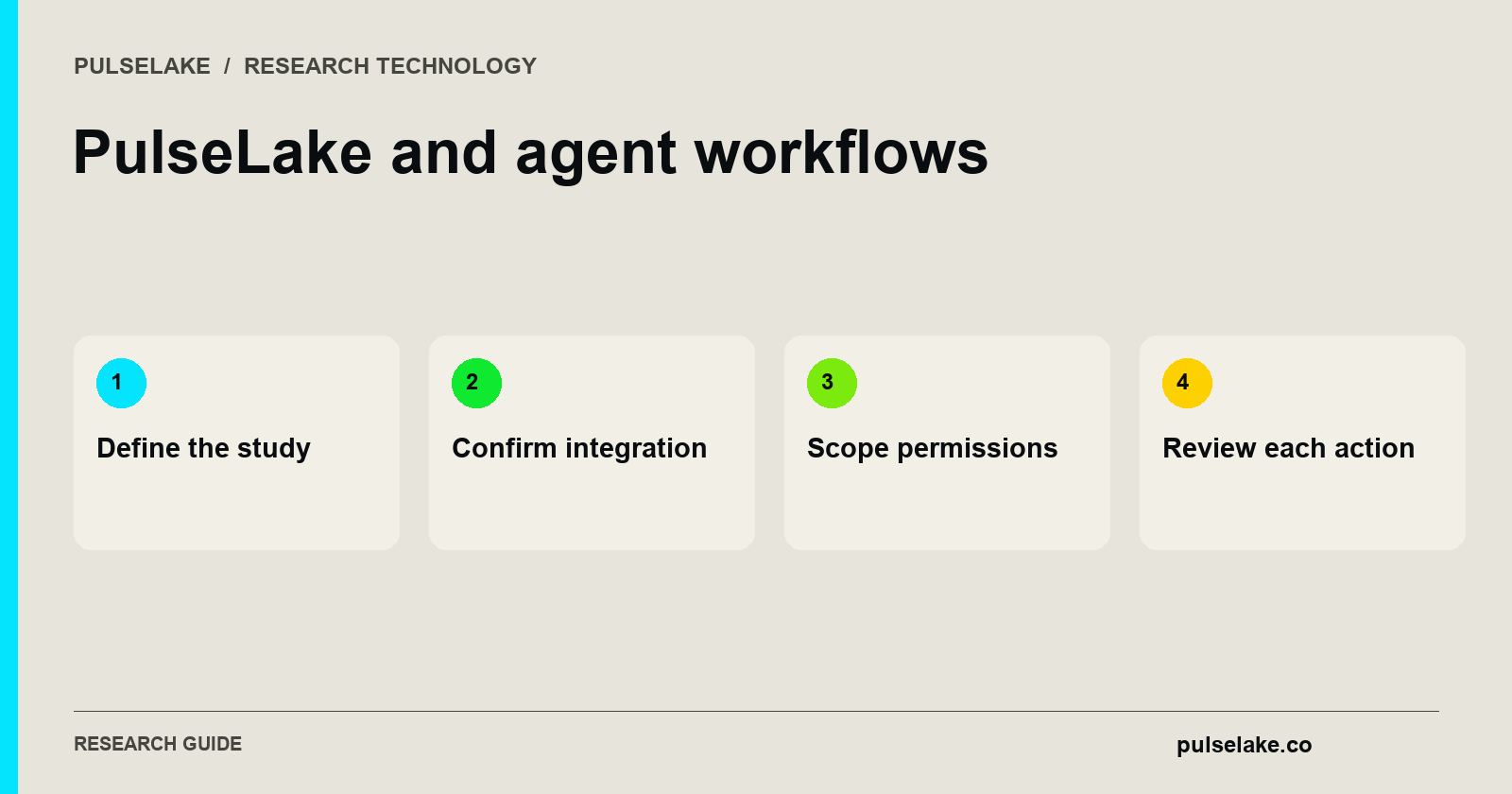
PulseLake is a research operating system that connects study design and evidence collection with structured analysis, interpretation and reporting. Its research frameworks organise questions and measures into dimensions and sub-dimensions. That structure gives the evidence a shared meaning and makes it usable for analysis beyond an individual response or survey. Public documentation for an external PulseLake MCP endpoint and tool contract still needs to be confirmed before configuring a client.
The Analysis Workbench supports dimension-based metrics, filters and ad-hoc pivots. Copilot analytics tools use the same normalized study data and calculation services. A numerical answer is therefore tied to a defined study and calculation method, while interpretation still requires researcher review.
Disclosure: We make PulseLake. This overview and comparison reflect our assessment and link to each vendor's public documentation.

How do research frameworks shape the analysis?
A research ontology describes the concepts being studied, their relationships and the measures used to examine them. In PulseLake, reusable frameworks organise dimensions, sub-dimensions and questions. The Analysis Workbench uses the selected study type to choose the applicable calculations, rather than treating every response as the same kind of score.
For example, researchers might define service quality through clarity and responsiveness, then compare dimension-level results across appropriate groups. These are illustrative dimensions; teams define the framework for their own study.
What is the architecture of the PulseLake research system?
Most market research tools help run a single study in isolation. PulseLake runs the research system around it across three connected layers sharing one persistent study context:
- The Execution Layer: Running traditional surveys and qualitative assessments, conversational and avatar-based AI-led interviews with real participants, versioned synthetic persona studies, and scenario simulations.
- The Intelligence Layer: Understanding everything the organization knows through a persistent study context, a research knowledge graph, cross-study search, natural-language questions with evidence provenance, and a calculation mode that computes answers against study data rather than generating them.
- The Delivery Layer: Turning insight into decision-ready outputs via dashboards, automated PowerPoint reporting, client workspaces and portals, research Q&A, scheduled monitoring, and repeatable downstream workflows.
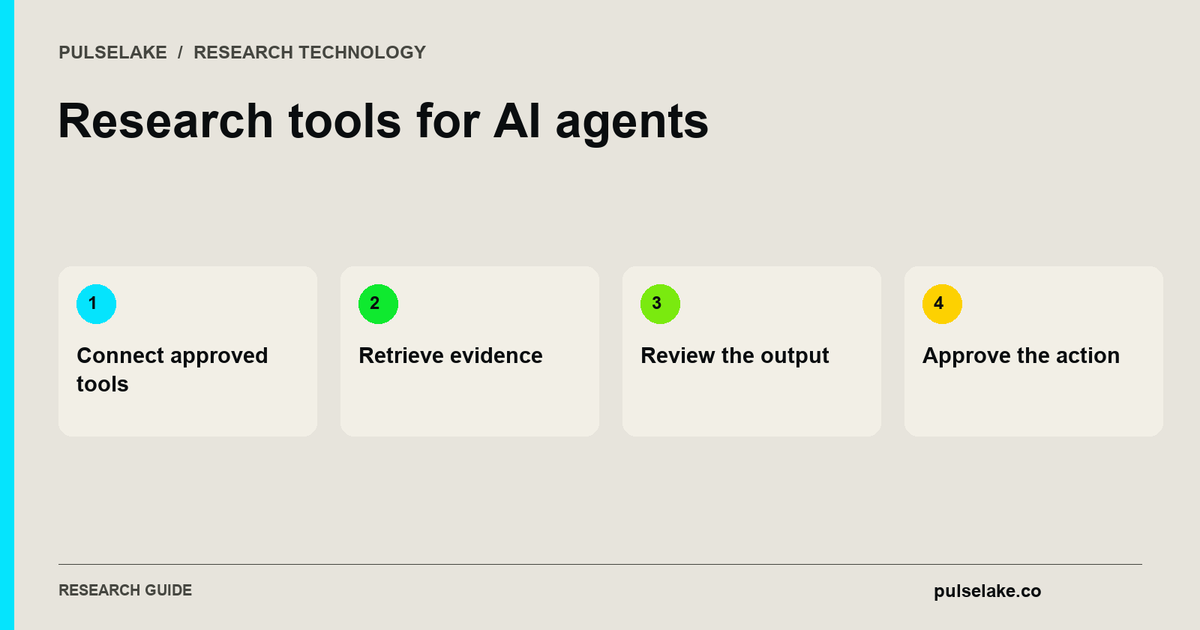
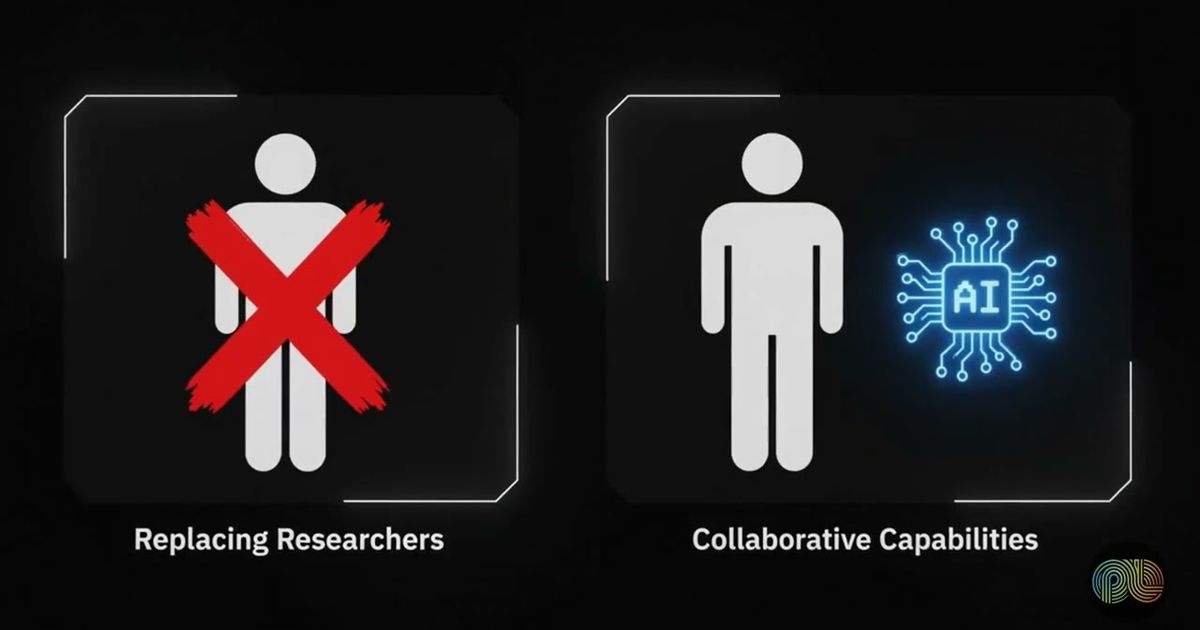
Within the platform, PulseLake deploys specialized AI agents for research design, interviewing, qualitative analysis, deep research, reporting, and client Q&A, with researchers retaining judgment and approvals. To learn more about how agentic systems interact with structured evidence, see our guide on AI agents for research and our framework for AI research orchestration.
How do you connect to PulseLake for AI-assisted workflows?
Public documentation specifying PulseLake's remote MCP server URLs, local client configuration snippets, and exact tools/list function schemas is not yet verified in PulseLake's public product documentation.
To use PulseLake's native AI agents, research modes, and workspace workflows today:
- Create or Access a Workspace: You can create a PulseLake workspace on the Get Started page, sign in to an existing workspace at
https://app.pulselake.co/users/sign_in, or try the free research calculators on our Resources page. - Researcher Governance and Approvals: Inside PulseLake, AI agents assist with research design, interviewing, analysis, and reporting while researchers retain judgment and approvals. Workflow automation governs approvals, QA, recurring studies, and notifications as repeatable flows.
- Request Technical Details: If your engineering or insights team is evaluating external agent integrations or MCP documentation for PulseLake, please reach out to our team via the Contact page.
What capabilities and research modes does PulseLake provide for AI-assisted workflows?
Rather than restricting AI to text summarization, PulseLake provides capabilities across four distinct research modes and an underlying intelligence foundation:
- Cross-Study Research Intelligence & Calculation Mode: Teams can query PulseLake's persistent study context and research knowledge graph using natural-language questions backed by evidence provenance. When quantitative precision is required, PulseLake's calculation mode computes answers directly against study data rather than relying on a language model to generate or guess numbers.
- Traditional Research & AI-Led Interviews: Supports framing research questions, managing surveys, panels, and assessments, and deploying conversational or avatar-based AI interviewers that follow a protocol, probe adaptively, and turn participant conversations into structured evidence.
- Synthetic Research: Enables testing instruments, concepts, and hypotheses with explicit, versioned synthetic personas and populations, maintaining clear provenance and a path into human validation. For background on validation standards, read our analysis on how accurate synthetic respondents are.
- Scenario Simulation: Runs scenario models grounded in prior evidence and explicit assumptions to explore what could happen under alternative conditions and identify what to test next.
- Reusable IP & Maturity Assessments: Packages studies, assessments, agents, dashboards, workflows, methods, and ontology into reusable team or client-facing solutions. You can see how PulseLake structures assessments on our Maturity Assessments overview.
Example prompts for AI-assisted market research workflows
When working with AI research agents—whether inside an AI-native research operating system or via an MCP-connected assistant—prompts are most effective when they specify the study context, methodology, and validation requirements. Below are three example prompts illustrating how insights teams frame requests across cross-study intelligence, synthetic simulation, and maturity assessments.
Example Prompt 1: Cross-Study Intelligence and Calculation Mode
Use this prompt pattern to retrieve institutional knowledge across past studies while requiring computed metrics and provenance:
"Search our persistent study context for all B2B onboarding studies completed in the last two quarters. Identify the primary drivers of churn mentioned in AI-led exit interviews, trace each theme to its source study provenance, and use calculation mode to compute the satisfaction score variance between enterprise and mid-market cohorts."
Why this structure matters: Instead of asking an LLM to estimate averages in its context window, this prompt pairs qualitative theme retrieval (backed by evidence lineage) with calculation mode against underlying study data.
Example Prompt 2: Versioned Synthetic Persona Concept Testing & Simulation
Use this prompt pattern to explore a product concept and model scenarios before moving into human fieldwork:
"Set up a synthetic concept test for our proposed usage-based pricing tier using our versioned 'Mid-Market CFO' and 'VP of Data Engineering' persona populations. Run a scenario simulation comparing a 15% base platform fee against a pure consumption model, and highlight which assumptions should be prioritized for human panel validation."
Why this structure matters: Grounding simulations in explicit, versioned personas and prior evidence helps teams explore alternative conditions and identify what to test next with real participants.
Example Prompt 3: Multi-Respondent Maturity Assessment
Use this prompt pattern to organize and review a structured organizational assessment:
"Prepare a multi-respondent assessment using our Finance Operating Model framework for four department leads. Check whether responses across the governance and automation dimensions are complete, and generate a scored summary deck for executive review."
Why this structure matters: Combining structured assessment frameworks with automated QA and PowerPoint reporting turns recurring diagnostic studies into repeatable workflows.
How do market research platforms and MCP servers compare in 2026?
Only a small number of market research platforms publicly document Model Context Protocol servers. The table below compares PulseLake alongside market research providers with documented MCP integrations or announcements.
Fit Breakdown of Peer MCP Providers
User Intuition
Based on User Intuition's MCP reference guide and product post, User Intuition provides both a remote Streamable HTTP endpoint and a local stdio package. Its documented capabilities cover study creation and customization, launching global panel recruits (with dry-run estimates) across a 4M+ participant network in 80+ languages, uploading Bring Your Own Participant (BYOP) email batches, generating reports, and searching across prior findings.
- Best for: Teams whose primary workflow is launching AI-moderated qualitative interviews with 5 to 7 levels of laddering across a global participant panel or uploaded customer lists.
- Where it suits less well: According to User Intuition's reference guide, each automated panel launch targets a single country at a time, audiences below 10% incidence require a manual feasibility request, customer lists must be exported because there are no direct CRM segment-sync tools in MCP, and quantitative preference shares or ranked themes are not guaranteed typed fields in JSON report outputs.
Voicepanel
According to Voicepanel's MCP documentation, Voicepanel offers a remote HTTP MCP server that exposes read/write tools for Admins and Editors and read-only tools for Viewers, grouped into study setup, link and website intercept distribution, and analysis.
- Best for: UX and product researchers who want an MCP client to draft discussion guides, upload stimuli, and publish shareable link or website intercept usability studies.
- Where it suits less well: Voicepanel's documentation notes that panel publishing is not yet enabled over MCP. While an assistant can draft a panel recruit, screener, and targeting via MCP, publishing a paid panel study must be completed inside the Voicepanel web app.
Minds
According to Minds' MCP server guide, Minds provides a remote Streamable HTTP MCP server that connects AI clients to synthetic audience simulations. Capabilities include creating persistent personas, running 1-to-1 and multi-persona panel conversations, and executing simulated MaxDiff and Conjoint Analysis trade-off workflows.
- Best for: Early-stage exploratory hypothesis generation, message framing, and synthetic trade-off simulations before investing in human fieldwork.
- Where it suits less well: Teams requiring human respondent data or combined human-and-synthetic evidence lineage in one system. As Minds explicitly notes, synthetic outputs are directional hypotheses and cannot establish statistical representativeness, causal proof, demand forecasts, or exact willingness to pay.
Rival Technologies
In its Rival MCP announcement, Rival Technologies introduced Rival MCP as a standardized two-way connection between enterprise AI applications and Rival's conversational research platform, insight communities, and Voice of Market programs.
- Best for: Enterprise brands already managing ongoing mobile-first conversational insight communities on Rival.
- Where it suits less well: Teams seeking immediate self-serve MCP documentation or synthetic simulation tools, as Rival MCP was announced in customer pilot without an open public tool catalog.
Where PulseLake fits (and when to choose another platform)
PulseLake is designed for internal insights teams, market research firms, and consulting practices that need one operating system connecting research execution, institutional knowledge, and client delivery.
Choose PulseLake if:
- You want to run four research modes—traditional research, AI-led interviews, versioned synthetic personas, and scenario simulations—within a single persistent study context.
- You need a research knowledge graph and calculation mode so teams and internal AI agents can trace answers to evidence provenance and compute metrics against study data rather than generating unverified summaries. Learn more in our guide to machine-readable research.
- You want to package studies, assessments, agents, dashboards, workflows, and ontology into reusable IP for your team or consulting clients, with human researchers retaining judgment and approvals.
Choose another platform if:
- You immediately require a publicly documented, self-serve MCP server to launch global panel interviews or BYOP email batches from an external AI client—where User Intuition documents remote HTTP and local stdio MCP tools.
- Your immediate requirement is managing AI-moderated voice, video, and prototype usability studies over a documented HTTP MCP endpoint—where Voicepanel provides public setup documentation.
- You only want a standalone MCP connector for directional synthetic persona chats and simulated MaxDiff/Conjoint exercises—where Minds offers a dedicated synthetic MCP server.
To learn more about PulseLake's capabilities, visit our FAQ, get started with a workspace, or contact the PulseLake team.
Frequently Asked Questions
Does PulseLake have public MCP server documentation?
While PulseLake provides an AI-native market research operating system with specialized internal AI agents, a research knowledge graph, and workflow automation, public documentation detailing external PulseLake MCP server endpoints and tool schemas is not yet verified in our public product documentation. Teams interested in external agent integrations can reach out via the Contact page.
How do AI agents work inside PulseLake?
PulseLake includes specialized AI agents for research design, interviewing, qualitative analysis, deep research, reporting, and client Q&A. These agents operate on a shared, persistent study context and research knowledge graph while human researchers retain judgment and approvals.
How does PulseLake prevent AI hallucinations when answering questions across past studies?
PulseLake pairs its persistent study context and research knowledge graph with natural-language evidence provenance and a calculation mode. Rather than generating or guessing statistics with a language model, calculation mode computes answers directly against the underlying study data.
Can PulseLake combine synthetic respondents with human research?
Yes. PulseLake supports four research modes in the same study context: traditional research (surveys, qualitative research, assessments, panels), AI-led interviews with real participants, synthetic research using explicit, versioned personas, and scenario simulations. Synthetic studies maintain clear provenance and a structured path into human validation.
Which market research platforms publicly document MCP servers?
Based on public vendor documentation, User Intuition and Voicepanel publish technical MCP documentation for AI-moderated interview workflows, Minds documents an MCP server for synthetic audience simulations, and Rival Technologies announced an enterprise MCP connector pilot for conversational insight communities.
All trademarks belong to their respective owners. If you represent a vendor listed on this page and would like to request a correction regarding your public documentation, please reach out via our Contact page.