Dovetail alternatives for AI-native research synthesis in 2026
Compare research-synthesis alternatives by evidence traceability, repository reuse, AI review and migration requirements.
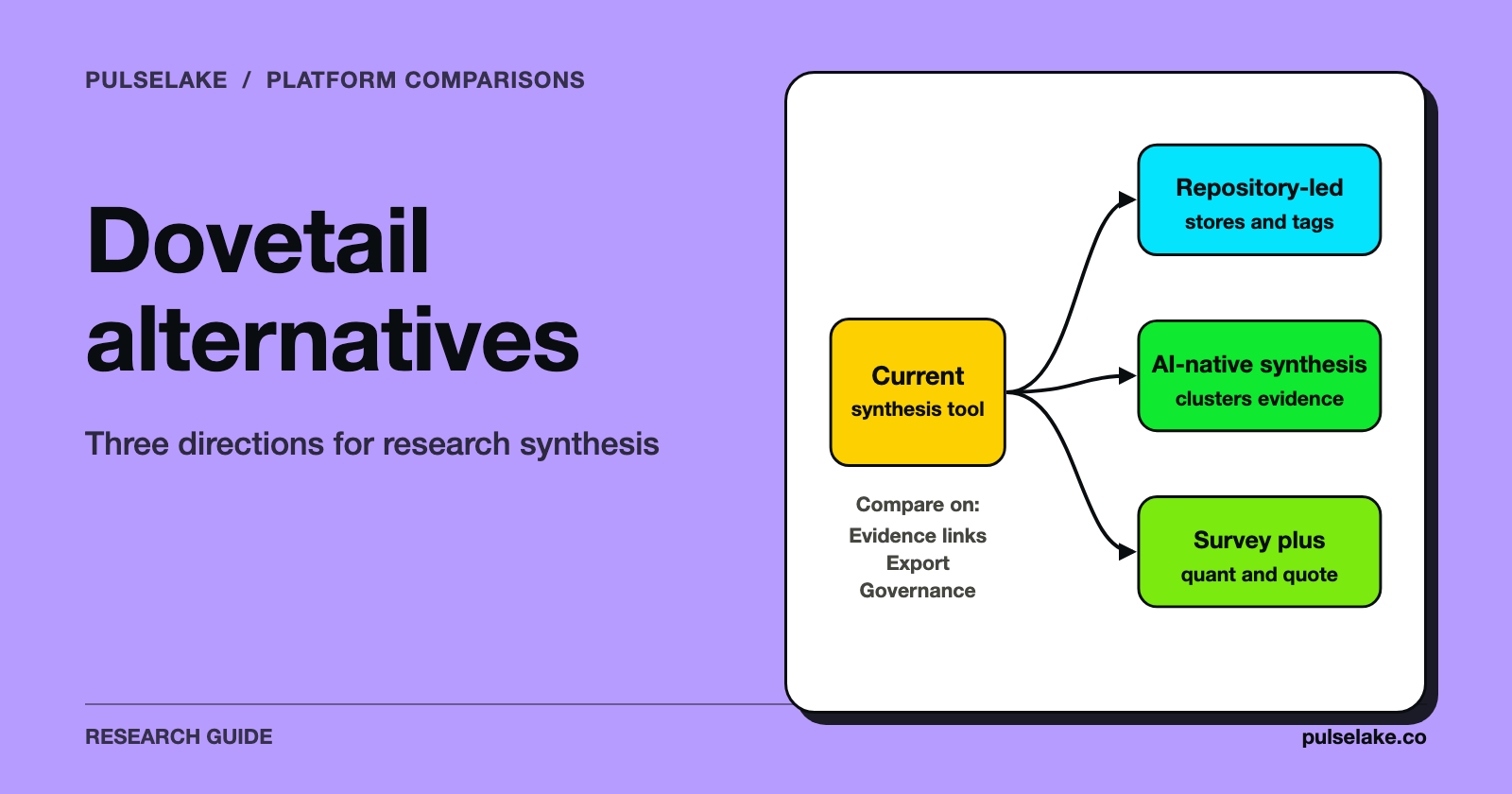
What should a Dovetail alternative do? Get researchers from source material to an interpretation they can defend, with the evidence still within reach. Condens, Marvin, Looppanel, Aurelius and other research workspaces deserve consideration, depending on how your team works. PulseLake is relevant when synthesis needs to connect with study planning, execution and reusable research context.
Producing a summary is the easy bit. Finding the right material, keeping its context and explaining why the evidence supports a recommendation: that's the hard part, so build your evaluation around it.

What should a research synthesis platform actually do?
Trace a recent research question backwards from the final slide. Can a colleague find the interviews behind the conclusion? Can they see who was studied, what was asked and which participants disagreed?
Those questions should be cheap to answer, and the platform should fit the way your team codes, reviews and shares material. A striking AI answer is worth a lot less when researchers can't correct the interpretation underneath it.
Dovetail describes itself as a customer intelligence platform. When you look at alternatives, then, decide which part of that role you actually need: qualitative analysis, a searchable repository, continuous feedback intelligence, or a wider research workflow.
Which Dovetail alternatives belong on the shortlist?
| Option | Best fit to investigate | What to inspect |
|---|---|---|
| Condens | Qualitative analysis and a research repository | Source links, coding and stakeholder sharing |
| Marvin | Customer-insight workflows | How source material becomes a reviewable finding |
| Looppanel | Research analysis and repository use | Interview handling and evidence retrieval |
| Aurelius | Research organisation and synthesis | Project structure and reuse across studies |
| Notably | A named research-synthesis candidate | Confirm current product availability and support directly |
| Notion | A general knowledge workspace | Research-specific controls and manual work required |
| PulseLake | Connected study context and research intelligence | Traceability across planning, analysis and reporting |
Product categories are mixed on that shortlist. A general workspace won't necessarily give you the same research-specific workflow as a dedicated tool, so don't assume it will.
How can you evaluate AI synthesis without a beauty contest?
Start with a small review set your team knows inside out. Put in one clear recurring issue, one minority view and one ambiguous statement, and leave one topic out of the material entirely. Every candidate gets the same questions.
Omissions count as much as wrong claims. A summary that nails the main theme but drops a minority concern with real consequences may be unfit for the decision, so ask the tool where each claim came from.
Now ask something the material can't answer. A useful system shows you the evidence gap. A confident paragraph about an audience nobody studied is a warning sign, however reasonable it sounds.
Finally, compare how much researcher effort each one takes: the work needed to correct categories, check sources and produce a finding you'd share. The finished, reviewed output is the payoff. How fast the first response arrives tells you very little.
Where does Aurelius fit?
If organising and reusing research sits at the centre of your requirement, Aurelius is a research-repository candidate worth examining.
The most telling demo is a cross-project question. Give the team a topic that shows up in several studies, each with different audiences and dates. Does the result keep those differences, or flatten them into one general claim?
Habits matter too. A tool can support consistent tagging and project structure, but somebody still has to maintain the definitions and decide which findings are still current.
What about Notably and Notion?
Notably shows up in research-synthesis shortlists. Confirm its current product availability and support directly before any buying decision; we haven't verified a current feature set here, so treat it as a research lead, not a scored recommendation.
Notion is a general workspace option. It can make sense when a team wants research to sit alongside other company knowledge, but your evaluation should name the research-specific work that stays manual or needs another tool.
How will you manage source recordings, participant permissions, evidence links and cross-study interpretation? A flexible page system can be useful without being equivalent to a dedicated qualitative-analysis environment.
How should Marvin and Looppanel be compared?
Both Marvin and Looppanel belong in a comparison of customer-insight and research-analysis workflows. Give them the same permitted source material and the same research question.
Have each one find a theme, pull the supporting passages and surface a counterexample. Then a researcher revises the theme. You'll soon see whether the workflow supports interpretation or just hands you a first draft.
Interview context is the next thing to look at. Someone talking about a hypothetical future feature, the "I'd probably use it if..." kind of comment, shouldn't quietly turn into evidence about current product use, and the analyst needs to see the surrounding conversation.
When is Condens worth evaluating?
Condens presents qualitative analysis and repository capabilities. Consider it when your team wants to organise evidence, work directly with source material and make findings easy for colleagues to reach.
Run it on a project with varied material: an interview, some field notes, a supporting document. A researcher creates a finding; a stakeholder traces it back. Both experiences count, because research loses most of its value when only the person who wrote it can find their way around.
Revisions need checking as well. If a researcher changes a finding after reviewing contradictory evidence, colleagues should see what changed. Nobody should be relying on a stale exported slide.
What should happen to the existing repository?
Export the source material together with the context needed to read it: study purpose, audience, dates, permissions, tags, and the links between evidence and findings. Does the export keep those relationships, or hand you a pile of loose files?
Be choosy about what migrates. Old findings can stay useful, but a stale assumption shouldn't become current just because it landed in a new tool, so give archived material an explicit status.
Sensitive research needs an access check after import. A repository migration shouldn't widen the audience for recordings or identifying details by accident. Test it as a researcher, as a stakeholder, and as someone without project access.
How should the final decision be made?
Choose against how your team actually does synthesis. A small group doing careful qualitative work may value different features from a large organisation answering recurring questions across many studies.
Get a commercial proposal covering the intended users, source volume, storage, AI usage and support, and raise exports and exit conditions while the supplier is still helping you evaluate. The conversation is easier then.
The winner should make the reasoning easier to inspect and reuse. If all it does is polish the prose, it has solved a small slice of the research problem.
Where does PulseLake fit?
PulseLake is a research operating system that connects study design and evidence collection with structured analysis, interpretation and reporting. Its research frameworks organise questions and measures into dimensions and sub-dimensions, which gives the evidence a shared meaning you can use beyond a single response or survey.
We think reusable research knowledge needs consistent concepts, not just searchable text. Because PulseLake organises questions and measures within frameworks, dimensions and sub-dimensions, analysis gets a structure people can review and reuse.
Picture a follow-up study. It can start from earlier evidence and the questions that are still open, instead of a detached summary. Calculation mode uses study data, and qualitative interpretation can keep its links to the supporting evidence.
Synthetic exploration and scenario simulation are supported too, which is useful for speed and early direction. If those outputs enter a synthesis workflow, keep them clearly separate from interviews and other observed evidence, and validate anything consequential with real respondents.
Frequently asked questions
Can a general workspace replace a research repository?
Sometimes, as long as your team can manage source context, permissions and evidence links well. Before going that way, list the manual work and the research-specific capabilities you'd be missing.
How should AI-generated themes be checked?
Read the supporting passages, the contradictory evidence and the category definitions. Use material your team already understands, and include questions the sources can't answer.
Should every old study be migrated?
Not automatically. Keep the records you're required to keep, but separate current evidence from archived or superseded findings. A migration is a good moment to sort out ownership and status.
What matters more than summary quality?
Traceability, context, permissions and the ability to revise interpretations. A fluent summary only helps when researchers can show it accurately represents the evidence.