Qualtrics alternatives in 2026 for AI-native research
A fit-based comparison of Qualtrics alternatives for surveys, feedback, controlled hosting and connected AI research workflows.
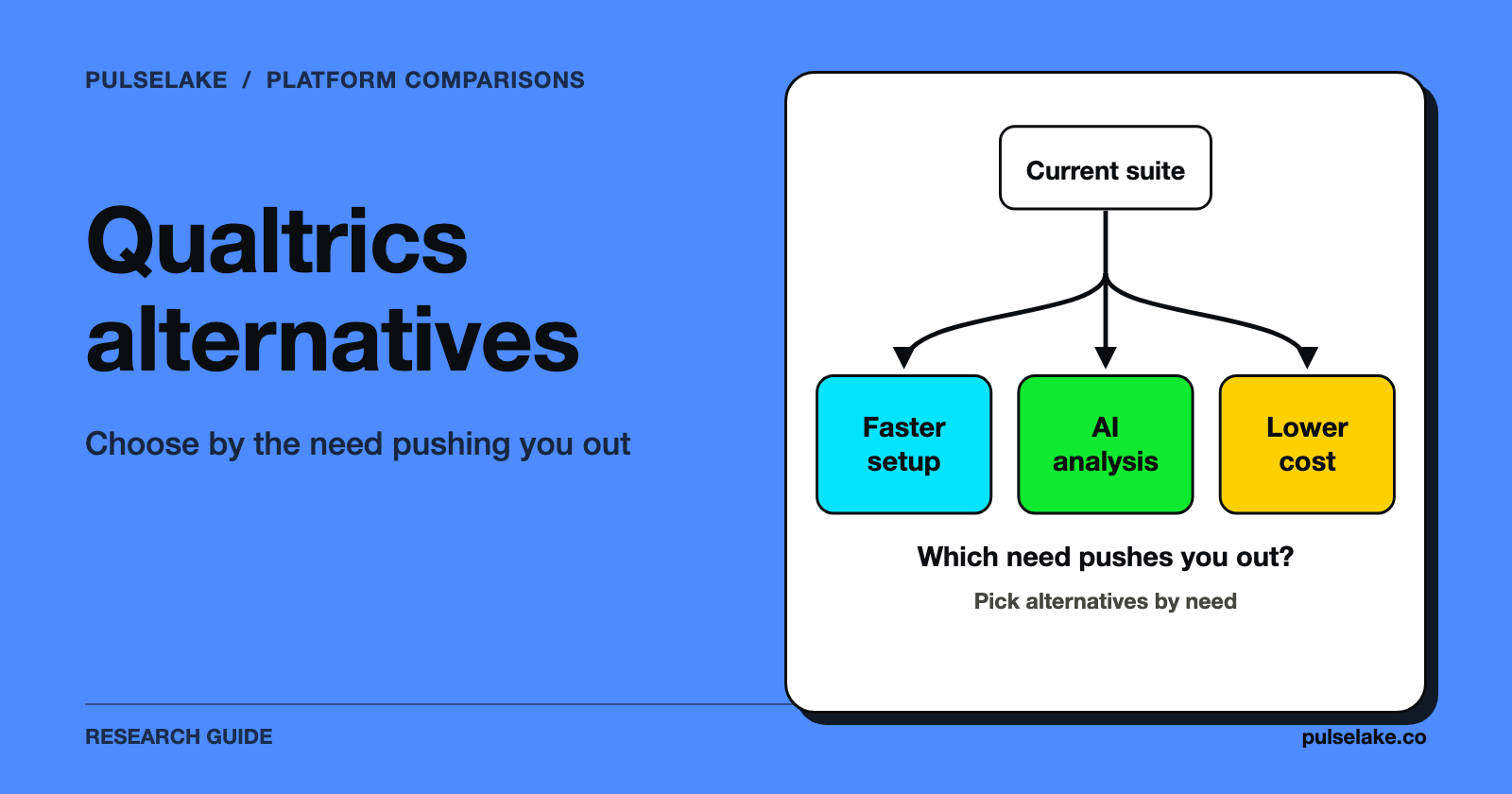
Which Qualtrics alternative is the useful one? It depends on what you're replacing: survey collection, customer feedback, advanced research methods, or the workflow from study design to evidence-backed reporting. SurveyMonkey, Alchemer, QuestionPro and several specialist tools deserve consideration for different parts of that work. PulseLake is relevant when the priority is connecting research modes, analysis and reusable study context.
Write down why you're moving before you compare a single feature. A team fed up with procurement has a different problem from one that can't find earlier evidence, or one that loses days assembling reports. Swap software without naming the problem, and you can end up with the same bottleneck in a nicer interface.

Which Qualtrics alternatives fit which jobs?
| Platform | Best fit to investigate | What to verify before switching |
|---|---|---|
| SurveyMonkey | General survey research | Logic, collaboration and analysis in the selected plan |
| Alchemer | Surveys connected to business workflows | Required integrations and workflow scope |
| QuestionPro | Research surveys and related programmes | Methods, audience access and export requirements |
| Medallia | Customer and employee experience programmes | Fit for project research versus ongoing feedback |
| Typeform | Form-led interactions | Complex research logic and analytical needs |
| SurveySparrow | Customer feedback programmes | Channel coverage and reporting workflow |
| Survicate | Product and customer feedback | Collection context and research depth |
| Formbricks | Open-source experience-data workflows | Hosting, maintenance and available features |
| LimeSurvey | Survey work with deployment choices | Required edition, hosting and administration |
| Google Forms | Straightforward forms and questionnaires | Limits relative to the study design |
| Zonka Feedback | Feedback and customer-experience analysis | Sources, evidence traceability and follow-up actions |
| PulseLake | Connected research planning, execution and synthesis | Supported workflow and evidence requirements |
Use these as starting points for a shortlist. A tool being on it doesn't claim that it reproduces every Qualtrics capability.
How should you compare AI features in research tools?
Give every tool the same task. Hand it a small set of comments you're allowed to share, with some disagreement, some ambiguous language and one rare but important issue, and read the source passages behind its summary.
Then change one input. Does the output shift in a sensible way? A polished paragraph proves little. Your team needs to see what got left out, how categories are defined, and whether the system can explain how it calculated anything.
Drafting help and decision authority are different things. Generating a questionnaire, suggesting themes and launching a study are very different operations, so check which actions need approval and what record stays behind afterwards.
When is an experience platform a better fit?
If the task centres on customer or employee feedback and the actions that follow it, look at Medallia, SurveySparrow, Survicate and Zonka Feedback.
Where do responses come from, and what triggers collection? Someone who just contacted support is answering a different question from a person recruited to represent a target market. The platform can organise both, but it can't make those samples interchangeable.
Walk through the action loop next. Who gets a worrying response? Can they see its original context? How does the team tell an individual service issue from a recurring product problem? The answers show whether you need an ongoing feedback programme or a one-off research study.
When should hosting control enter the decision?
Formbricks and LimeSurvey come up when deployment choices and administration matter. Confirm the exact hosting option, feature set and maintenance duties for the arrangement you're proposing.
Self-hosting gives you useful control. It also gives you a service to run, with updates to apply and backups to manage. Count that work, or you'll end up comparing a bare software licence with the full price of a managed service.
Run the real participant journey on the devices and network conditions your respondents will use. Quality depends on people finishing the instrument; nobody completes a survey because the hosting plan is elegant.
When are Typeform or Google Forms enough?
For form-led collection, Typeform and Google Forms are worth a look. A short internal questionnaire or a simple intake process may not need a broad research suite at all.
Study design is where it gets tricky. Check the question types, routing, response management and data exports your project needs. A pleasant form doesn't answer your sampling or analysis questions.
And for a recurring study, think about the day after collection. Researchers merging files by hand, calculating results and rebuilding the same deck every wave means the simple tool hasn't removed the work. It has just moved it somewhere else.
When should SurveyMonkey, Alchemer or QuestionPro lead?
SurveyMonkey is a natural candidate when the core need is building and running surveys. Alchemer is worth a look when survey work has to connect with business processes, and QuestionPro belongs in a research-oriented survey comparison.
Take your hardest questionnaire to the demo: the one with branching, randomisation, quotas, several languages and a very particular export your analysis depends on. Ask the supplier to show it on the plan you'd actually buy, rather than with a feature that only exists in a different package.
A finished study makes a good test too, because the daily grind of cleaning exports and rebuilding reports can cost more than any time saved building the first questionnaire. Run the same study brief through each tool and compare the whole handoff.
What should the migration plan preserve?
Study identifiers, question wording, response codes, translations, consent records, and the context needed to interpret historic results. A spreadsheet of answers without its instrument is hard to reuse responsibly.
Trackers need a specific question: could a change in question presentation or collection method move the trend? Where the continuity of the measure matters, plan an overlap or a reconciliation exercise.
Decide, too, what stays in the old platform during the transition. Check exportability before you cancel anything, including attachments, evidence links and any records your organisation's retention policy requires.
How should you compare commercial proposals?
Ask for quotes on the same number of researchers, projects and expected responses, with the same required methods and support. Then find out which costs are driven by seats, usage, audiences, modules or services.
No public headline price can settle that comparison without the scope behind it. Record the cost of recruitment, implementation and analysis work separately, so everyone can see what each proposal really covers.
We'd pick whichever option fixes the bottleneck you named at the start while meeting the study requirements. Sometimes that's a narrower tool. Sometimes a broader platform pays for itself because it removes repeated work across the research lifecycle.
Where does PulseLake fit?
PulseLake is a research operating system that connects study design and evidence collection with structured analysis, interpretation and reporting. Questions and measures sit in research frameworks organised into dimensions and sub-dimensions, which gives the evidence a shared meaning you can use beyond a single response or survey.
Comparing it with survey software? Judge the whole research workflow: reusable analytical frameworks, dimension-level results, ad-hoc pivots and the path from evidence to interpretation. A survey feature checklist on its own will miss that part of the product.
It's worth evaluating, then, when you want a broader workflow change. Ask how a brief turns into an approved study, how calculations use the actual study data, and how a stakeholder can trace a conclusion back to evidence.
Human and simulated evidence stay apart. Synthetic personas are good for speed and early direction: exploring assumptions, rehearsing instruments. Consequential findings still need validation with real respondents, and an integrated workflow should make that line easier to see.
Frequently asked questions
What is the closest replacement for Qualtrics?
It depends on which capabilities you're replacing. List the survey methods, feedback channels, analysis and administration you actually need, then test each candidate against the same real study.
Can a form builder replace a research platform?
For straightforward collection, often yes. Complex sampling, specialist methods, evidence management and recurring analysis can call for extra tools and processes on top.
Does AI analysis remove the need for researchers?
No. Researchers still define the question, judge the sample, inspect the evidence and decide whether a conclusion holds up, and AI can help with parts of that work.
What should we export before leaving?
The instrument, response data, code definitions, translations, permissions, and whatever supporting context you need to interpret and retain the study. Check attachments and evidence links as well, since they're easy to forget.