Kantar Alternatives: AI Interviews, Analysis & Reporting
PulseLake combines surveys, AI-led interviews with real participants, evidence analysis and automated reporting in one research operating system. If you are comparing it with Kantar Marketplace, evaluate the required methods, participant costs, analysis and delivery effort, and which historical data can move. The comparison below explains where each option fits; a specific savings estimate needs a comparable study scope.
Compare Kantar Marketplace alternatives by research method, audience access, study flexibility and implementation needs.
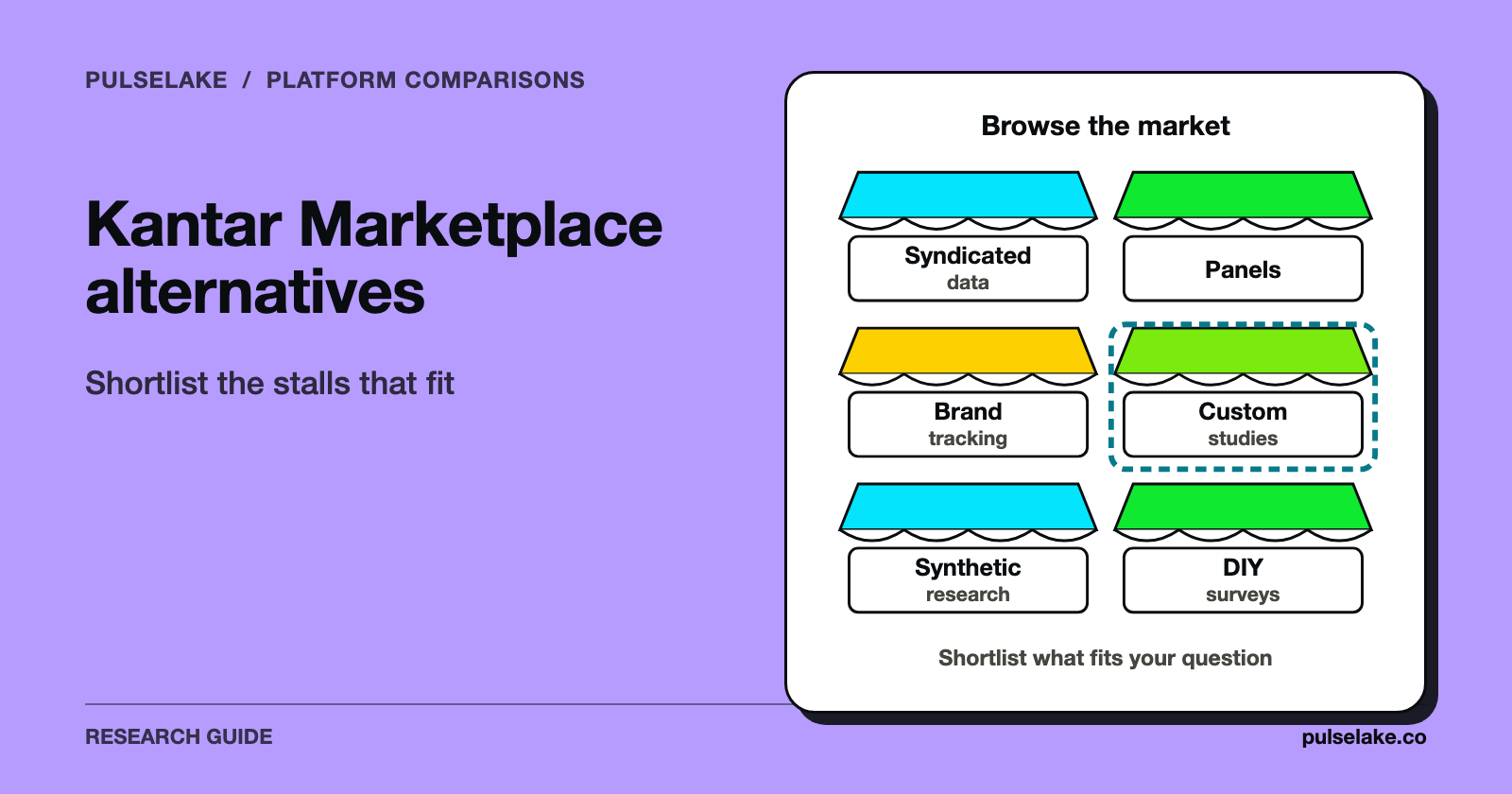
Looking for an alternative to Kantar Marketplace in 2026? This comparison covers Zappi, Qualtrics, Quantilope, Suzy, PulseLake, SurveyMonkey and Attest. Which option fits depends on the research task and workflow you need.
Disclosure: We make PulseLake, an AI-native operating system for market research. We have built this guide to objectively compare the structural differences between our approach and traditional agile research platforms.
Kantar's proprietary normative databases, such as the Meaningfully Different framework and LINK ad testing, are why plenty of enterprise brands lean hard on Kantar Marketplace. When teams start looking around, it's usually for one of three reasons. They want more methodological flexibility. They want AI that does more than basic text summarization. Or they'd rather not pay a premium for normative data they don't really use.
What follows: what each alternative does best, how it copes with complex research work, and how pricing models differ across the market.

Why are research teams seeking alternatives to Kantar Marketplace?
Kantar Marketplace offers automated market research built to deliver insights quickly, drawing mainly on Kantar's extensive historical benchmarks. For teams living inside the Kantar ecosystem, that works very well. Everyone else runs into structural limits.
Start with normative data. Kantar's value proposition is closely tied to its normative databases, so if your organization relies on custom benchmarks, unique brand metrics or experimental methods, paying for Kantar's proprietary frameworks may not pay back.
Then there's rigor against flexibility. Kantar provides rigorous, validated frameworks for ad testing and innovation, but the templates can be rigid. Researchers who want to heavily modify survey flows, add non-standard logic, or blend qualitative probing into automated quantitative studies often find template-based systems confining.
Third, the market has moved from "agile" to "AI-native." The last generation of research tools was about "agile" execution: making surveys faster to launch. Now platforms don't just run surveys. They use AI to conduct interviews, fold past studies into a continuous knowledge graph, and produce automated reporting, and teams that want those deeper AI capabilities often outgrow traditional automated platforms.
Last, cost predictability. Kantar Marketplace is positioned as a faster, more cost-effective option than full-service agency consulting. Even so, high-volume teams often want subscription models or platform-fee structures that push down the marginal cost of each extra study.
Kantar vs other tools: platform comparison overview
| Platform | Primary Differentiator | Core Target Audience | Best Used For |
|---|---|---|---|
| Kantar Marketplace | Validated normative frameworks | Enterprise CPG & Brands | Benchmark-driven ad and innovation testing |
| Zappi | Automated, expert-built templates | Global Insights Teams | High-volume, standardized concept testing |
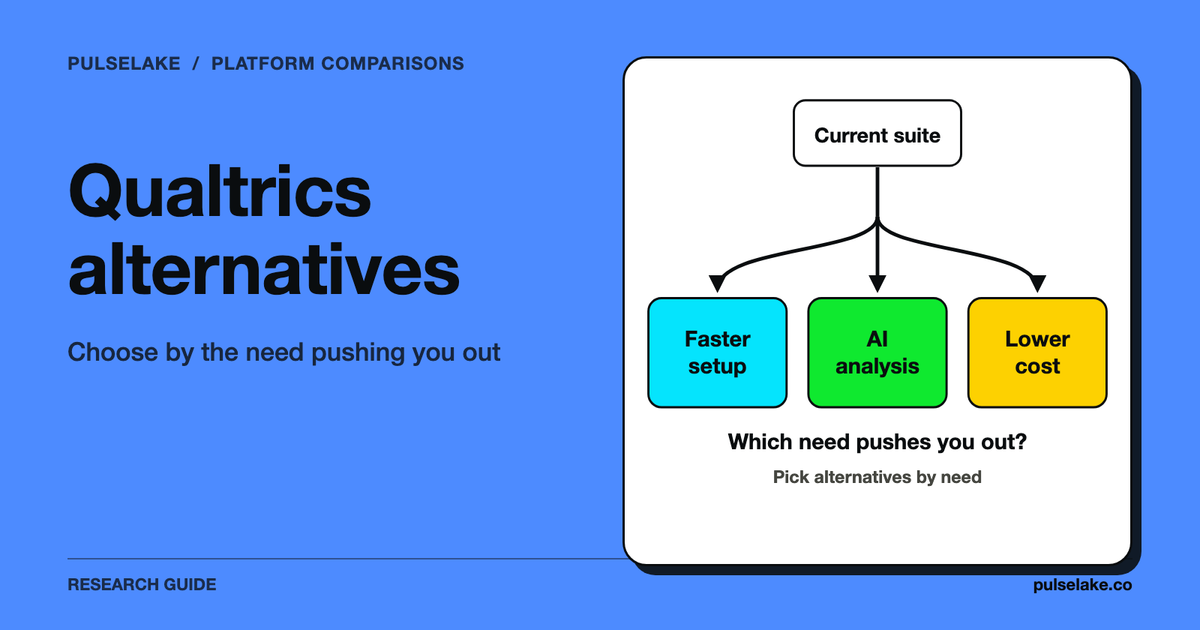
| Qualtrics | Deep customization and integrations | Enterprise IT/Insights | Complex, bespoke survey design and XM |
| Quantilope | Automated advanced quantitative math | Researchers & Marketers | In-house MaxDiff, Conjoint, and TURF |
| Suzy | Proprietary integrated consumer panel | B2C Marketing Teams | Rapid, iterative consumer pulse checks |
| PulseLake | AI-native OS with intelligence layer | Insight Teams & Agencies | Blending human/AI methods and knowledge retention |
What are the best Kantar alternatives?
Research technology platforms tend to sort by their core technical architecture. So ask yourself what matters most: survey customization, advanced statistical automation, proprietary panel access, or AI-driven intelligence?
Zappi
For Zappi, check whether the available research workflow fits the study you need to run.
Its core strength is speed and standardization. Zappi claims to cut the time from study creation to insight delivery to a matter of hours, and because the platform runs on standardized templates, data collected across regions or product lines stays highly comparable. Best fit: consumer brands that run lots of ad testing and early-stage concept testing questions and need a standardized, repeatable process across global teams.
For a bespoke study, ask Zappi to demonstrate the required question types, routing, permitted template changes and exports before choosing a plan.
Qualtrics (Strategy & Research)
Qualtrics is a massive enterprise experience management (XM) platform. Its Strategy & Research suite is for organizations that want complete control of the research process, from complex sample routing to custom dashboards.
Use a representative study to verify routing, conjoint requirements and integrations in the proposed Qualtrics plan. Check sample sourcing, permissions and exports rather than assuming every workflow is included.
Confirm the training, administration and implementation work required for the proposed Qualtrics configuration, and compare it against the same study scope on other platforms.
Quantilope
Quantilope positions itself as an Insights Automation Platform. What sets it apart is automating advanced quantitative methods that used to need specialist statisticians.
It makes advanced methods accessible: Quantilope automates the setup, execution and analysis of methods like MaxDiff and Conjoint analysis, Total Unduplicated Reach and Frequency (TURF), and implicit association testing. Best fit: mid-to-large insights teams that want to run sophisticated pricing and portfolio optimization studies in-house but don't have the budget for a dedicated marketing sciences team.
If you need adaptive conversational interviewing or cross-study knowledge retrieval, ask Quantilope to demonstrate those exact workflows in the proposed plan.
Suzy
Suzy pairs a continuous consumer research platform with its own proprietary, gamified panel, designed for fast, iterative feedback from a verified audience.
The core strength is integrated audience access. Suzy runs both the software and the panel, so you can retarget the same respondents for follow-up studies, which makes longitudinal tracking and quick quantitative-to-qualitative pivots possible. Best fit: B2C marketing and product teams that need continuous pulse checks on consumer sentiment and like having one vendor for software and sample.
Need very niche B2B audiences, medical professionals, or international respondents outside Suzy's core panel footprint? You may not get the platform's main benefit.
PulseLake (Our Platform)
PulseLake is an AI-native operating system for market research and insight professionals. It doesn't stop at helping you run one agile survey; it runs the whole research system around it.
The core strength is a unified persistent study context. PulseLake combines traditional research (surveys, assessments) with AI-led interviews, where conversational agents follow a protocol to run adaptive interviews with real participants. It links the execution layer (running research) with an intelligence layer: a research knowledge graph that lets users ask natural-language questions computed against historical study data, with evidence provenance. Best fit: internal insights teams, market research firms and consulting practices that want to blend human and AI-native research, automate repetitive reporting, and keep institutional knowledge across studies.
Limitations: PulseLake is an enterprise operating system built to manage complex, multi-modal research systems. If all you want is a single, isolated ad-testing tool with no broader intelligence layer, a narrower point solution may be quicker to set up.
SurveyMonkey: survey-led research
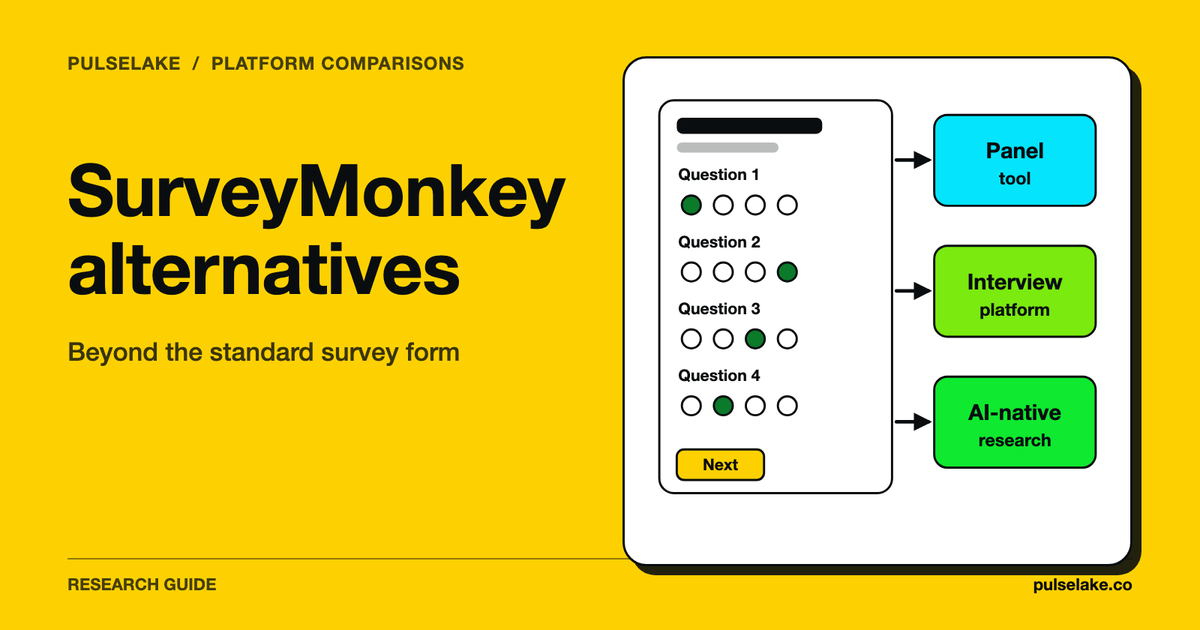
SurveyMonkey is another candidate when the requirement is mostly about surveys. Check the selected plan, audience sourcing and analysis workflow against the study you have in mind.
Attest: consumer research
Attest belongs on a consumer-research shortlist. Confirm audience coverage, study design and commercial scope directly, and don't assume it matches Kantar's methods or benchmarks.
How do these alternatives handle research delivery and reporting?
Research only pays off once someone can act on it, and platforms take very different routes to get there.
Compare the available templates, permitted question and routing changes, reporting setup and delivery times in the proposed Zappi or Kantar plan. Ask each supplier to demonstrate the same representative study rather than assuming either inputs are locked or reporting requires no setup.
Qualtrics and Quantilope offer highly customizable dashboard suites, where researchers can build cross-tabulations, run significance tests on the fly and make custom charts. The trade-off: manual setup time for each new study.
PulseLake treats the study context as part of a persistent intelligence layer. Beyond exporting a dashboard, researchers can deploy specialized AI agents for reporting and client Q&A. The delivery layer includes automated PowerPoint generation, client portals, and a calculation mode that computes answers against study data instead of simply generating text. Downstream users can then question the data safely, while researchers keep judgment and approval controls.
How do pricing models compare?
To understand how much market research costs on these platforms, separate software fees from sample fees. Four models turn up.
Pay-per-study: platforms like Kantar Marketplace often let you pay purely per study, and the cost is usually bundled: platform access, the standardized template, and the audience sample needed to complete the study.
Platform fee plus sample (unbundled): enterprise platforms like Qualtrics charge an annual software licence fee based on user seats or data volume. You then source and pay for sample separately, through external panel providers or the vendor's panel services team.
Subscriptions: platforms like Zappi and Quantilope generally run on annual subscriptions. They may include a base level of sample or require you to buy sample as an add-on, but software access is treated as an annual recurring cost.
Capacity and compute: AI-native platforms bring new cost structures. Running conversational AI interviews or deep research agents takes computing power, so pricing often includes capacity usage alongside standard software access and traditional human sample costs.
Note: Vendor pricing is subject to custom enterprise negotiations. Always request a detailed scoping call to understand the total cost of ownership, including onboarding, custom integrations, and anticipated sample spend.
How PulseLake connects evidence to analysis
PulseLake is a research operating system that links study design and evidence collection with structured analysis, interpretation and reporting. Its research frameworks organise questions and measures into dimensions and sub-dimensions. That structure gives the evidence a shared meaning, so it can be analysed beyond any single response or survey.
Its analytical layer ties framework dimensions and measures to study-specific results, pivots and reporting. Weigh that alongside study execution when you're comparing a reusable research system with a service for one particular test.
Frequently Asked Questions
Can I migrate my historical Kantar data to another platform?
Ask Kantar which raw response data, formats, metadata and usage rights your study agreement allows you to export, and test a representative export before planning migration. Confirm separately whether any licensed normative benchmarks can be reused; check response-data export rights and normative-benchmark rights under your agreement.
How do alternative platforms handle qualitative research?
Qualitative coverage varies by platform. Check the methods, participant interaction, follow-up and evidence exports against your study design rather than assuming every alternative has the same scope.
Are synthetic respondents a reliable alternative to human panels?
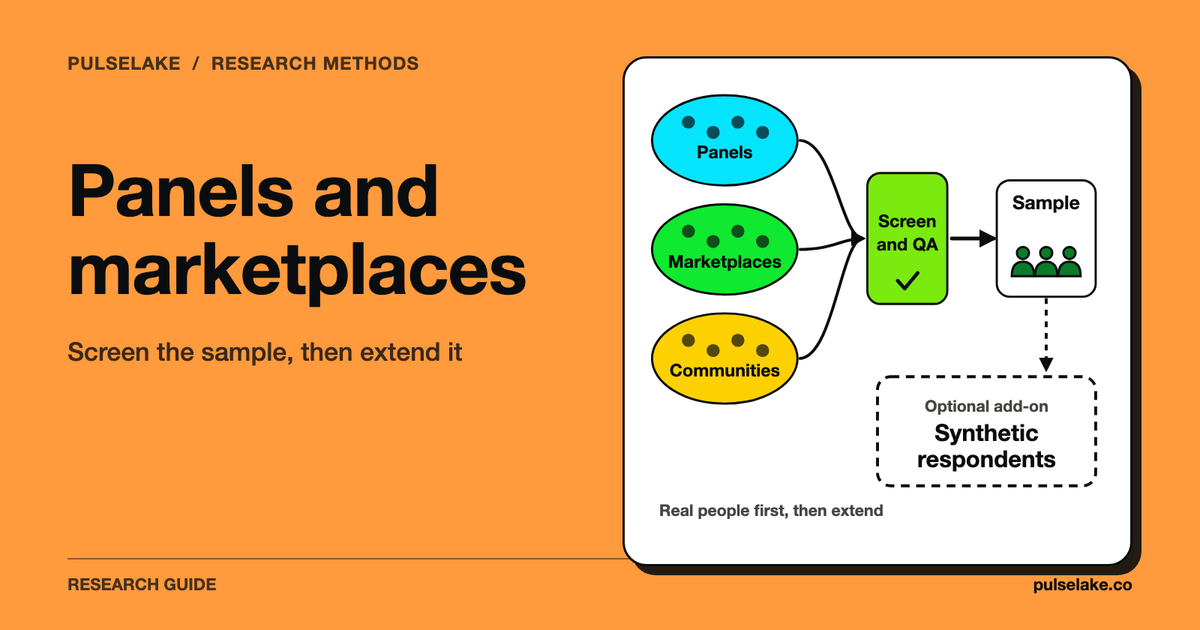
Not as a guaranteed replacement. Synthetic research uses explicit, versioned synthetic personas for testing instruments, concepts and hypotheses, and it can quickly pressure-test a survey design or simulate early hypothesis outcomes from prior data. Platforms offering synthetic data, PulseLake included, strongly recommend keeping a clear path into human validation for final decisions.
Do these tools require an in-house statistician?
Requirements depend on the study design and decisions. Ask a qualified researcher to review the method, assumptions, sample and interpretation. Automated calculations do not establish that a method is appropriate.