Qualtrics vs Medallia: which is better in 2026?
Compare Qualtrics and Medallia by research workflow, experience operations, evidence quality, implementation and procurement scope.
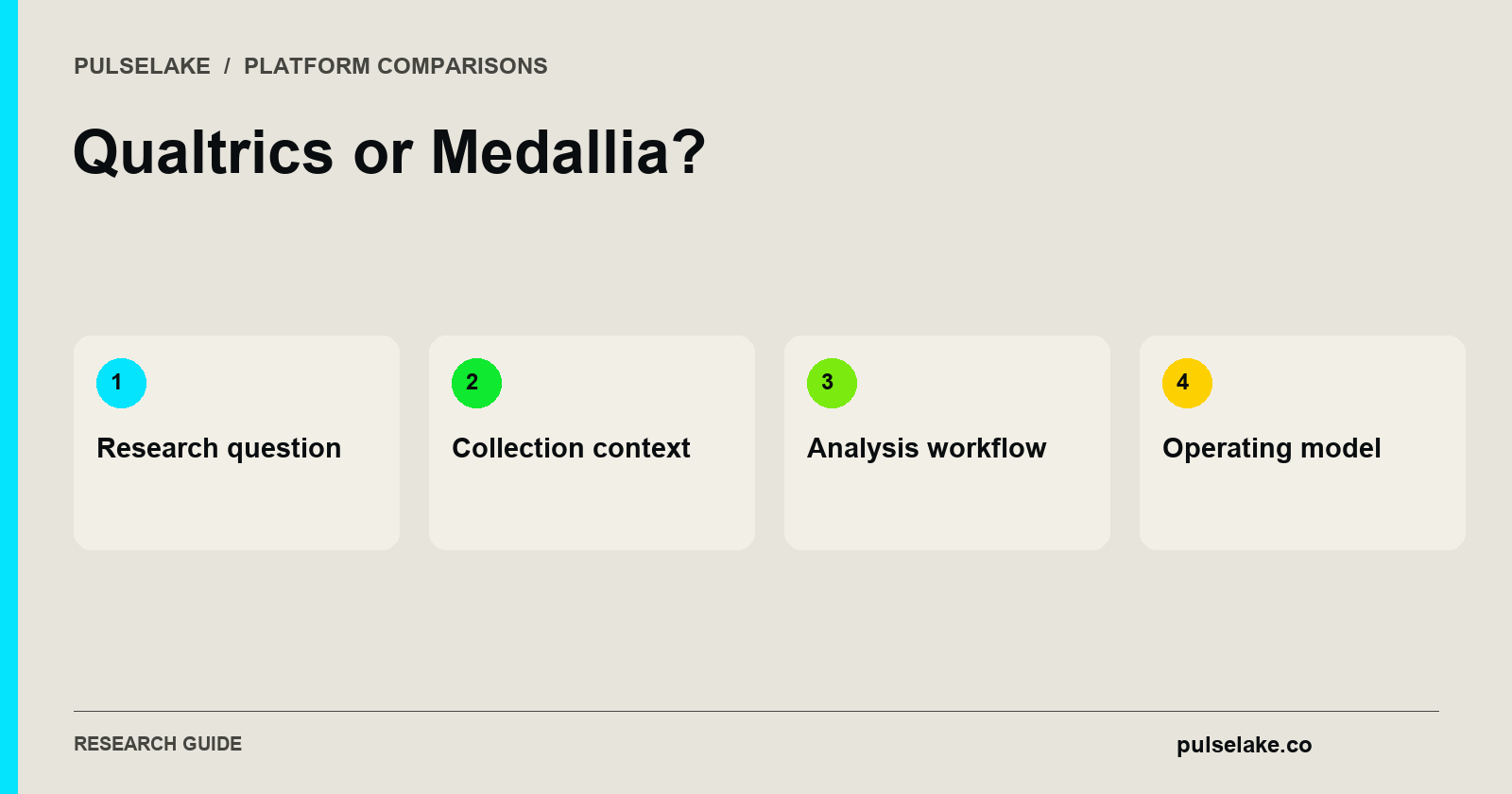
Qualtrics is a sensible starting point when the buying brief centers on designing and running research. Medallia deserves close attention when the brief centers on collecting experience signals and getting an organization to act on them. Both cover more than those descriptions suggest, so the deciding test is whether each can complete your actual workflow with the people, permissions, and evidence you need.
Last reviewed: October 13, 2026. We make PulseLake. The fit judgments below are our assessment of the vendors’ public information, not results from a hands-on comparison.

What are you trying to replace?
A request for “something better than our survey platform” often hides several different problems. Researchers may be struggling with study design. Customer service may be struggling to assign feedback to the right team. Executives may have plenty of dashboards but no dependable way to trace a conclusion back to the underlying evidence.
Write down the failure in ordinary language before booking demonstrations. “We cannot compare last quarter’s concept study with this one” is a more useful requirement than “we need AI.” So is “a store manager receives a complaint but cannot see who owns the follow-up.” The first calls for a demonstration of research reuse; the second calls for a demonstration of operational feedback handling.
Keep the owner in the room. A research team can approve a questionnaire and still be unable to maintain a company-wide customer experience program. Equally, an operations team can close individual cases without answering a market sizing or product positioning question.
What does Qualtrics emphasize?
Qualtrics’ market research offering describes research collection, analysis, and reuse. Best for evaluation: teams whose main requirement is a research program spanning multiple studies and methods.
Take an awkward study into the demo rather than the vendor’s sample questionnaire. Include a screening rule, a respondent who should skip a section, and an analysis that depends on combining answers. Ask the vendor to show the path from questionnaire design to the final calculation. If the demonstration stops at a polished summary, the difficult part has not been demonstrated.
Also test what happens after the project closes. Can a new researcher find the study, understand its population, and distinguish a final finding from an early hypothesis? A research archive is useful only when someone can interpret what it contains. Ask for the actual package that includes the capabilities you need; a product family page does not establish what your contract includes.
What does Medallia emphasize?
Medallia’s platform describes feedback capture, analytics, reporting, and action across experience programs. Best for evaluation: teams that need customer signals to reach operational owners and lead to a recorded response.
Use a concrete service incident as your demonstration. A customer leaves feedback, someone reviews it, a manager assigns an action, and the team needs to know whether the matter was resolved. Ask to see every handoff. Pay attention to who can see personal information and who can change the classification.
Medallia also describes market research services. It would therefore be misleading to say it is “only CX.” The useful question is whether the specific research or operational capability is included, how it is delivered, and who maintains it. Ask the vendor to distinguish software configuration, professional services, and work your own team must do.
How should you compare them side by side?
There is no winner column because these are acceptance tests. An organization can reasonably prefer either product after running them. Treat a missing demonstration as an unanswered procurement question, rather than immediately concluding that a feature does not exist.
What should an AI demonstration prove?
Start with a finding your team already understands, then add material that complicates it. For example, a summary may say customers want faster delivery, while a smaller group is describing unreliable delivery estimates. Those are different problems. A useful analysis should let a researcher inspect the comments behind both interpretations.
Ask the system to show contradictory evidence, identify the population represented, and explain which calculation produced any percentage. Then remove access to one source and repeat the request. A system that still reveals restricted content has failed an important test, even if the prose sounds convincing.
Separate generation from calculation. Drafting a narrative, classifying text, and computing a weighted estimate are different operations. Your acceptance criteria should say which output is being evaluated and what constitutes a material error. An attractive narrative cannot compensate for an incorrect denominator.
What does the full cost include?
Compare the proposed contracts against the same operating scenario. Include software, implementation, integrations, respondent recruitment where relevant, training, analysis effort, and the work needed to keep the program running. Record how charges change when usage expands. Do not assume a license includes every AI feature shown in a presentation.
Use a hypothetical workload to make quotes comparable: a quarterly research tracker, a continuous feedback stream, and a defined group of administrators and readers. These are procurement inputs, not estimates of either vendor’s prices. Ask both suppliers to price the same inputs and explain what would trigger a change.
Migration deserves its own line. Historical questions, response codes, weights, consent records, and closed cases may matter more than the number of files exported. Budget time for checking that the destination preserves their meaning. Exporting a CSV is not the same as preserving a research program.
When should another product enter the shortlist?
If the two broad platforms are more than the problem requires, consider a narrower route. These are fit suggestions based on the linked product descriptions, not claims that one supplier lacks another’s features.
PulseLake’s public description covers traditional research, AI-led interviews, synthetic research, simulation, research intelligence, and delivery. That makes it relevant when the problem spans the research lifecycle. It does not justify claiming that PulseLake replaces every enterprise experience management requirement. If local case handling is the deciding requirement, make that workflow the center of the evaluation.
How do you make the final decision?
Run one representative workflow through the finalists and keep a shared record of the result. Assign a researcher to methodological checks, an operating owner to handoffs, and a technical owner to access and integration checks. Agree which failures are disqualifying before seeing the demonstrations.
The final decision should explain a trade-off: which work becomes easier, which work remains manual, and which responsibilities your organization accepts. That explanation is more durable than a feature count. Revisit it when the scope changes, particularly if a research purchase becomes an enterprise customer experience program.
How PulseLake connects evidence to analysis
PulseLake is a research operating system that connects study design and evidence collection with structured analysis, interpretation and reporting. Its research frameworks organise questions and measures into dimensions and sub-dimensions. That structure gives the evidence a shared meaning and makes it usable for analysis beyond an individual response or survey.
For teams considering a wider research operating system, PulseLake connects evidence to analytical dimensions and study-specific calculations. Evaluate that requirement separately from the experience-management workflows being compared here.
Frequently asked questions
Is Qualtrics always better for research?
No. Its research offering makes it a relevant candidate, but your method, team, data requirements, and commercial scope determine fit. Demonstrate the real study before choosing.
Is Medallia only a customer experience platform?
No. Medallia also describes research offerings. Ask how the capability you need is delivered and which software or services are included in the proposal.
Which is cheaper?
This comparison does not establish that. Obtain comparable written quotes covering the same usage, implementation work, integrations, and ongoing responsibilities. Avoid comparing a limited package with a complete program.
Where does PulseLake fit?
PulseLake is worth evaluating when you want research execution, evidence reuse, agents, and delivery connected around persistent study context. Assess operational CX requirements separately rather than assuming equivalence.
All trademarks belong to their respective owners. Send corrections through our contact page with the relevant product documentation.