
Consumer insights without an agency: comparing cost, time and responsibilities
Compare the responsibilities, cost drivers and trade-offs of running consumer insights internally or working with a research agency.
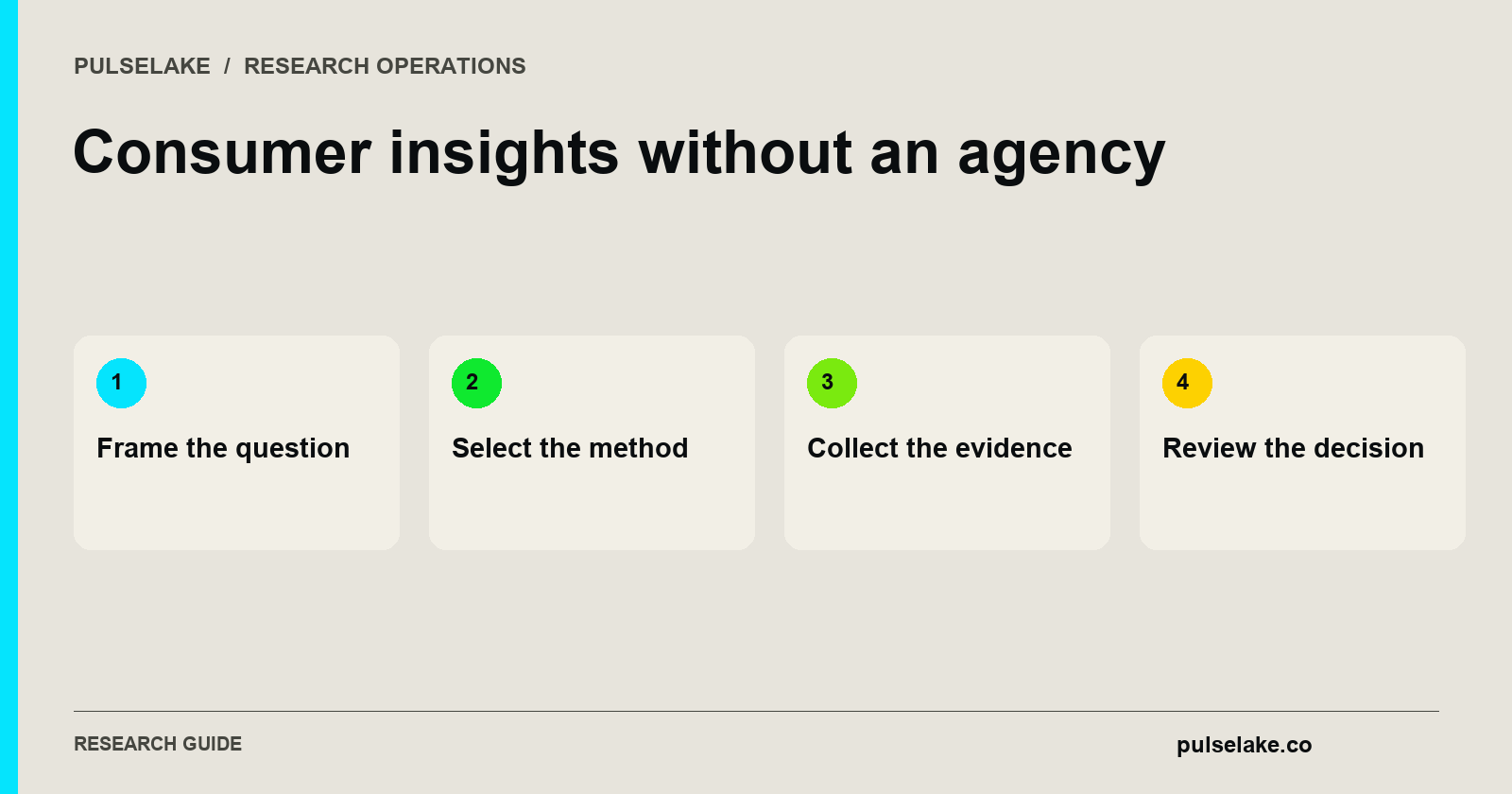
Consumer insights can be gathered without an agency when the internal team can design the study, recruit an appropriate audience and interpret the evidence. Compare software, recruitment and staff effort together. The fastest useful route depends on the decision and the evidence already available.
Disclosure: We make PulseLake. This comparison reflects our assessment, quotes third-party agency benchmarks, and links to each vendor's public documentation.

What determines research cost and turnaround?
Cost depends on the audience, recruitment difficulty, instrument, fieldwork and analysis. An agency quote can include design and delivery work that a software subscription leaves with the internal team. Compare the same scope before treating a price difference as a saving.
Request current quotations for the intended study. There is no universal delivery time or agency price that applies to all of these routes.
Which tools replace agency work in 2026?
Five platforms cover core self-serve and behavioral workflows—Reddit, Hotjar (Contentsquare), Pollfish, SurveyMonkey, and Qualtrics—alongside AI-native research platforms Listen Labs and PulseLake.
How do the top self-serve and AI research options compare?
1. Reddit and Reddit Pro: For exploratory community listening
Reddit for Business documents over 100,000 active communities where users discuss product recommendations and frustrations. Through Reddit Pro, brands track keywords, monitor trending conversations, and identify relevant subreddits at no software cost.
- Fit & limits: Ideal for day-one exploratory discovery and natural buyer vocabulary. However, you cannot verify anonymous posters, enforce demographic quotas, or run structured pricing models.
2. Hotjar (now part of Contentsquare): Best for observing digital behavior
Per Hotjar's official site, Hotjar merged into the Contentsquare Group on July 1, 2025, combining Heatmaps, Session Replay, and Funnels with Voice of Customer surveys and usability testing across Free, Growth, Pro, and Enterprise plans.
- Fit & limits: Built for continuous product and website discovery with existing digital traffic. It cannot recruit prospective buyers from competitors or run off-site category sizing.
3. Pollfish: Best for pay-per-response quantitative surveys
Pollfish's documentation lists a free account tier with an AI survey builder, 16 question types, and pay-per-response access to 250M+ consumers across 160+ countries via parent company Prodege. It supports screening, quotas, and built-in Van Westendorp, Gabor-Granger, Monadic, MaxDiff, and Conjoint methods with real-time cost estimates.
- Fit & limits: Strong for rapid quantitative concept and price testing. Teams needing adaptive qualitative interviews or cross-study knowledge graphs require a multi-mode system.
4. SurveyMonkey and SurveyMonkey Audience: Best for template-driven surveys
SurveyMonkey offers 400+ survey templates, AI-assisted creation, and SurveyMonkey LaunchPad for guided Van Westendorp and concept testing. Via SurveyMonkey Audience, buyers purchase targeted responses across 130+ countries per response.
- Fit & limits: Suits teams already using SurveyMonkey that want fast panel responses. SurveyMonkey Audience is unavailable if account data is stored in its European Data Center, and costs rise with survey length and custom screeners.
5. Qualtrics: Best for enterprise-wide CX and research standardization
Qualtrics positions its Strategy & Research suite (Research Hub) for enterprises combining quantitative surveys, automated Conjoint and MaxDiff, customer communities, human panels across 200+ markets, and synthetic panels.
- Fit & limits: Built for large enterprises wanting advanced statistical modules and governance under one contract. Custom enterprise quotes (and Account Executive involvement for synthetic credits) make it heavier for lean self-serve teams.
6. Listen Labs: Best for high-volume AI-moderated video interviews
Listen Labs recruits participants, conducts parallel AI-moderated text, voice, and video interviews, and generates automated slide decks and video highlight reels.
- Fit & limits: Built for teams scaling qualitative consumer interviews and stakeholder video reels. Public pricing is not verified on its site, and it focuses on interview execution rather than combining synthetic population simulation, reusable maturity assessments, and calculation-verified intelligence graphs.
7. PulseLake: Where our platform fits—and when to choose something else
Most DIY tools field a single survey or interview batch but leave findings in disconnected exports. PulseLake is an AI-native operating system for market research that runs four connected modes inside one persistent study context:
- Traditional research: Surveys, qualitative studies, maturity assessments, and panels.
- AI-led interviews: Conversational and avatar-based AI interviewers that probe adaptively with real participants.
- Synthetic research: Explicit, versioned synthetic personas for pre-testing instruments and hypotheses before human validation.
- Simulation: Scenario models grounded in prior evidence and explicit assumptions.
Every study feeds PulseLake's research knowledge graph, evidence lineage, cross-study search, and calculation mode (computing answers against study data rather than generating them), supported by specialized AI agents with human review. Note that public MCP documentation and platform pricing tiers for PulseLake are not verified in our supplied product documentation.
- Who should choose differently: Choose a traditional agency for physical sensory/taste testing, in-store ethnography, or regulatory/M&A sign-off. Choose Hotjar for website heatmaps, or Reddit Pro for $0 social listening. Choose PulseLake if you want human and AI-native research that compounds in a searchable intelligence system (explore free calculators or create a workspace).
Practical guide: How to organise a focused self-serve study
Instead of relying on a single DIY survey—which shows what people clicked but rarely why—this five-day workflow pairs zero-dollar discovery and synthetic pre-testing with human qualitative and quantitative evidence.
- Day 1: Frame the decision and mine organic conversations ($0). Define the exact decision your study must inform. Spend two hours checking support tickets and Reddit Pro to capture natural buyer phrasing and draft three core hypotheses.
- Day 2: Stress-test instruments with synthetic personas. Launching a flawed survey on a paid panel means paying for sample twice (QuestionPro). Run your draft questionnaire and concepts against versioned synthetic personas to catch double-barreled questions and scale ceiling effects (How accurate are synthetic respondents?).
- Day 3: Run parallel AI-led interviews with real participants. Deploy an AI interview protocol to 15–25 real consumers to probe adaptively and capture timestamped verbatim quotes and objections overnight (Listen Labs, October 2026).
- Day 4: Quantify prevalence with a targeted self-serve survey. Field a 10-minute survey to 200–400 panelists matching your screener. At a 95% confidence level (50% finding), 385 completes yields roughly ±5% margin of error, while 196 yields ±7% (How much does market research cost?).
- Day 5: Synthesize into a persistent knowledge system. Link transcripts, survey tables, and calculations to their underlying evidence lineage so future studies build on your findings.
How PulseLake connects evidence to analysis
PulseLake is a research operating system that connects study design and evidence collection with structured analysis, interpretation and reporting. Its research frameworks organise questions and measures into dimensions and sub-dimensions. That structure gives the evidence a shared meaning and makes it usable for analysis beyond an individual response or survey.
Running research internally includes owning the analytical framework. PulseLake connects that framework to dimension-level results, filtering, pivots and reporting, so the work continues after collection finishes.
Frequently asked questions
Is self-serve research always faster?
No. Internal review, recruitment and analysis can still take substantial time. Compare the actual study scope and available skills rather than a universal turnaround claim.
Can you get meaningful consumer insights with a $0 budget?
Yes, for exploratory and secondary research. Public federal data, free Small Business Development Center (SBDC) advising, organic trend tracking in Reddit Pro, and free-tier website session replays or heatmaps cost $0. However, once you need primary data from a verified demographic quota outside your existing website traffic, you must pay participant incentives or panel per-response fees.
What does an agency quote usually need to explain?
Ask which design, recruitment, fieldwork, analysis and delivery responsibilities are included. Compare those responsibilities with the work your team would perform in a self-serve arrangement.
When should you still hire a full-service research agency instead of going DIY?
Hire a full-service agency when your study requires physical presence (such as in-home ethnography, taste tests, or tactile packaging clinics), complex multi-country cultural calibration across a dozen markets, or an independent third-party brand name on a report for M&A due diligence or regulatory proceedings.
How do synthetic personas fit into a low-budget consumer insights workflow?
Synthetic personas work best at the start of a project to stress-test survey instruments, spot ambiguous wording, and explore early hypotheses in minutes before you spend budget recruiting human participants. High-stakes product, pricing, or positioning decisions should still be validated with real human respondents.