Best AI survey tools with automated analysis in 2026
Compare AI survey tools by evidence traceability, automated analysis, calculation transparency and researcher control.
The most useful AI survey tool makes the path from a response to a finding easy to inspect. SurveyMonkey, Qualtrics, SurveySparrow, Sprig, quantilope and PulseLake are candidates for different survey workflows, while Thematic is relevant when analysing existing feedback is the main need. Compare their treatment of evidence, calculations and researcher review rather than the polish of a generated summary.
A survey report can be readable and still misleading. It may use the wrong denominator, overlook a small but important group or combine comments that describe different problems. An evaluation should deliberately look for those failures.

What does automated analysis include?
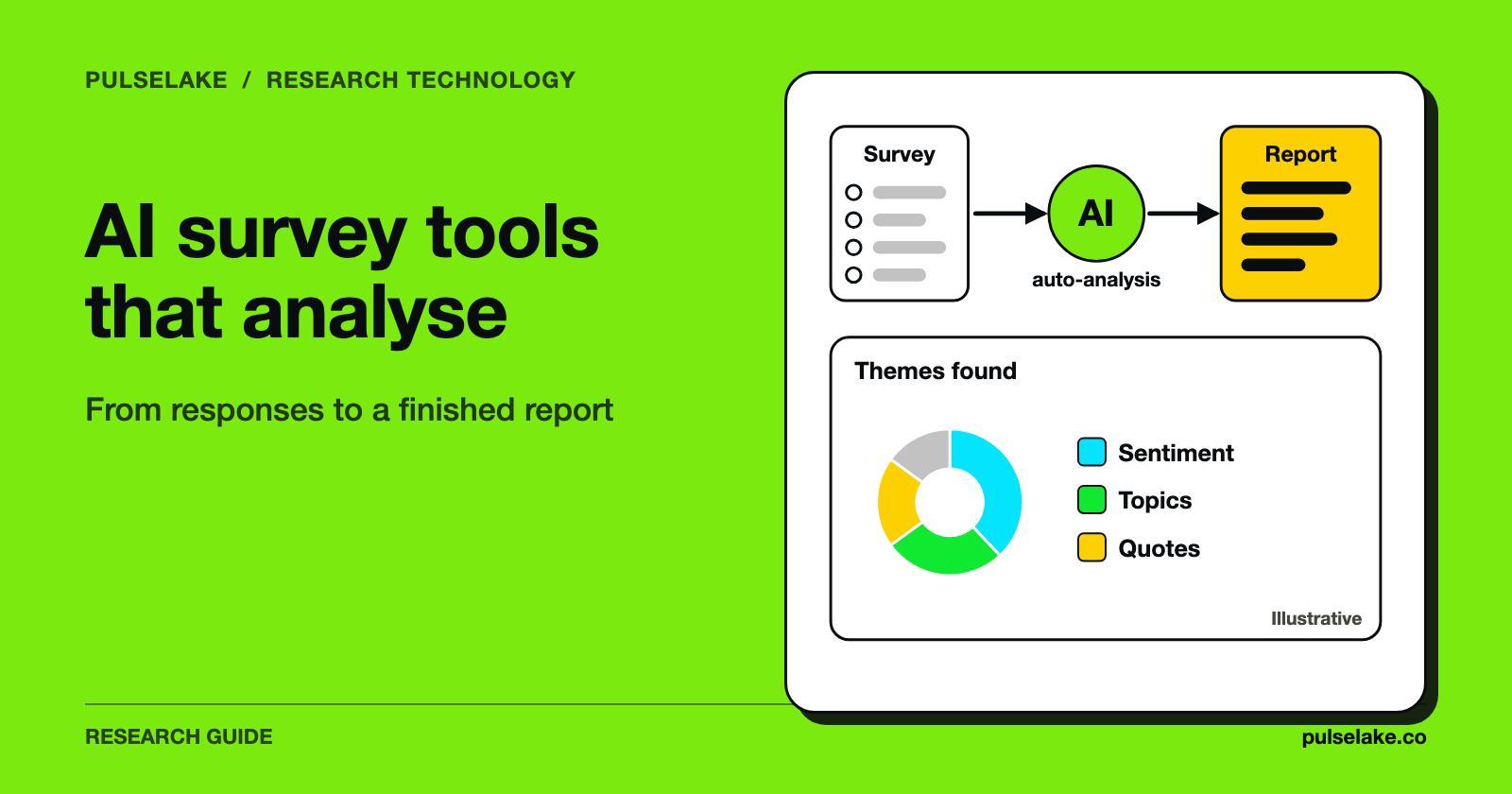
The label can cover several operations: summarising comments, suggesting themes, classifying sentiment, calculating results or drafting a report. Ask which operation the product actually performs and which inputs it uses.
A summary of selected comments is different from a calculation over all responses. A suggested theme is different from an approved coding scheme. A report draft is different from a reviewed conclusion.
Keep these distinctions in the workflow. Researchers should be able to inspect the source records and correct the interpretation without losing the connection between the finding and its evidence.
Which tools should you compare?
| Tool | Best fit to investigate | Analysis question to ask |
|---|---|---|
| SurveyMonkey | Survey collection and reporting | Which AI functions apply to the selected plan and data? |
| Qualtrics | Broad research and experience programmes | How are text analysis and quantitative results reviewed? |
| SurveySparrow | Customer-feedback workflows | Can themes be traced to the collection context? |
| Sprig | Product and enterprise survey workflows | How does the analysis connect to the product question? |
| quantilope | Automated quantitative research | Which method produces each reported result? |
| Thematic | Analysis of existing customer feedback | Can the team inspect and maintain the taxonomy? |
| PulseLake | Connected studies, calculation and synthesis | Can stakeholders follow findings back to study evidence? |
None of these categories removes the need to assess the sample or the instrument. Analysis begins with the quality and relevance of the collected data.
How should SurveyMonkey and Qualtrics be assessed?
SurveyMonkey and Qualtrics belong in a comparison where survey collection and analysis need to work together.
Use a completed study, not only a blank questionnaire. Ask the supplier to show how it handles incomplete records, multiple-response questions and comments containing mixed sentiment. Identify which outputs are calculations and which are generated interpretations.
Inspect the export as well. Analysts may need to reproduce a result outside the platform or combine it with another dataset. The exported values and definitions should make that possible without guessing.
When should SurveySparrow or Sprig be shortlisted?
SurveySparrow is relevant to customer-feedback programmes, while Sprig presents an enterprise survey platform with AI agents. Evaluate the connection between collection context and the analysis question.
For a product workflow, timing can change the meaning of feedback. A response collected immediately after an error is different from a general assessment by a long-term user. The analysis should preserve that context.
Ask how the team can compare groups without accidentally treating unlike samples as equivalent. A useful dashboard should help the researcher see who responded and under what conditions.
When is quantilope appropriate?
quantilope describes automated quantitative methods and an AI research partner. It is worth considering when the decision calls for a structured method rather than a general summary of comments.
The evaluation should begin with the method's assumptions. Ask what the researcher must specify, how the sample is obtained and how the result should be interpreted. Automation can make a method easier to execute without making it suitable for every question.
Review the report with a researcher who understands the design. The business recommendation should stay within what the study can establish, even when the software offers a confident narrative.
When does Thematic belong in the shortlist?
Thematic is relevant when the main problem is analysing customer feedback already collected across sources. Treat that as a different starting point from selecting a questionnaire builder.
Bring comments from different channels and ask how the analysis handles their context. A support ticket and a survey response can describe the same issue but arise from different selection processes.
Inspect how themes are defined, changed and compared over time. If a taxonomy changes, analysts need to know whether a trend reflects customer experience or a new classification rule.
Where does PulseLake fit?
PulseLake is a research operating system that connects study design and evidence collection with structured analysis, interpretation and reporting. Its research frameworks organise questions and measures into dimensions and sub-dimensions. That structure gives the evidence a shared meaning and makes it usable for analysis beyond an individual response or survey.
Its Copilot analytics tools use the Analysis Workbench dataset and study-specific calculation services. Researchers can inspect the study context and applicable measures instead of treating an AI-generated numerical statement as sufficient evidence.
A researcher can evaluate whether the workflow reduces repeated handoffs: moving from a question to a study, from responses to reviewed findings and from findings to a report. Persistent context matters when the next question arrives after the first presentation.
Keep synthetic exploration separate from observed results. If simulated personas were used to rehearse the survey, their answers should not enter the human response dataset or its reported sample size.
What should an analysis review set contain?
Create a small, permitted collection that includes straightforward responses, ambiguous responses and a rare issue the team considers consequential. Add at least one comment that mentions two different topics.
Ask the tool to propose themes and show the records behind them. Check whether the rare issue remains visible and whether the multi-topic comment can be represented appropriately. The goal is not to force every response into one neat category.
Then ask a question the dataset cannot answer. If the tool invents an explanation for a trend without evidence, the team needs a stronger review process or a different workflow.
How do you check the numbers?
Write down the unit of analysis. Are you counting people, responses or coded mentions? A respondent who mentions three topics can contribute to three theme counts, so those percentages may legitimately sum to more than the whole.
In a hypothetical set of 100 respondents, suppose 20 mention delivery and 15 mention price, with five mentioning both. There are 35 topic mentions across those categories but only 30 distinct people represented. The report should say which quantity it uses.
Inspect missing-data handling and exclusions. A percentage based on all invited people is different from one based on completed responses or people shown a particular question. The tool should make the denominator explicit.
What should remain under researcher control?
Researchers should approve the coding approach, inspect consequential claims and decide what the findings imply. They also need to recognise when the available data is insufficient and a follow-up study is required.
Keep the source data, coding version and report together. If a category changes or an error is corrected, the team should be able to reproduce the revised result and explain why it differs.
Commercial comparisons should include the analysis work left to the team, alongside seats, usage, response volume and support. The useful measure is effort to reach a reviewed finding, not seconds to produce a first summary.
Frequently asked questions
Is sentiment analysis enough for survey analysis?
No. Sentiment can be one useful description, but it may miss the topic, reason and context that matter to the decision. Inspect the original responses and the study question.
Can AI calculate survey percentages reliably?
Use a calculation process over the actual dataset and inspect the denominator and exclusions. A language-generated estimate based on selected comments is not an adequate substitute.
Should every response receive one theme?
Not necessarily. A response may contain several topics or remain ambiguous. Define coding rules that reflect the research question rather than forcing a tidy structure.
How can we compare tools fairly?
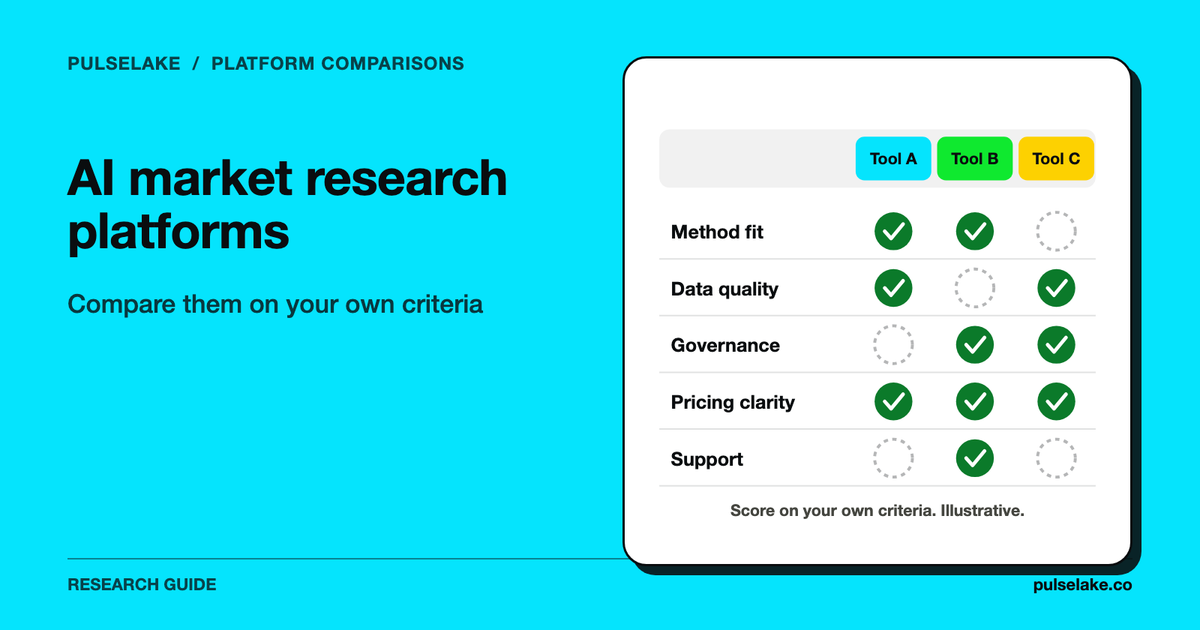
Use the same study and review set, then compare traceability, calculation transparency, handling of disagreement and the effort required to produce an approved report.