Best AI market research platforms in 2026: a practical comparison
A source-based comparison of AI research platforms across quantitative studies, interviews, consumer insight and simulation.
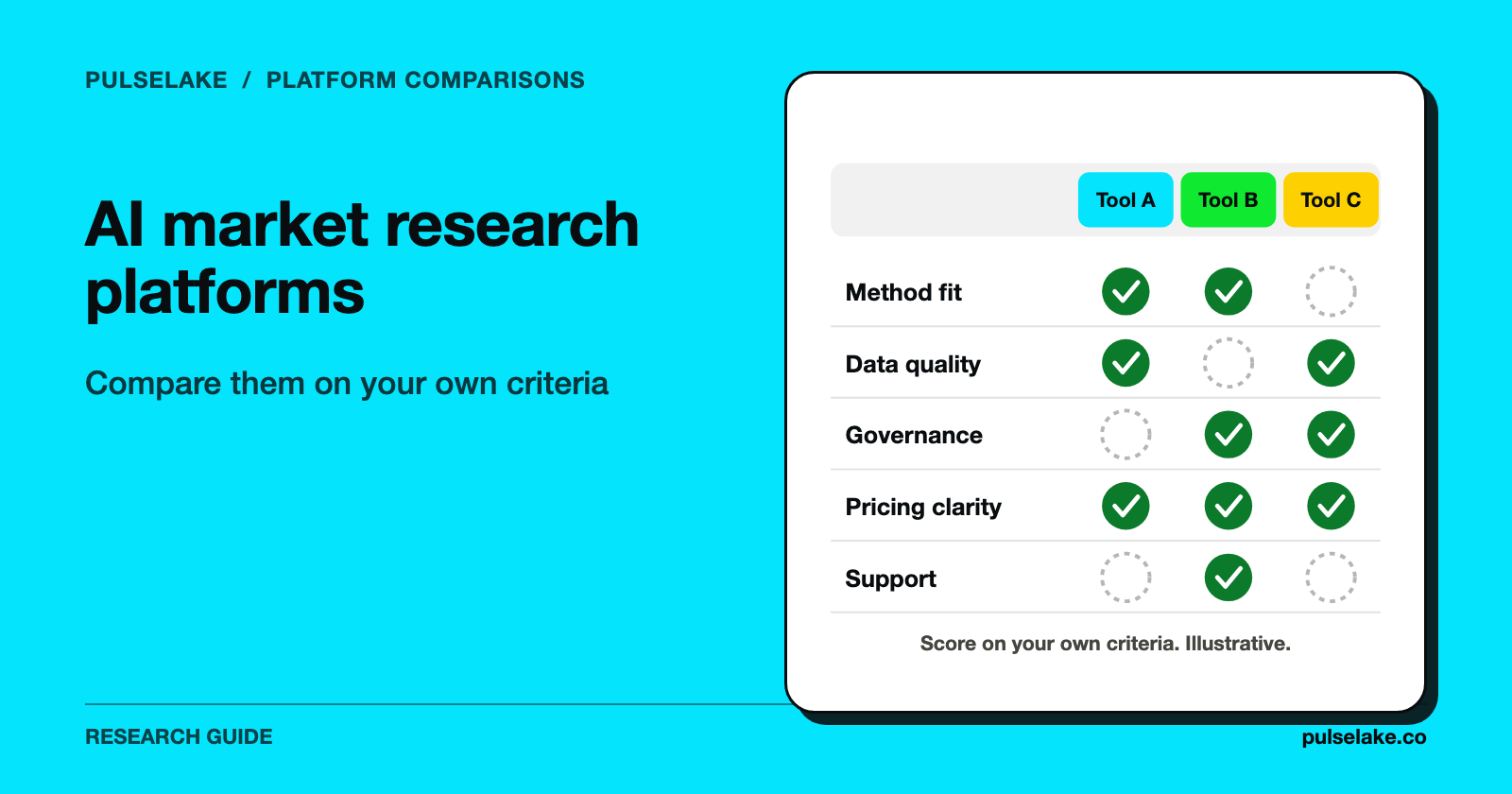
Which is the best AI market research platform? That depends on the job, and there are several. Some platforms design studies, some interview people, some analyse responses, some explore existing datasets, some simulate audiences. Decide which one your decision rests on. Compare the evidence each platform can produce, and the review work it leaves you, before you compare how fast it writes a report.
This comparison is built from public product information and a practical evaluation framework. We haven't run a hands-on benchmark or an original accuracy test across these products.

Which AI market research platforms belong in the comparison?
| Platform | Best fit to investigate | Main evaluation question |
|---|---|---|
| Qualtrics | Broad research programmes | Which methods and AI functions are available in the proposed scope? |
| quantilope | Automated quantitative research | Does the method match the decision and sample? |
| Zappi | Consumer insight for advertising and innovation | How does the study fit the available research approach? |
| Attest | Consumer research | Can the intended audience and instrument be supported? |
| Outset | AI-moderated research | How are interviews reviewed and probed? |
| Listen Labs | AI-led research | How are participants, transcripts and conclusions connected? |
| Perspective AI | Qualitative research workflows | Can researchers inspect and revise the analysis? |
| Brandwatch | Social and consumer intelligence | What population does the available conversation represent? |
| GWI | Existing consumer insight | Does the dataset cover the audience and question? |
| PulseLake | Connected research modes and reusable context | Can findings remain traceable across the study lifecycle? |
| Perplexity | Desk-research assistance | Are the retrieved sources sufficient and directly relevant? |
The last row is a different animal. Finding published material can feed a research brief; it doesn't recruit anyone, and it doesn't hand you a new primary-research result.
Where does desk research fit?
Say you need a brief by Friday. A search assistant such as Perplexity can help you find the material. Then the work starts: open the original sources, check their dates, and see what they really support.
Desk research earns its place in three jobs: getting the terminology straight, mapping competitors and finding prior studies. Passing it off as new evidence from the target audience is where it goes wrong.
If desk research shapes a decision, keep a source ledger with the claim, the source and the limitation. Nobody should later repeat a convenient summary as if it were established fact.
When are AI-led interviews the right approach?
Outset, Listen Labs and Perspective AI belong in a qualitative research comparison. Two things to watch: how the conversation is run, and how a researcher can inspect what happened.
Bring an interview guide with a real ambiguity in it, then ask a few things. How does the system follow up without leading the participant? What happens with an answer nobody expected? Does it notice when a conversation should stop or go to review?
Our rule: read the transcript before the summary. A compelling synthesis can't repair a badly framed question or a follow-up that never happened. Check that quotations keep their context, and that the analysis separates what people said from what it makes of it.
And the participant? They should understand what kind of interaction they're in and how their information will be used under the study's approved process.
When is a quantitative research platform appropriate?
Need structured research methods and analysis? Then Qualtrics and quantilope belong in the comparison. Quantilope explicitly describes automated methods including conjoint and MaxDiff, so the open question is whether the method suits the business decision.
An easy launch button is a bad reason to pick a method. A choice exercise still needs sensible alternatives, a suitable audience and an interpretation that fits the design.
Ask the supplier to spell out three things: what the AI drafts, what the researcher specifies, and what the statistical calculation really uses. Those lines should still be visible in the final report. Automated preparation can save you effort, but the assumptions the method depends on stay exactly where they were.
When should Zappi or Attest be considered?
Zappi presents consumer-insight workflows for areas such as advertising and innovation, and Attest is another consumer-research candidate. Weighing Zappi among Qualtrics alternatives? Judge both against your actual audience and decision, and ignore the generic promise of faster insight.
For a concept study, bring the real stimulus and your decision rule. Ask how the platform handles comparisons, context and a weak result. By the end you should know whether you're learning about an idea's clarity, its appeal or likely purchase behaviour.
What can you reuse? A consistent research approach makes repeated studies easier to read, though comparability only holds while the relevant parts of the design and audience stay stable.
What can social and existing consumer data tell you?
Brandwatch is relevant to social and consumer-intelligence work, and GWI provides consumer insight. Either can help you frame a question or look at an existing audience pattern.
Coverage is the limit to examine. Public conversation reflects who talks, where they talk and what the data source can reach, and an existing dataset brings its own population, collection period and question definitions.
Check those boundaries before pointing either source at a new question. A good source can still be wrong for a particular claim. Silence proves nothing either: no discussion of an issue doesn't mean the issue isn't there.
Where does PulseLake fit?
PulseLake is a research operating system that links study design and evidence collection with structured analysis, interpretation and reporting. Its research frameworks organise questions and measures into dimensions and sub-dimensions. That structure gives the evidence a shared meaning, so it can be analysed beyond any single response or survey.
The Analysis Workbench provides dimension-level results, filtering and pivots, while study-specific calculators keep the meaning of each measure intact. Much of evaluating PulseLake as a research OS comes down to that, alongside its research execution modes.
Picture a sequence like this: start with prior evidence, use synthetic exploration to expose assumptions, collect human responses, and finish with a report whose claims link back to the study. Each stage keeps its evidence type attached.
Judge PulseLake on that sequence. Several research modes doesn't mean every study should use all of them; a simple question may only need a simple study.
How should a buyer compare quality?
Pick a few tasks from a real project, give every candidate the same permitted materials, and ask for output you can review. Then slip in one question the evidence can't answer and watch what happens.
Score the work on traceability, how it handles disagreement, how transparent the calculations are, and how much researcher effort it needs. One "AI quality" score hides the real strengths and weaknesses.
Simulated audiences need validation evidence that fits your intended use. A vendor-wide similarity claim doesn't establish accuracy for a new market, language or decision, and simulated counts should stay apart from human sample sizes. Where we land: synthetic work gives you speed and early direction, and real respondents give you validation.
How should cost and implementation be compared?
Have every vendor quote the same scope: users, study volume, respondents, methods, AI usage, storage and support. Are recruitment, services and integrations included, or billed separately? Find out.
Then map what's still on your team's plate. Questionnaire review, participant quality, analysis and stakeholder interpretation don't vanish because a platform generates a report.
Start with a first project that has a clear decision and an audience you can manage. A good first deployment leaves you with a useful finding and a process you can repeat. A persuasive demo isn't enough on its own.
Frequently asked questions
Which AI research platform is best overall?
None wins everywhere. Surveys, interviews, social data and simulation are different jobs, so build your shortlist around the evidence you need and run the same real task through each candidate.
Were these platforms tested head to head?
No. This article draws on public product information and an evaluation framework, and it doesn't report an original benchmark or an independently measured accuracy ranking.
Can AI-generated respondents replace people?
They can help with exploration and instrument preparation. Any consequential claim about people needs appropriate validation first, and AI-generated respondents should always be labelled separately from human research.
What should every AI research report include?
The question, audience, method, evidence sources, calculation basis and important limitations. A reader should be able to tell observations, model outputs and recommendations apart.