SurveyMonkey alternatives for market research in 2026
Compare SurveyMonkey alternatives by research method, respondent sourcing, analysis workflow and migration effort.
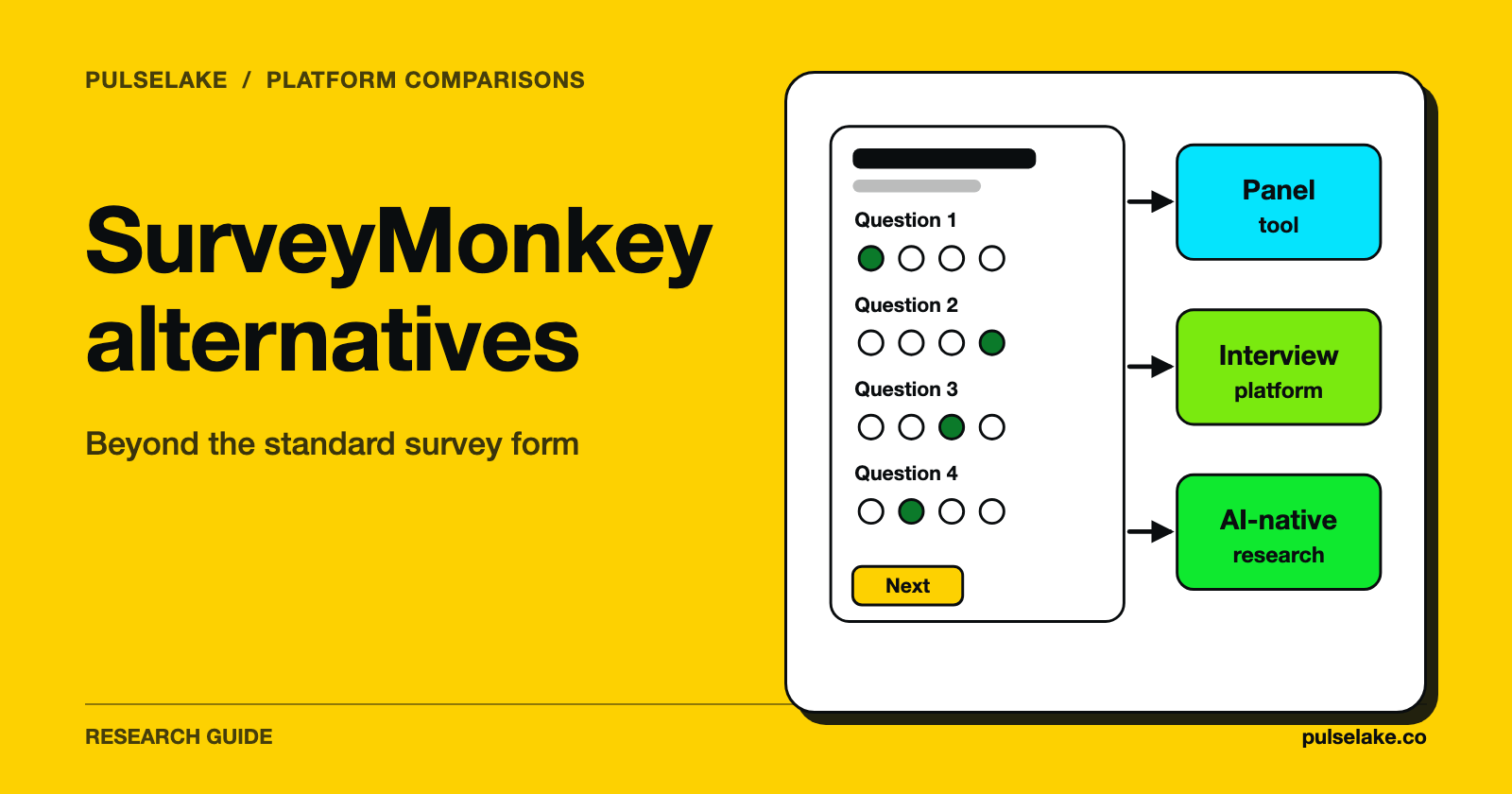
SurveyMonkey alternatives for market research run from full research platforms to form builders and respondent-sourcing services. Qualtrics, QuestionPro, Alchemer, Typeform, Pollfish, Forsta and PulseLake are all worth comparing, and they solve different problems. Choose around the study you need to run and the work your team still does by hand.
Is the survey tool really your bottleneck? Often it's fine, and recruitment or analysis is what's holding you up. So before you migrate anything, follow one recent project from brief to report and note where the time went. Your shortlist gets a purpose that way.

Which SurveyMonkey alternatives should you compare?
| Platform | Best fit to investigate | Decision to resolve |
|---|---|---|
| Qualtrics | Broad research programmes | Which methods and modules are required? |
| QuestionPro | Survey-centred research | How do collection, audience access and analysis fit together? |
| Alchemer | Surveys linked to business processes | Which workflow connections are needed? |
| Typeform | Form-led experiences | Does the instrument fit the required logic and exports? |
| Pollfish | Survey research with audience sourcing | Can the intended audience and quality rules be supported? |
| Forsta | Research and experience programmes | What deployment and service scope fits the team? |
| PulseLake | Research planning through evidence-backed synthesis | Can study context and reusable work reduce repeated effort? |
Treat the table as a way to pick a few candidates to demo. It doesn't claim every option has the same feature set or commercial model.
When should Pollfish enter the comparison?
Pollfish comes up when survey delivery and audience sourcing matter. Does its recruitment approach fit your population and your decision? That's the real question.
Hand them your target definition, geography, screening rules and expected incidence. Then ask how eligibility is checked, how exclusions are handled, and what evidence you'll get about the sample you actually achieved.
Access to respondents isn't proof of representativeness, and we'd call that the most common shortcut in this whole category. A completed sample still gets reviewed for coverage, quality and the limits of the recruitment method. Those limits belong in the final report.
When is Typeform a sensible choice?
Typeform makes sense if the interaction itself is form-led and your research design works in that format. A short screening form or a focused feedback exercise can gain from a simpler collection experience.
Test your exact questionnaire on a phone, not only a desktop. Can respondents follow the navigation? Fix a mistake? Does any wording or layout feel awkward?
Open the export next. A form can be a pleasure to complete and still create extra analysis work, so decide whether that's acceptable for the number and frequency of studies you expect to run.
How do QuestionPro and Alchemer differ in a shortlist?
QuestionPro is relevant to survey-led research programmes, while Alchemer is worth a look when feedback has to connect to business workflows. Both are starting points for evaluation, not mutually exclusive boxes.
With either one, check the instrument and what happens downstream. Response codes: do they stay intact? Partial completions: how are they handled? Can it produce the files your analysts need? And which integrations come with the package you're being offered?
Then have an ordinary project owner repeat the demo task alone. A workflow that needs a specialist administrator might still suit you, but see the staffing cost before you buy, not after.
When should you evaluate Qualtrics?
When your organisation needs a broad research environment, Qualtrics' research offering belongs on the shortlist. Start from your specific methods and governance requirements, because a bigger platform isn't automatically a better fit.
Bring a study that stretches your current workflow: advanced choice questions, say, or several audiences, or repeated reporting. Ask the supplier to walk the complete path, including whatever a researcher would still have to do outside the platform.
It's a trade-off of breadth against implementation and administration. Extra capability pays off when your team will use it and can run it consistently. Otherwise you've bought more to maintain.
What does Forsta add to the shortlist?
Forsta covers research and experience-management use cases. It's relevant if your organisation needs a wider programme and wants to look at the platform and the service arrangement together.
Pin down which parts are software, which are services, and who owns the day-to-day work. A proposal can look comprehensive and still leave questionnaire setup, data preparation or reporting with your team.
Use one real project to sort out responsibilities. What you're after is a practical delivery model, not a list of capabilities nobody has mapped to the study.
Where does PulseLake fit?
PulseLake is a research operating system that connects study design and evidence collection with structured analysis, interpretation and reporting. Its research frameworks organise questions and measures into dimensions and sub-dimensions. That structure gives the evidence a shared meaning, so you can use it for analysis beyond a single response or survey.
Compare what happens after responses arrive. How do measures relate to research dimensions? How do researchers filter or pivot results? Do the findings stay interpretable in later work?
Imagine your team wants to reuse earlier findings when designing a follow-up, calculate results from the study data and keep the evidence behind a recommendation. That's a different need from collecting another batch of responses.
Ask to see the workflow that matters to you. Synthetic outputs should stay labelled, and approval should stay explicit wherever the workflow changes a study or produces a consequential recommendation.
How should AI-generated summaries be reviewed?
Make the system show the comments behind each theme. Slip in a response with mixed sentiment and one that contradicts the majority. A useful summary keeps meaningful disagreement instead of smoothing everything into one tidy story.
Check the numbers separately. Does a report say a theme appears in some proportion of responses? Find the denominator, the coding rules and how multiple themes were handled. Fluent prose is no evidence the calculation is right.
A researcher owns the interpretation. The system can propose categories or draft a narrative; your team decides whether the evidence supports the business implication.
What should a migration exercise contain?
Rebuild a small survey that's still representative, with some branching, required questions and one open-ended response. Feed it test records that include skipped questions and incomplete submissions, so the analysis handoff gets a real workout.
Then read the resulting data dictionary. Could someone who didn't build the instrument understand the question labels, response values and missing-data codes? Keep those definitions with the study.
Running a tracker? Compare presentation and collection changes before calling the new results a continuation of the old series, since a platform migration can shift respondent behaviour even when the words look the same.
What belongs in the commercial comparison?
Ask each supplier to quote the same study volume, researchers, required methods and support. Split out software, respondent costs, implementation and professional services, and confirm what happens when usage runs past the plan.
Count migration and recurring manual work as well. Time spent cleaning data or rebuilding a standard report can swallow a cheaper subscription. Flip it round, though: an expensive broad suite may be overkill for a simple recurring survey.
Our rule of thumb: go with the smallest arrangement that handles the research you need well and can grow in the directions your team really expects.
Frequently asked questions
Should we replace SurveyMonkey just to get AI features?
Only if the new workflow solves a real problem and gives you results you can inspect. Compare the analysis and review process; whether something carries an AI label tells you little.
Is a respondent marketplace a survey-platform replacement?
Not necessarily. Recruitment and questionnaire software do different jobs, even when one supplier offers both. Confirm the full workflow and who's responsible for each part.
Can old studies move to a new platform?
Some data may export, but instruments, attachments and metadata each need their own check. Rebuild and inspect one representative study before you assume the whole archive will move cleanly.
What is the most useful demo request?
Ask the supplier to run your actual study brief through setup, collection and analysis, then show you the export and the evidence behind the report. Practical differences surface fast.