What is a customer digital twin? Definition, uses and limits
A practical definition of customer digital twins, their research uses, evidence requirements and limits.
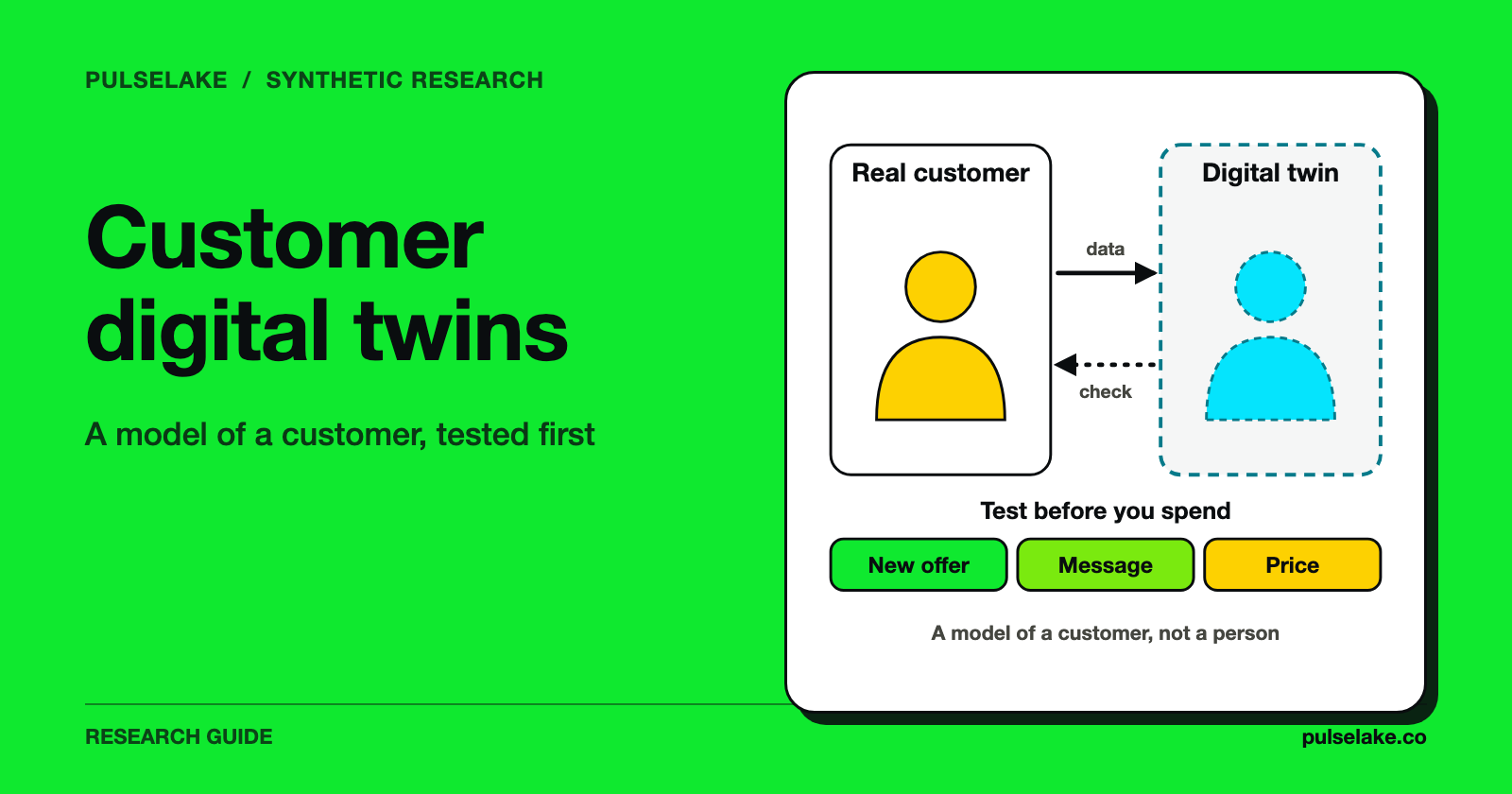
A customer digital twin is a maintained model of a customer or customer group, grounded in evidence and used to explore possible behaviour. For the term to be useful, the model needs a defined subject, an update process and a way to check its outputs. A detailed persona that answers questions is not automatically a reliable predictor of a customer's next decision.
The attraction is easy to understand. Research captures a moment, while product decisions continue after the report is delivered. A reusable model offers a way to ask follow-up questions without starting every discussion from a blank page. The difficulty is knowing which answers reflect evidence and which reflect assumptions.

What makes a model a digital twin?
The term is used loosely in marketing. A practical definition has four parts: a subject being represented, source evidence about that subject, a model that uses the evidence and a process for updating and evaluating the model.
The subject might be one consenting customer, a business account or a segment. Those are materially different models. A segment model should not be presented as a replica of a particular person, and a model of one person should not be treated as representative of an entire market.
A useful model also has a boundary. It might represent how a defined audience evaluates onboarding options under specified conditions. It does not follow that the same model can predict brand choice, political opinion or willingness to share sensitive information.
| Research asset | Main purpose | Evidence relationship | Maintenance question |
|---|---|---|---|
| Persona | Summarise an audience for a team | Often a synthesis of research and assumptions | Is the description still useful? |
| Synthetic respondent | Generate answers under a defined profile | Depends on the supplied context and model | Can the run be reproduced and assessed? |
| Customer digital twin | Maintain a model for repeated questions | Should have explicit grounding and evaluation | What changed since the last validated version? |
| Customer record | Store observed facts and interactions | Records events rather than simulating them | Are the records accurate and permitted for this use? |
These assets can work together. Keeping their roles visible prevents a fictional detail from gradually becoming an accepted customer fact.
What can a team use it for?
The strongest starting uses are questions that help researchers prepare better work. A model can expose assumptions in a product concept, suggest situations to investigate or help compare alternative explanations for earlier findings.
Consider a fictional business software team exploring a simpler reporting workflow. Existing interviews suggest that managers want speed while analysts want control. A model can help articulate the tension: which tasks require checking the underlying data, and which can safely use a prepared summary?
The team can then build prototypes around those situations and observe actual users. The simulation has improved the research plan. It has not established that a particular interface will increase adoption.
Repeated use may also reveal gaps in the evidence base. If the model cannot answer questions about occasional users without relying on general assumptions, that is a reason to recruit occasional users, not a reason to give the model a more elaborate personality.
What evidence should go into the model?
Begin with material collected for a compatible purpose and within the permissions attached to it. Study findings, documented customer journeys and appropriately governed behavioural records may all be relevant. More data is not necessarily better if the new material introduces conflicting definitions or unclear consent.
Keep source types distinct. A support complaint, an observed product event and an interview explanation answer different questions. The complaint describes a reported problem; the event records an action; the interview offers a person's account of their reasoning.
Record the audience, collection period and limitations for each source. A model trained on long-standing customers may know little about people who abandoned onboarding. A model built around one market should not quietly answer for another.
Avoid decorating profiles with unnecessary personal detail. A fictional name or hobby can make a model memorable, but it can also encourage readers to mistake a constructed character for an observed individual.
How do you know whether it works?
Choose a specific use and an evaluation before looking at the generated answer. If the intended use is prioritising interview topics, assess whether it identifies issues that researchers find useful. If the intended use is predicting a ranking, compare that ranking with suitable held-out human evidence.
The evaluation data should not be included in the material used to generate or tune the answer. Otherwise, apparent agreement may reflect access to the result. Keep the comparison focused on the audience and conditions for which the model will be used.
Examine disagreement rather than reporting only a single similarity score. A model might capture a broad preference while missing the reasons that matter to a smaller customer group. That can be a serious failure if the decision concerns accessibility, trust or a costly migration.
Also assess stability. Ask whether a small wording change or a model upgrade changes the conclusion. A stable answer can still be wrong, but an unstable answer is a warning against using the output as a firm basis for action.
What do existing products offer?
Minds describes reusable synthetic audiences with explicit profiles and source grounding. Synthetic Users offers simulated user research. These are useful examples of the category, but their presence on a shortlist does not establish that every use meets the stricter definition of a maintained, validated customer twin.
Ask suppliers to show the evidence behind a particular answer, explain how an audience is updated and identify where validation applies. A general product demonstration cannot establish accuracy for a new segment or a new decision.
PulseLake is a research operating system that connects study design and evidence collection with structured analysis, interpretation and reporting. Its research frameworks organise questions and measures into dimensions and sub-dimensions. That structure gives the evidence a shared meaning and makes it usable for analysis beyond an individual response or survey.
A customer model needs explicit concepts and measures if it is to support analysis. PulseLake provides a research framework around those dimensions; calling a persona a digital twin does not by itself demonstrate predictive validity.
How should a customer twin be maintained?
Give it an owner and a version history. A new study, a change in the product or a shift in the audience can change the model's usefulness. Record what changed and which earlier conclusions may need another look.
Separate the evidence refresh from the model refresh. New customer information can alter the model even if the underlying AI system stays the same. A new AI model can alter outputs even if the evidence stays the same. Both changes need to be visible.
Preserve old versions for comparison, subject to retention and deletion requirements. If a recommendation changes, the team should be able to ask whether the cause was new evidence, a changed assumption or a different generation process.
Retire models that no longer have a clear use. A growing library of impressive-looking personas is not useful if nobody knows which ones are current or what decisions they can support.
Where should teams draw the line?
Do not use a simulated answer as a customer quotation. Do not infer that a person agreed to a decision because their model produced a favourable response. Avoid using a segment model to make consequential claims about a named individual.
For a major product, pricing or market decision, use the model to sharpen the questions and then collect the evidence the decision requires. The right handoff is often a better study brief, not a final verdict.
A practical report separates observed findings, model outputs and recommendations. Readers should be able to identify which category each statement belongs to without reading a footnote.
Frequently asked questions
Is a customer digital twin the same as a persona?
No. A persona usually summarises an audience. A useful digital twin adds a maintained model, explicit source grounding and evaluation for a defined use. The terminology varies by supplier, so inspect the underlying process.
Does it predict what an individual will buy?
That requires evidence specific to the prediction and context. A plausible conversation or a detailed profile does not demonstrate predictive accuracy for an individual's future purchase.
Can it replace interviews?
It can help prepare interviews and explore hypotheses between studies. Interviews remain necessary when the decision requires fresh evidence from people, especially about experiences or changes absent from the model's sources.
How often should it be updated?
Use evidence-based triggers such as a new product, audience shift, contradictory study or model change. A fixed calendar alone may miss important changes or prompt unnecessary rebuilding.