Customer Research Methods: Modern Techniques for Insights Teams (2026)
Customer research methods compared: interviews, surveys, observation and AI-moderated studies, with a step-by-step process and how to choose by question.
Customer research methods fall into four working groups: conversations (interviews, focus groups, diary studies), questionnaires (surveys, concept and pricing tests), observation (usability sessions, field visits, product analytics) and existing evidence (support tickets, past studies, secondary data). Choose by the question: use qualitative methods to find out why, quantitative methods to find out how many, and combine them when a decision needs both.
We make PulseLake, a research platform that supports several of the methods below. Where it fits, we say so; where another approach is better, we say that too.

What are the main customer research methods?
Most guides sort methods along two lines, and both help when you are choosing.
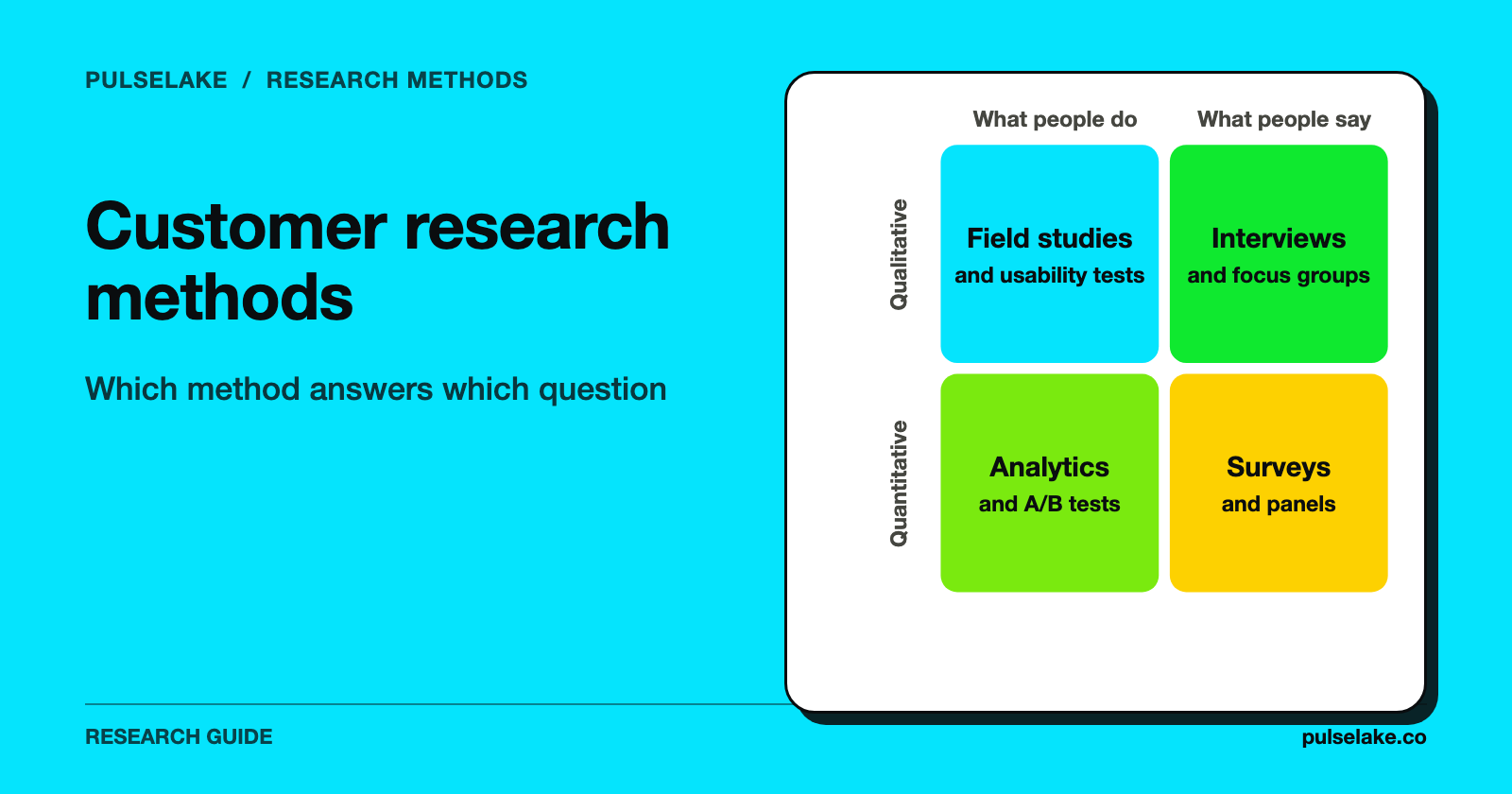
The first line separates qualitative from quantitative. Nielsen Norman Group describes qualitative methods as ones where you hear or watch participants directly and can ask follow-ups, so analysis is interpretive; quantitative methods collect predetermined data through an instrument such as a survey or analytics tool and analyse it numerically. The first is suited to understanding why something happens; the second to measuring how many people do it or how large an effect is.
The second line separates what people say from what they do. The same Nielsen Norman Group framework calls surveys, focus groups and card sorting attitudinal (stated beliefs), and A/B tests and eye tracking behavioural (observed actions). Stated and observed evidence can disagree, which is a reason to use both for important decisions.
| Method | Type | Best for | Watch out for |
|---|---|---|---|
| One-to-one interviews | Qualitative, stated | Motivations, language, how a decision was made | Small samples; interviewer influence |
| Focus groups | Qualitative, stated | Reactions to an idea, vocabulary | Dominant voices; group conformity |
| Surveys | Mostly quantitative, stated | Measuring how common a view or behaviour is | Question wording; who actually responds |
| Concept and pricing tests | Quantitative, stated | Choosing between options | Hypothetical choices are not purchases |
| Usability or task sessions | Both, leaning behavioural | Where people get stuck | Tasks set by you may not match real use |
| Product and web analytics | Quantitative, behavioural | What people do at scale | Shows what, not why |
| Diary studies and field visits | Qualitative, behavioural | Context over days or in the real setting | Time and cost |
| Secondary research and past studies | Either | Scoping before fieldwork | Age and fit of the data |
How do you conduct customer research? A step-by-step process
The sequence below is the customer research process in its simplest form. Conveo and the U.S. Chamber of Commerce also start their processes with the research question or goal; their step lists differ from this one, which puts the decision first.
- Name the decision. Write down what will change depending on the answer. "Learn more about our customers" is not a research question. "Should onboarding start with a checklist or a guided tour?" is.
- Check what you already know. Look at past studies, support tickets and analytics before collecting anything new. Secondary evidence often shrinks the question.
- Choose the method from the question type. Exploring unknowns calls for conversations. Measuring prevalence calls for a survey. Comparing options calls for a concept test or experiment.
- Define who you need. Be specific: recent buyers, churned accounts, people who evaluated and chose a competitor. Screen on behaviour, not only demographics.
- Design the instrument. Write the interview guide or questionnaire, and read it for leading wording. Our article on writing questions that don't bias responses covers this step.
- Collect. Pilot first, with two or three people, so you find a broken question before you have used up your sample.
- Analyse. Code interview transcripts into themes and keep verbatim quotes attached; for surveys, check response quality before you cut the data.
- Report and act. Lead with the answer to the decision, show the evidence and state the limits. Then record what was decided, so the next team can find it.
A short worked example (hypothetical): a software company wants to know why trial users stop after the first week. It starts with its own usage data and support tickets, which show most drop-off happens before a first project is created. It then interviews eight recent trial users who dropped off, hears that the setup step assumes data they do not have yet, and runs a short survey of a few hundred trial users to see how common that problem is. Each step answers a different question, and none of them alone would have been enough.
Which method should you use for which question?
Start from the question, not the tool.
- "Why are people doing this?" Interviews or diary studies. You need explanation, and a survey can only offer options you thought of in advance.
- "How many people feel this way?" A survey with a sample that matches the population you care about. See avoiding sampling bias.
- "Which of these options do people prefer?" A concept test, MaxDiff, conjoint or pricing study. Our answers on MaxDiff vs conjoint and Gabor-Granger vs Van Westendorp explain how to choose among them.
- "Where do people struggle?" Usability sessions and analytics, ideally together: analytics shows where, sessions show why.
- "What do people do when no one is asking?" Behavioural data and field observation. This is the check on what people tell you.
What sample size do you need?
There is no single number. It depends on the method and on what you will do with the result.
For qualitative work, the aim is to reach the point where new interviews stop producing new themes. Guides commonly suggest starting small: Conveo's guide gives 8 to 12 participants for a first qualitative study, though it is a vendor's rule of thumb rather than a standard, and its concept-test example uses 15 to 20 AI-moderated interviews. Treat these as starting points and add interviews for each distinct segment you must compare.
For quantitative work, sample size depends on how precise you need to be and how many subgroups you will compare. A survey that must report on four segments needs enough responses in each segment, not only in total. Decide the cuts you need before you fieldwork, not after.
In both cases, who is in the sample matters more than how many. A large sample of the wrong people produces a confident wrong answer.
What are the modern techniques insights teams are adding?
Three changes are widely discussed, and each has trade-offs.
Always-on and continuous research. Rather than one large project a year, teams run small recurring studies, such as a monthly pulse of interviews or a tracked survey. This works when the questions recur. It needs a place to keep the results, or each study is forgotten when the next begins. Our post on research as a living knowledge base discusses that side.
AI-moderated interviews. An AI interviewer follows a discussion guide with real participants, probes based on their answers and records the conversation. The attraction is that many interviews can run at the same time and in participants' own time. The cost is that the guide has to be good, because there is no human adjusting live. See what an AI-moderated interview is and how it works.
Synthetic respondents and simulation. Models stand in for people, to test a questionnaire or explore a hypothesis before spending on fieldwork. They are useful for finding broken questions and generating hypotheses. They are not a substitute for evidence from real customers on a decision that matters, and results should be labelled as synthetic. See how accurate synthetic respondents are and synthetic respondents and their limits.
Whatever the technique, the test is the same: can you trace each conclusion to the evidence behind it?
What are common customer research mistakes?
- Starting with a method instead of a decision.
- Interviewing only happy customers, or only the ones who answer emails.
- Asking people to predict their own future behaviour and treating the answer as a forecast.
- Running a survey before an interview, so the options in the survey come from guesswork.
- Presenting themes without quotes or counts, so no one can check them.
- Storing findings in a slide deck nobody can search later.
The mixed-methods approach addresses several of these at once: interviews to find the right questions, then a survey to measure them. Our post on mixed methods research done right walks through it.
Where does PulseLake fit?
PulseLake is a platform for market research and insights teams. According to its public site, it supports four research modes: traditional research (surveys, qualitative research, assessments and panels), AI-led interviews with real participants, synthetic research with explicit, versioned personas, and simulation based on prior evidence and stated assumptions. It keeps objectives, methodology and evidence in the same study context, so a conclusion can be traced back to its source.
It is built for internal insights teams, research firms and consulting practices. If you run a single occasional survey, a simple form tool may be enough. If you want to combine methods and keep what you learn, a system that holds the study context is more useful.
Frequently asked questions
What is customer research?
Customer research is the structured collection and analysis of information about the people who buy, use or might buy a product, to inform a specific decision. It covers their needs, behaviour, motivations and reactions to options.
What are the 4 types of customer research?
There is no official list, but a practical grouping is conversations (interviews, focus groups), questionnaires (surveys, concept tests), observation (usability sessions, analytics, field visits) and existing evidence (past studies, support data, secondary sources).
What is the difference between qualitative and quantitative customer research?
Qualitative research hears or watches participants and interprets what they say, which explains why something happens. Quantitative research collects predetermined data from many people and analyses it numerically, which shows how common something is.
How do you conduct customer research on a small budget?
Start with what you already have: support tickets, analytics and past studies. Then interview a small number of the right customers and, if needed, run a short survey. Avoid collecting data before you have named the decision it informs.
How many customer interviews are enough?
Enough that new interviews stop adding new themes. A common starting point for a first qualitative study is 8 to 12 interviews, adding more for each segment you need to compare. It is a rule of thumb, not a guarantee.
What is the customer research process?
Name the decision, check existing evidence, choose a method, define the audience, design the instrument, collect, analyse and report. The order matters mainly at the start: decision first, method second.