Voice of the Customer (VoC): Frameworks and Research Methods (2026)
What Voice of the Customer (VoC) is, the main research methods and frameworks (needs hierarchy, Kano, journey maps, CTQ), sample sizes and analysis.
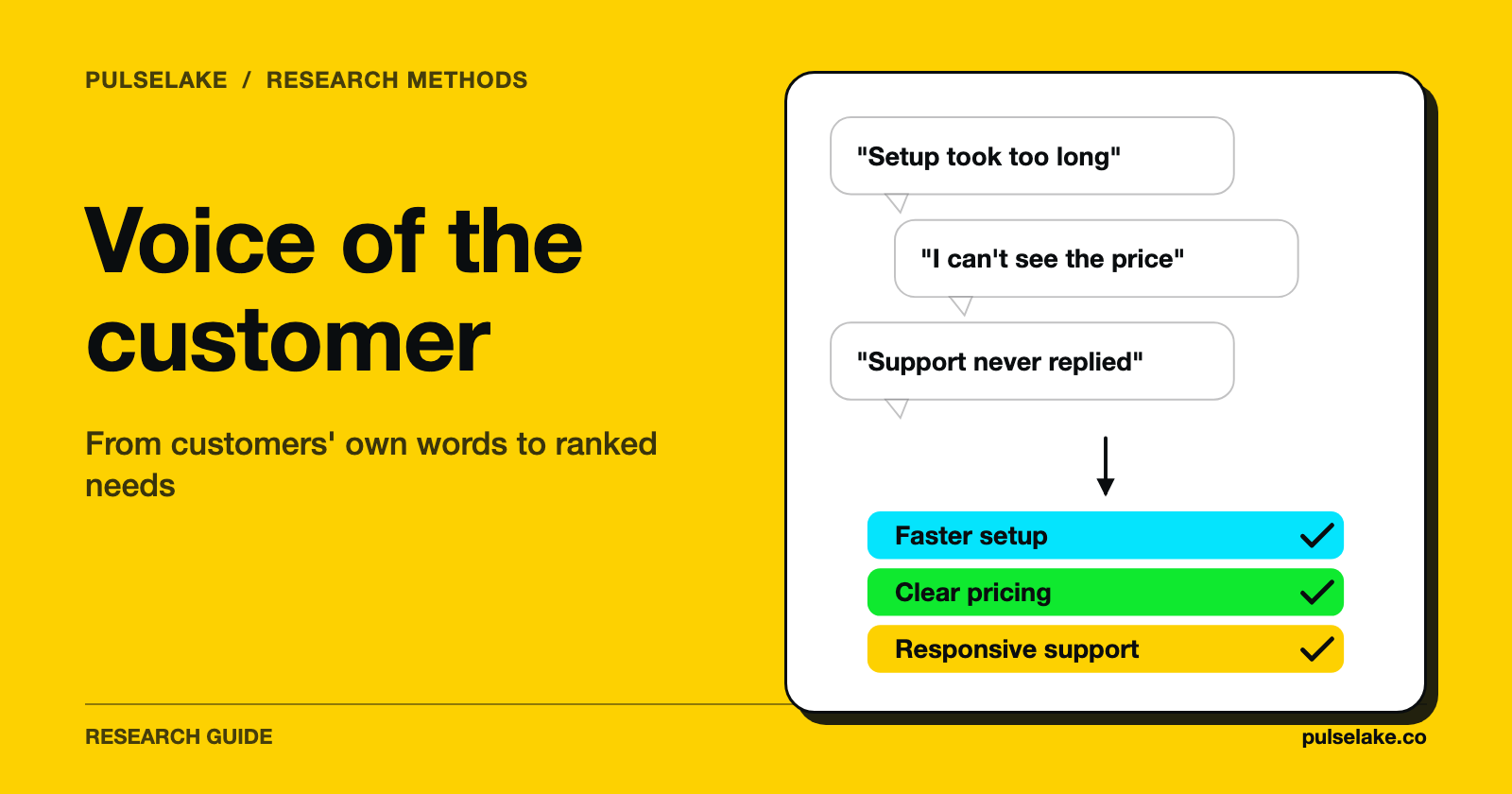
Voice of the Customer (VoC) is the structured practice of capturing what customers need, expect and struggle with, in their own words, and turning that into priorities a team can act on. The toolkit is a handful of collection methods (interviews, surveys, support and review data, observation) plus a framework to organise what you find, such as a needs hierarchy, a Kano classification, a journey map or a critical-to-quality (CTQ) translation. A common recommendation: start with qualitative interviews to find the needs, then use quantitative work to size and rank them.
We make PulseLake, a research platform, and mention it once near the end. Everything else here is method-first and works with any tools.

What is Voice of the Customer (VoC)?
People mean one of two things by it, and it's worth knowing which.
The research definition comes from product development. In a note summarising the 1993 paper by Abbie Griffin and John Hauser, Hauser describes the voice of the customer as a hierarchical set of customer needs, each with a priority, where a need is a description "in the customer's own words" of the benefit to be fulfilled (Hauser, MIT Sloan). A need isn't a solution (a specific monitor type). It isn't an engineering measure either (the number of breaks in a line). It's how the customer wants the result to look or work.
The programme definition comes from quality management and customer experience. Quality-One describes VoC as the needs, wants and expectations of the customer, stated and unstated, and as a continuous process of collecting, documenting and analysing customer feedback (Quality-One). Most vendor guides use this broader sense: an ongoing programme pulling together several feedback sources.
Both agree on the core idea. VoC isn't a satisfaction score. A score tells you how people rated something. VoC tells you what they were trying to do, and why it went well or badly.
What are examples of VoC?
VoC data, from least to most structured:
- A customer says in an interview, "I never know whether my export finished." That sentence is raw VoC.
- A support ticket reads, "Can't find where to change the billing contact."
- A product review praises setup speed but complains about reporting.
- An open-ended survey answer explains why someone gave a 6 out of 10.
- A recorded sales call where a prospect lists what they currently work around.
VoC outputs, after analysis:
- A short list of primary needs (Hauser describes roughly two to ten), each with sub-needs written in customer language.
- A ranked list of problems by how many customers raise them and how much they matter.
- A journey map showing where customers get stuck.
- A set of measurable targets (CTQs) such as "export confirmation visible within a stated time".
A hypothetical example. A software team hears "reporting is confusing" on four calls and sees it in plenty of reviews. Interviews turn up two different needs hiding in that one phrase: finding last month's numbers, and sharing a view with a manager. Each needs its own fix and its own metric.
What are the main VoC research methods?
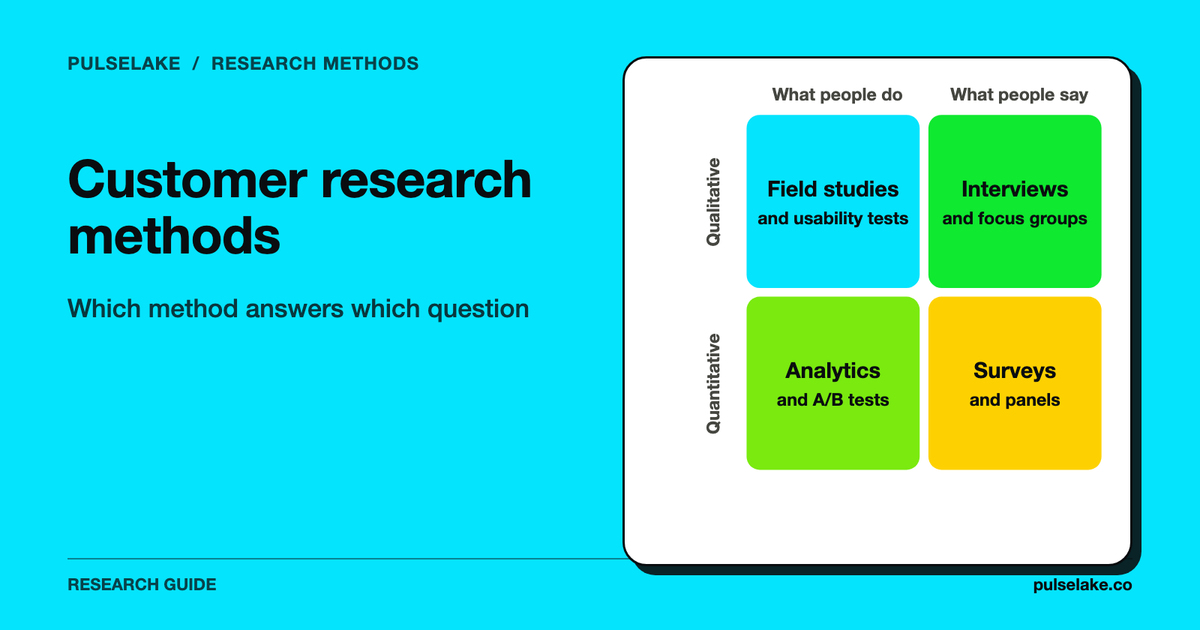
They split three ways: asking customers, listening to what they already say, and watching what they do. The fairest way to choose is by the question each one answers.
| Method | Best for | Main limitation |
|---|---|---|
| One-on-one interviews | Discovering needs and the reasons behind behaviour | Slow to run and analyse |
| Focus groups | Reacting to concepts and wording | Shared air-time; dominant voices |
| Surveys (CSAT, NPS, custom) | Measuring how common something is and tracking change | Closed answers miss the "why"; response bias |
| Open-ended survey and review text | Customer language at scale | Needs coding to be usable |
| Support tickets and call recordings | Unprompted problems | Only reflects customers who make contact |
| Social listening and public reviews | Unsolicited opinion | Noisy; skewed toward extremes |
| Behavioural and usage data | What people actually do | Shows what, not why |
| Observation and diary studies | Needs people cannot easily articulate | Time-intensive |
Practitioner guides group these in much the same way. Thematic lists surveys, interviews, focus groups, social listening, online reviews and behavioural data (Thematic), and Help Scout lists ten techniques that also include listening to recorded calls and talking to customer-facing employees (Help Scout).
Should you use qualitative or quantitative methods?
Both, one after the other. SurveyMonkey's guidance is to run qualitative interviews first to find the right questions, then validate with a quantitative survey (SurveyMonkey). Qualitative work answers "what do customers need, and why?" Quantitative work answers "how many, and how much does it matter?" Do only the second and you end up measuring needs you never discovered. For more on combining them, see our piece on mixed methods research.
How should you ask about needs?
Hauser's note makes a point plenty of guides skip. Customers often struggle to list their needs when you ask directly, so it's better to infer needs from experiential interviews or observation. In an experiential interview, the customer describes a real or imagined use, and the interviewer keeps probing until no new needs come up (Hauser, MIT Sloan). "Walk me through the last time you did this" usually gets you more than "What do you want?"
How many customers do you need to interview?
The most-cited evidence comes from Griffin and Hauser. In one study, 30 potential customers of portable food-carrying products were interviewed and their needs merged across analysts. Interviewing 20 of them identified over 90% of the needs that all 30 produced. Hauser adds that with modern interviewing methods about twenty respondents should be enough in most product categories, and that if segments are quite different, 10 to 20 interviews per segment may be needed (Hauser, MIT Sloan).
Two cautions, though. That's one study in one product category, and it's about finding needs, not measuring how common they are. Measurement follows normal survey statistics. SurveyMonkey's guide gives about 370 responses for a 10,000-customer base at a 5% margin of error and 95% confidence, and notes that you have to invite more people than you need because not everyone responds (SurveyMonkey).
The same Hauser note compares formats. In a study of office equipment, two one-hour interviews found about as many needs as one two-hour focus group (51% versus 50%). That suggests one-on-one interviews are at least as efficient as groups for discovery.
What are the main VoC frameworks?
Methods collect the voice. Frameworks give it shape. Four come up often, and each answers a different question.
The needs hierarchy (Griffin and Hauser)
Conversations with customers typically produce 100 to 200 phrases that could be needs. No team can work with that many. The classic approach structures them into primary (strategic), secondary (tactical) and tertiary (operational) needs, with roughly two to ten primary needs, each broken into three to ten secondary needs. The team then measures the priority of each (Hauser, MIT Sloan).
The team can do the structuring in an affinity chart, or customers can sort need cards into piles. In Hauser's food-carrying example, managers found the customer-sorted hierarchy clearer than the team's affinity chart. Reach for this framework when you're defining a product, a positioning or a service from scratch.
The Kano model
Kano sorts features by how they affect satisfaction: must-be (expected, and their absence causes strong dissatisfaction), one-dimensional (more is better), attractive (unexpected delighters), indifferent and reverse. It comes from a 1984 paper by Noriaki Kano and colleagues. Respondents answer a pair of questions per feature: how they'd feel if it were present, and how they'd feel if it were absent (Wikipedia, Kano model). A feature's category can shift as competitors improve, so re-test now and then. Our guide to Kano analysis walks through the method. Use Kano when you're deciding which features to build.
Customer journey mapping
Nielsen Norman Group describes a journey map as a visual timeline of a persona's goals, actions, thoughts and emotions across phases, with touchpoints and the insights, pain points and owners that follow from them (NN/g). NN/g's advice is that it should support a known business goal. Use it when the problem is spread across teams and nobody sees the whole experience.
Critical to quality (CTQ)
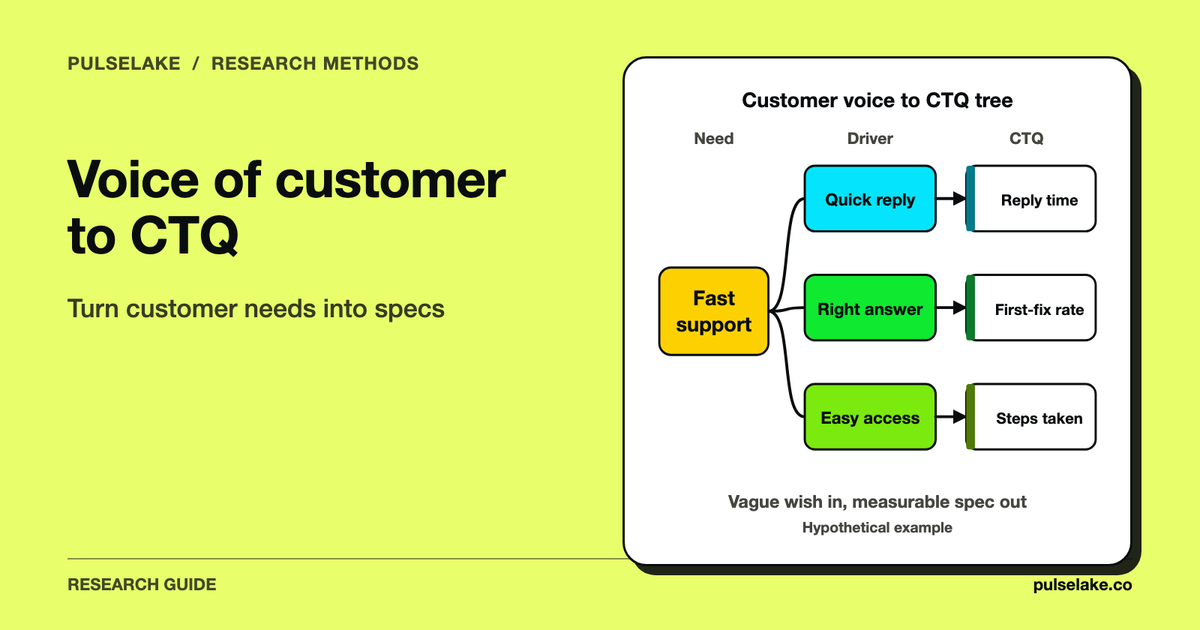
Six Sigma translates VoC into measurable requirements. One Six Sigma guide describes separating needs from wants, converting feedback into measurable requirements and using tools such as Pareto charts to prioritise (Six Sigma Institute). Quality-One describes a related step: linking customer "whats" to design "hows" in a House of Quality matrix (Quality-One). Use CTQ when you have to turn "it feels slow" into a number a process can be held to. Using VoC inside Six Sigma projects and building a standing VoC programme are separate topics, and we cover each in its own guide.
The collect-analyse-act loop
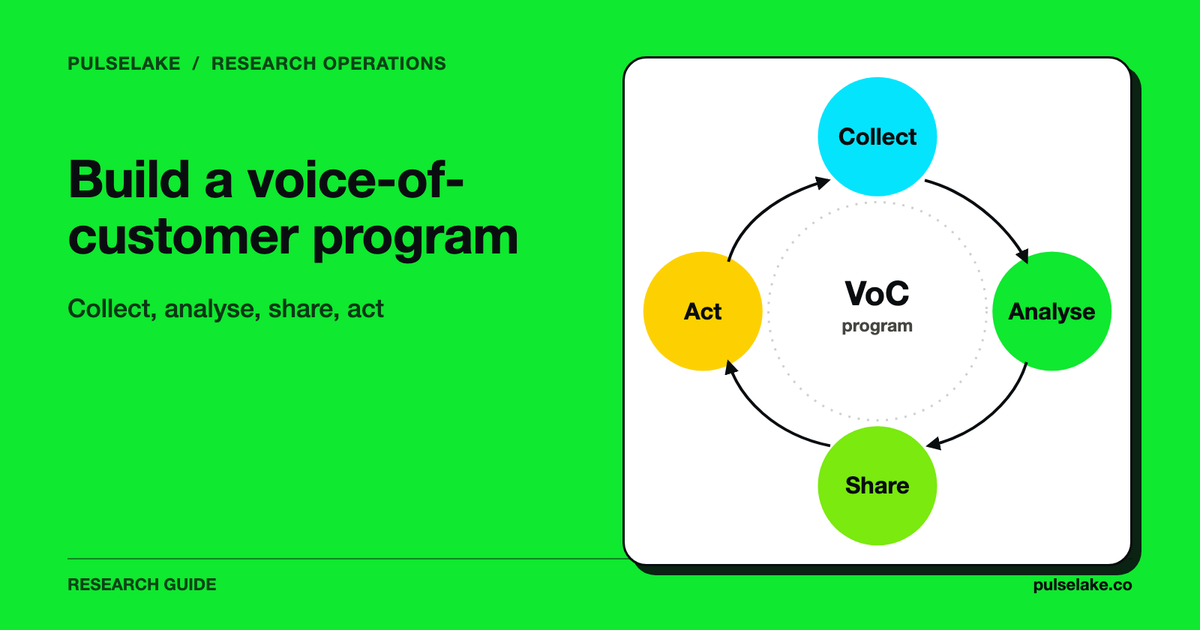
Thematic describes a five-stage programme model: collect, analyse, share, act, monitor (Thematic). It's less a research framework than an operating cycle, and it's where a lot of programmes stall. SurveyMonkey's guide, for example, ties surveys and qualitative deep dives to a cadence, from continuous transactional surveys to quarterly qualitative work (SurveyMonkey).
Which VoC framework should you choose?
| Your question | Start with |
|---|---|
| What do customers need from a new product or segment? | Needs hierarchy |
| Which features should we build or cut? | Kano |
| Where does the experience break down end to end? | Journey map |
| How do we set measurable targets from complaints? | CTQ |
| How do we run this continuously? | Collect-analyse-act loop |
Pick one primary framework and add others as the programme grows up. They complement each other. They don't compete.
How do you analyse VoC data?
Collection is rarely the weak spot. Analysis is. For open text, the standard approaches are thematic coding, sentiment analysis (best read alongside themes) and keyword or entity extraction (SurveyMonkey).
A practical sequence:
- Keep the customer's wording. Code from the original phrase, not a paraphrase.
- Build a codebook with a definition and an example for each theme, and write down exclusions.
- Have two people code a sample and compare. Disagreement usually means a theme is vague. Checks like this are easy to skip, and we think they're worth keeping.
- Count themes, but weight them too. A rare complaint from your highest-value segment can outrank a common one from a low-value segment.
- Keep observed feedback separate from your interpretation in the report.
If AI does the coding at scale, treat it as a first pass and check a sample against human coding; see qualitative coding at scale.
What are common VoC mistakes?
- Treating NPS or CSAT as the whole programme. A score with no reason behind it can't be acted on.
- Listening only to customers who contact you. Support data misses silent churners and non-buyers.
- Asking about solutions ("Would you like a dashboard?") instead of experiences.
- Collecting with no decision attached. Every study should name the decision it informs.
- Skipping consent and data-handling checks for recorded calls and transcripts.
- Never closing the loop. Telling customers what changed encourages them to keep giving feedback.
Where does PulseLake fit?
PulseLake supports traditional research, AI-led interviews with real participants, synthetic research and simulation. A persistent study context keeps objectives, methods and evidence together, with evidence provenance for answers drawn from study data. For VoC, that matters most in discovery and analysis: running interviews, coding responses, and keeping the link between a theme and the quotes behind it. It doesn't replace a support desk or a case-management system, and you should judge it against your own interview and analysis process.
Frequently asked questions
What does VoC stand for?
Voice of the Customer. The term covers both the process and the body of evidence it produces about customer needs, expectations and experiences, usually in the customers' own words.
What is the difference between VoC and customer satisfaction research?
Satisfaction research measures how customers rated past performance, while VoC explains why, capturing needs and reasons so scores can be interpreted and acted on. SurveyMonkey frames VoC as a diagnostic and satisfaction research as a measurement of past performance (SurveyMonkey).
What are stated, implied and silent customer needs?
Stated needs are the ones customers can put into words. Implied needs are taken for granted (a washing machine should clean clothes). Silent or latent needs are ones customers can't easily express, which you infer from context and observation. Sources differ on the exact terms; Hauser uses basic, articulated and exciting needs for a similar split (Hauser, MIT Sloan).
How often should you collect VoC?
That depends on the method. SurveyMonkey suggests continuous transactional surveys, relationship surveys every 6 to 12 months, and qualitative deep dives quarterly or per cohort (SurveyMonkey). Treat it as a starting point rather than a standard, and adjust to how fast your product and market move.
Who owns VoC in a company?
The sources we reviewed don't name a single owner. In practice it's shared: research or insights runs the studies, support and sales supply raw feedback, and product or operations decides what to act on. Name one person accountable for the loop, or findings won't reach decisions.
Can synthetic respondents replace real customers for VoC?
No, because VoC is about what real customers say and do. Synthetic respondents can help you test an interview guide or explore hypotheses before fieldwork, which is useful for speed and early direction, but their output should be labelled and validated against real customers.