Ad Testing in 2026: How to Test and Optimize Creative Concepts
How to test and optimize ad creative in 2026: concept testing, pre-testing and A/B tests, which metrics fit each stage, and where tools fit.
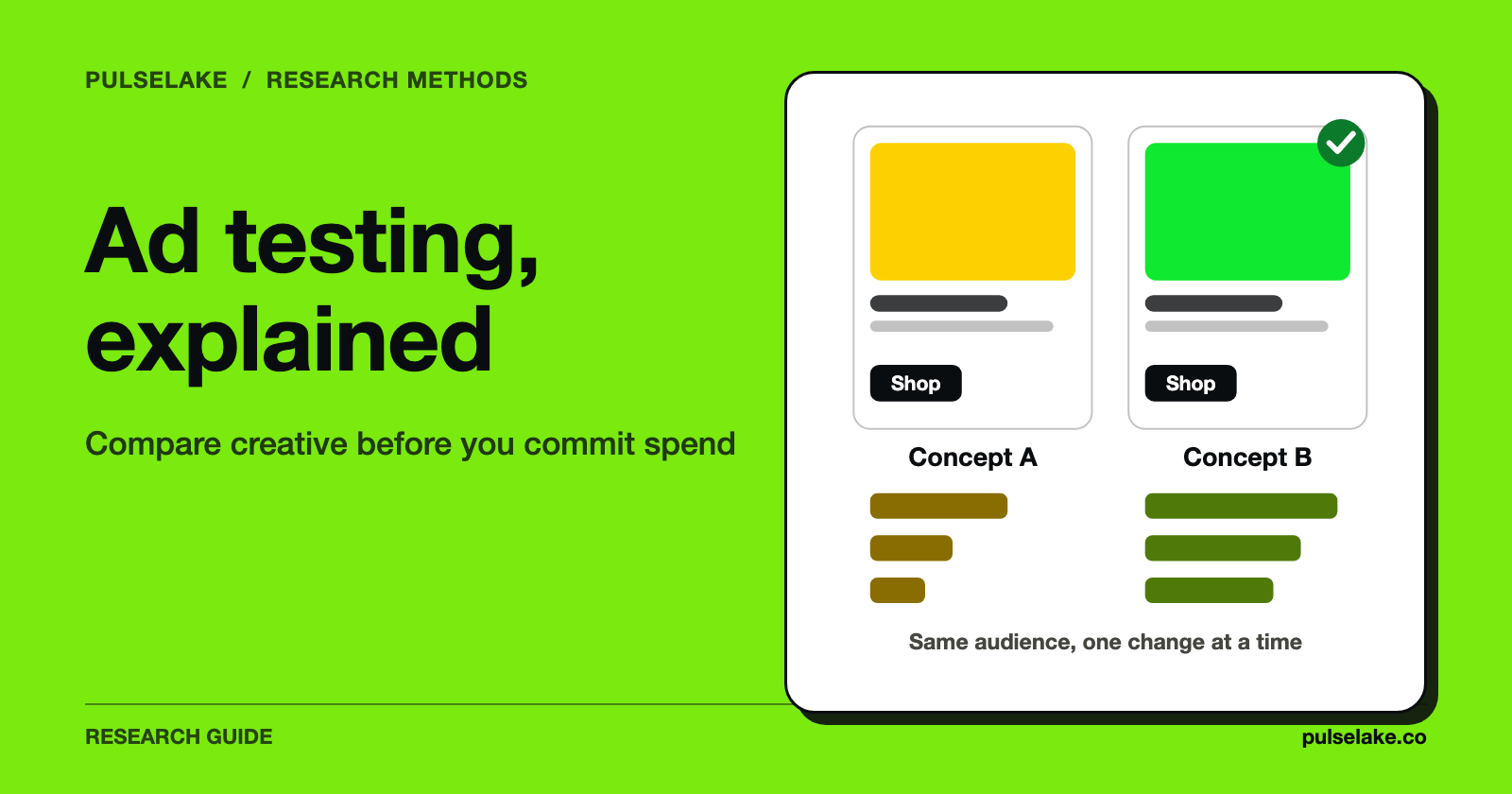
Ad testing means checking creative with real or modelled audiences before and during a campaign. The standard sequence is concept testing on early ideas, pre-testing on near-final ads, then live A/B tests that change one variable at a time. Each stage answers a different question, so most teams use more than one.
We make PulseLake, a research platform. PulseLake is not an ad-testing platform and does not run ad pre-tests with norms or benchmark databases; we explain below where it fits and where the tools named here are the better choice.

What are the main ad testing methods?
Most guides list the same family of methods. They differ in when they run, what they cost to run and what they can tell you.
| Method | When | Question it answers |
|---|---|---|
| Concept testing | Idea stage, before production | Is the idea clear and appealing to the right people? |
| Pre-testing | Near-final or finished ads, before launch | How will people respond, and what should we fix? |
| A/B testing | Live, in market | Which of two versions performs better on a chosen metric? |
| Multivariate testing | Live, with enough traffic | Which combination of elements works best? |
| Brand lift and incrementality | Live, after launch | Did the ad change awareness or sales that would not have happened anyway? |
| Qualitative feedback | Any stage | Why do people react the way they do? |
A/B results tell you which version won, not why. Pre-test and qualitative methods do the opposite: they explain reactions but cannot show real-world behaviour. That gap is the reason to combine them.
What is the difference between pre-testing and A/B testing?
Pre-testing evaluates creative before it runs, usually with a survey panel, attention or emotion measurement, or a model trained on past test results. Its advantage is that mistakes are cheap to fix. A weak script costs little to change; a weak finished film costs a lot.
A/B testing runs two or more versions in a live channel and compares them on a metric such as click-through or conversion. Its advantage is that it measures real behaviour. Its limits are that it needs live spend, needs enough audience to separate the versions, and says little about brand effects that do not show up as an immediate click.
A practical rule: pre-test when production is expensive or the creative must work across many markets, and A/B test when you can iterate cheaply in a digital channel. For big campaigns, do both.
How do you test creative concepts before production?
Concept testing is the earliest and cheapest stage. You show a short description, storyboard or rough visual and ask a defined audience a small set of questions.
- Write each concept in the same format and length so format does not drive the result.
- Define the audience before you test. A concept that works for existing customers can fail with new ones.
- Ask about comprehension first ("What is this ad telling you?"), then relevance, then intent. If people cannot restate the message, appeal scores do not matter.
- Include a plain open-ended question about confusion or doubts.
- Decide in advance what result would make you drop a concept.
Our guide to concept test questions covers wording in more detail.
Hypothetical example: a software company has three taglines for a launch ad. Respondents see one each. Tagline A is understood by most respondents but called "generic" in comments; tagline C is understood by fewer but triggers specific use cases. That pattern suggests rewriting C for clarity rather than shipping A.
How do you A/B test ads properly?
The common rule across platforms is to change one variable at a time. As of October 2026, Meta's A/B testing page says its tool splits the audience into random, non-overlapping groups, that only one variable should differ between versions, and that an adequate budget helps produce confident conclusions. It also says running separate campaigns side by side without the tool can skew delivery and budget distribution.
As of October 2026, Google's help page on custom experiments says advertisers choose how long an experiment runs and what share of traffic and budget the trial gets, then compare the trial with the original campaign and apply the changes if the trial performs better.
Steps that apply on any platform:
- State a hypothesis ("A shorter first line will raise clicks") before building variants.
- Change one element: headline, image, opening seconds, offer or call to action.
- Pick one primary metric and decide the duration before you start, so you do not stop the test when the numbers look good.
- Keep audience, budget and schedule the same across versions.
- Record the result even when there is no winner. "No difference" is useful: it tells you the element does not matter.
Multivariate tests vary several elements at once. They find combinations but need more traffic, so they suit large accounts more than small ones.
Which metrics should you use to judge creative?
Match the metric to the stage:
- Concept stage: comprehension, relevance, intent, stated confusion.
- Pre-test: attention, emotional response, branding (does the viewer know who the ad is for), message takeaway.
- Live test: click-through, conversion, cost per result, and for video, view-through.
- After launch: brand lift or incrementality, where the channel supports it.
Do not judge a brand-building ad by click-through alone, and do not judge a direct-response ad by liking alone.
Which tools and providers are used for ad testing?
The list below is not a ranking. Each "best for" line is our summary of what the provider's own public page describes as of October 2026. Prices are omitted.
- System1 Test Your Ad: best for measuring emotional response to ads. Its page describes second-by-second emotional tracking, testing of scripts, storyboards and animatics as well as finished ads, and results from 24 hours.
- Kantar (LINK+ and LINK AI): best for large advertisers that want survey-based and AI-based testing in one place. Its page says LINK AI screens ads at volume, including ones that often go untested, and that results can arrive in as few as 6 hours.
- Zappi: best for insights teams in consumer sectors that want to test TV ads, storyboards, early campaign ideas and digital ads across its consumer insights platform. Its page names CPG, QSR and dining, finance and telecommunications.
- PickFu: best for quick, small polls on ads, landing pages and messaging. Its page describes a respondent panel that votes and leaves written feedback, within minutes to hours.
- Meta A/B testing and Google Ads custom experiments: best for live tests inside those channels, since they use the platform's own delivery.
These providers describe their own results. We have not verified independent validation of prediction accuracy for any of them, so ask each for a validation study and compare predictions with your own past campaigns.
Can AI predict how an ad will perform?
Some providers now offer AI screening that estimates performance from patterns in past test data rather than from a fresh sample of people. As of October 2026, Kantar's page lists LINK AI as a separate offer alongside its LINK+ ad testing, so it is positioned as an addition for volume screening.
Treat AI scores as a way to screen many options quickly. For a high-stakes campaign, confirm the shortlist with real respondents or a live test.
Where does PulseLake fit?
PulseLake supports surveys and other traditional research, and it supports synthetic research, which uses explicit, versioned synthetic personas to test instruments, concepts and hypotheses with a path into human validation. In ad testing, that makes it relevant for early work: drafting a concept test questionnaire, comparing rough messages, and deciding what to test with real people.
Synthetic results are directional hypotheses, not evidence of how real audiences will react. See how accurate synthetic respondents are and synthetic respondents and their limits. If you need emotional measurement, benchmark norms or channel-level delivery tests, use one of the providers above.
Frequently asked questions
What is ad testing?
Ad testing is the practice of checking advertising creative with audiences, or with models of audiences, to learn how it is understood and how it performs. It covers concept tests, pre-tests before launch and live tests such as A/B experiments.
How many ad variants should you test at once?
Fewer is usually better. Each extra variant splits your audience and budget further, which makes it harder to reach a clear result. Meta's tool allows up to five variants, but a small account often learns more from two.
How long should an ad A/B test run?
Long enough to collect a meaningful number of results for your primary metric, and fixed before you start. The right length depends on your traffic and conversion rate. Check the current guidance on the platform you are using, as it changes.
Is pre-testing worth it for small budgets?
Often a light version is. A small concept test or a quick poll costs far less than producing the wrong ad. Full pre-testing platforms make most sense when production or media spend is large, or when the ad runs in many markets.
What is the difference between ad testing and creative optimization?
Ad testing is the measurement step. Creative optimization is what you do with the result: revise the message, change the visual, reallocate spend or retire an ad. A test without a decision attached rarely improves anything.
Can you test ads without a panel or live spend?
Yes, in limited ways: internal reviews against a written checklist, interviews with a few target customers, and AI screening. These are weaker than testing with a representative audience, so treat the results as early signals.