 PulseLake
AI Assisted Root Cause Analysis
AI assisted root cause analysis connects evidence to reveal plausible causes, test hypotheses, and guide decisions without replacing researcher judgment.

AI assisted root cause analysis uses artificial intelligence to help researchers identify plausible underlying explanations for an observed problem. It connects patterns across findings, feedback, behavioral data, prior investigations, and contextual evidence; organizes possible contributing factors; and highlights questions to validate. AI supports hypothesis development, while researchers determine whether evidence justifies a causal conclusion.
The distinction matters because solving a symptom can leave its mechanism untouched, while an unsupported explanation can send a team toward the wrong intervention. A disciplined process makes uncertainty visible and directs research toward the most consequential gaps. The short video above walks through the core ideas.
What is AI assisted root cause analysis?
AI assisted root cause analysis is a structured way to investigate why an observed outcome may be occurring. Rather than treating a visible problem as the explanation, researchers use AI to examine related evidence and develop stronger hypotheses about underlying mechanisms.
For example, workflow analytics might show that users frequently abandon a particular process. That observation describes what is happening, but it does not explain why. Possible contributing factors could include unclear expectations, confusing interactions, missing information, or organizational barriers outside the product itself.
AI helps bring those possibilities into view by finding relationships across customer feedback, behavioral patterns, previous findings, and contextual information. The result is not an automatically proven cause. It is a more organized set of explanations that researchers can evaluate and test.
How does AI assisted root cause analysis work?
The process moves from a clearly defined symptom to connected evidence, candidate explanations, and validation. Each stage should preserve the distinction between what is known, what is inferred, and what still needs investigation.
- Define the observed problem. State the outcome precisely without building an assumed cause into the problem statement.
- Connect relevant evidence. Gather findings, feedback, behavioral data, previous investigations, and contextual information related to the outcome.
- Generate competing hypotheses. Use AI to organize patterns and propose several plausible explanations rather than one preferred story.
- Validate likely causes. Check each explanation against its supporting and contradictory evidence, then design further research where gaps remain.
This division of labor treats AI as a research assistant rather than an autonomous judge. Researchers retain responsibility for interpreting context, evaluating evidence, and approving conclusions, consistent with the principles of using AI as a research assistant instead of a decision maker.

What evidence does root cause analysis need?
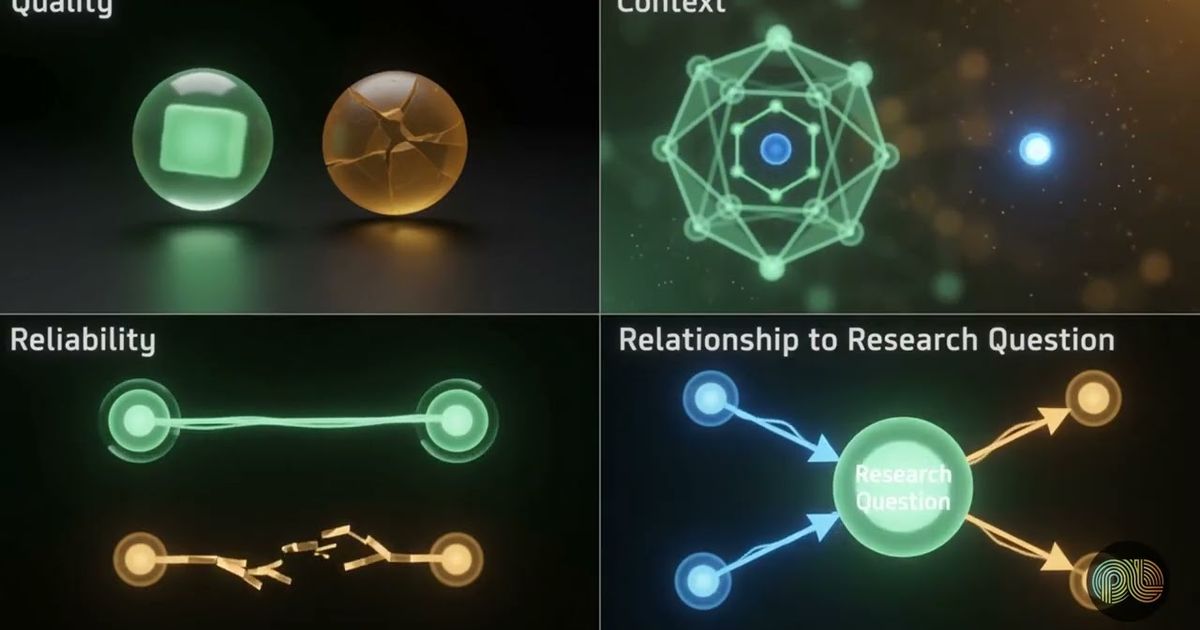
Effective analysis needs relevant, credible, and traceable evidence. AI can connect information efficiently, but its hypotheses will only be as dependable as the sources and relationships available to it.
A strong evidence structure links observations, findings, hypotheses, and supporting sources. Researchers should be able to move from a proposed cause back to the underlying interviews, survey responses, behavioral records, or prior investigations that support it. Contradictory evidence should remain visible as well.
Evidence quality also includes context. A complaint may have different implications across customer segments, product versions, workflows, or time periods. Without those distinctions, superficially similar observations can be grouped together even when they arise from different mechanisms.
This is why building AI-ready research data requires more than collecting documents. The material needs consistent structure, metadata, lineage, and relationships so both researchers and AI systems can assess where a claim came from.
What mistakes should you avoid?
The central mistake is treating a plausible pattern as a proven cause. Root cause analysis often involves uncertainty, incomplete evidence, and several factors interacting at once, so researchers need to test alternative explanations rather than accept the most attractive narrative.
Common mistakes include:
- Confusing correlation with causation. Two patterns occurring together do not establish that one produced the other.
- Ignoring competing causes. A workflow problem may reflect interface design, expectations, missing guidance, process constraints, or a combination of factors.
- Losing source traceability. A hypothesis becomes difficult to evaluate when its supporting findings cannot be inspected.
- Using weak or poorly connected evidence. Incomplete context can steer AI toward explanations that sound coherent but lack sufficient support.
Researchers should document uncertainty, look for disconfirming evidence, and identify what additional research would distinguish between hypotheses. The goal is not to force a single answer but to build an evidence-based account strong enough to guide a decision or the next investigation.

Key takeaways
- AI assisted root cause analysis helps researchers move from visible symptoms to plausible underlying explanations.
- AI can connect evidence, organize contributing factors, generate hypotheses, and identify gaps requiring further investigation.
- Human expertise remains necessary to assess context, evidence quality, uncertainty, and causal claims.
- Structured knowledge and source traceability reduce the risk of attractive but unsupported explanations.
- Rigorous validation creates a stronger foundation for informed decisions and evidence-based solutions.
How PulseLake helps
PulseLake keeps objectives, evidence, findings, decisions, and prior studies in a persistent study context supported by a research knowledge graph and evidence provenance. Cross-study search, deep research, and specialized agents can help teams examine connected information and develop hypotheses while researchers retain judgment and approvals. To discuss how this approach could fit your research system, talk to our team.
Frequently asked questions
Can AI prove what caused a research finding?
AI cannot independently prove the true cause of a research finding. It can detect relationships, organize evidence, and propose explanations, but causal conclusions require an appropriate research design, credible evidence, contextual judgment, and validation. Researchers should treat AI-generated explanations as hypotheses unless the available evidence supports a stronger claim.
Which data sources can support AI assisted root cause analysis?
Useful sources can include qualitative interviews, open-ended feedback, survey findings, behavioral data, support records, previous investigations, and relevant contextual information. The appropriate mix depends on the problem. Sources should be connected to their origin, population, time period, and methodology so researchers can judge relevance and quality.
How should researchers validate an AI-generated root cause hypothesis?
Researchers should inspect the supporting sources, search for contradictory evidence, compare alternative explanations, and assess whether the proposed mechanism fits the context. They can then collect targeted evidence through interviews, surveys, experiments, usability research, or further behavioral analysis. Validation should focus on distinguishing among plausible causes, not merely confirming the first explanation.
Can a problem have more than one root cause?
Yes. Many research problems arise from several interacting factors rather than one isolated cause. For example, workflow abandonment could reflect confusing interactions, missing information, and an organizational approval barrier at the same time. Analysis should represent these relationships and avoid simplifying a complex mechanism into a single unsupported explanation.