 PulseLake
AI Output Verification: A Practical Process
AI output verification checks generated answers for accuracy, completeness, grounding, context, and fitness for purpose before they influence decisions.

AI output verification is the practice of checking whether a generated response is accurate, complete, grounded in available evidence, faithful to instructions and context, and suitable for its intended purpose. It also tests whether claims are traceable, uncertainty is clear, and evidence is separated from interpretation before the output informs decisions.
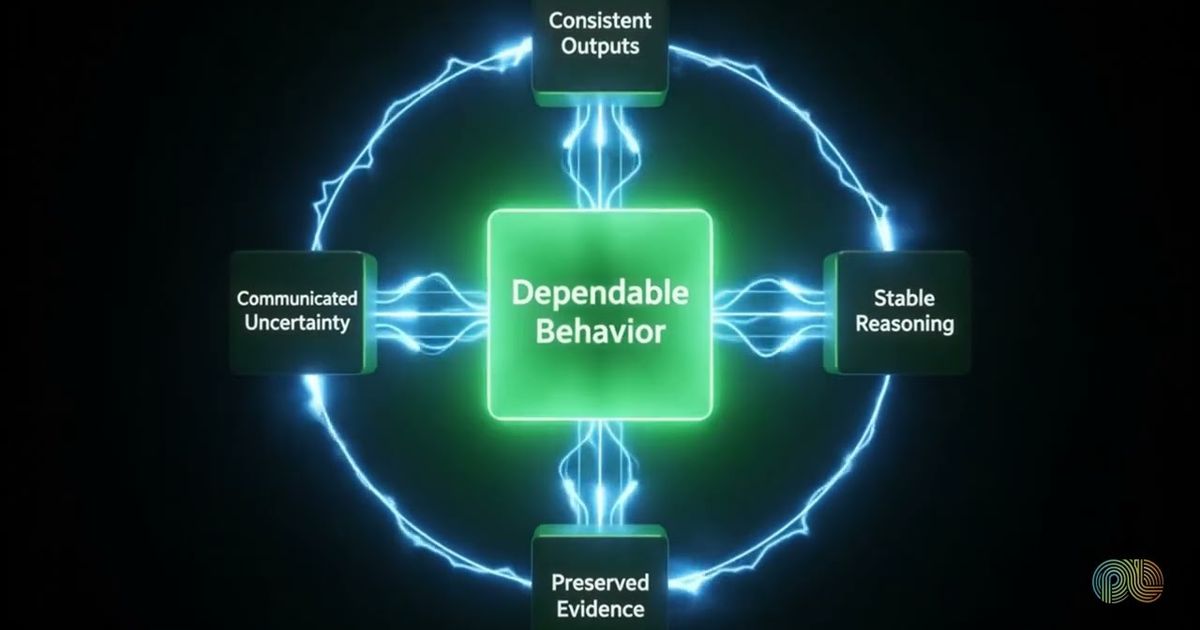
Unchecked errors can spread through reports, presentations, decisions, and organizational knowledge. A systematic review process turns AI from an informal source of suggestions into a participant in a controlled research workflow. The two-minute video above walks through the core ideas.
What is AI output verification?
AI output verification is a structured assessment of a generated response against its source evidence, instructions, research objective, and intended use. It goes beyond checking isolated facts.
A response may contain accurate statements while still being misleading because it omits an important limitation, ignores conflicting evidence, or presents interpretation as established fact. Verification therefore considers the output as a whole: what it says, what it leaves out, how strongly it states its conclusions, and whether it answers the original question.
This practice is especially important in research because generated content often moves into executive summaries, presentations, dashboards, and knowledge repositories. Once incorporated into those assets, an unsupported conclusion can become difficult to distinguish from validated evidence.
What should an AI output verification process check?
A useful verification process checks accuracy, completeness, grounding, instruction adherence, and fitness for purpose. These dimensions catch different kinds of failure and should not be collapsed into a single general judgment.
Reviewers should ask whether:
- Every significant factual claim is supported by available evidence.
- The response preserves relevant context and follows the original instructions.
- Important limitations, qualifications, or contradictory findings were omitted.
- Interpretations are clearly distinguished from direct evidence.
- Uncertainty is communicated when the evidence does not justify a definitive conclusion.
- The format, level of detail, and language suit the intended audience and decision.
These checks complement a broader process for evaluating AI-generated research outputs, which should consider both technical correctness and practical usefulness.
How should teams verify AI-generated research outputs?
Teams should begin with the evidence used to produce the response, trace important claims back to that evidence, and then evaluate the output against explicit criteria. Approval should depend on the output’s intended use and associated risk.
A practical sequence is:
- Review the source evidence. Confirm that the underlying documents, data, or research materials are relevant and sufficient for the question.
- Trace significant claims. Identify where each major assertion comes from and whether the source supports the wording and strength of the claim.
- Test completeness and balance. Look for missing limitations, ignored contradictions, lost context, and conclusions that go beyond the evidence.
- Assess fitness for use. Confirm that the response follows instructions, addresses the research objective, communicates uncertainty, and is appropriate for its audience.
Clear verification criteria make reviews more consistent. They also help teams document why an output was accepted, revised, or rejected instead of relying on an undefined sense that it “looks right.”

Why should automated checks and human review work together?
Automated checks and human review address different verification needs. Automation handles repeatable tests efficiently, while people evaluate meaning, nuance, and decision relevance.
Automated checks can flag missing references, inconsistent statements, formatting problems, or obvious contradictions. They can also confirm that required sections or fields are present before a response reaches a reviewer.
Human reviewers contribute domain expertise and contextual judgment. They determine whether reasoning is plausible, evidence has been interpreted fairly, uncertainty is appropriately expressed, and the answer genuinely satisfies the research objective. Neither approach is sufficient alone: automation can miss subtle misinterpretations, while manual review can be inconsistent or overlook mechanical errors.

How can verification be built into the research workflow?
Verification should operate throughout the research workflow rather than appear only as a final quality inspection. Good research infrastructure makes outputs easier to inspect before errors spread downstream.
Several foundations support routine verification:
- Structured knowledge makes relevant evidence easier to locate and compare.
- Evidence lineage connects conclusions to their underlying sources.
- Reliable retrieval reduces the chance that generation starts from incomplete material.
- Grounded generation keeps responses tied to an approved evidence base.
- Clear evaluation criteria make acceptance decisions repeatable.
- Defined approvals ensure consequential outputs receive appropriate review.
Building AI-ready research data supports this process by improving structure, context, and reuse. When verification is part of each stage, teams can identify issues before a conclusion enters a report, influences a decision, or becomes part of the organizational knowledge base.
Key takeaways
- AI output verification checks more than factual accuracy; it also assesses completeness, grounding, context, uncertainty, and intended use.
- Every significant claim should be traceable to supporting evidence.
- Automated checks and human judgment provide stronger assurance when used together.
- Verification works best when embedded throughout the research workflow.
- Structured evidence, lineage, retrieval, and clear criteria make verification more reliable.
How PulseLake helps
PulseLake keeps objectives, methodology, evidence, analysis, and decisions in a persistent study context. Its research intelligence capabilities support evidence provenance, cross-study search, and natural-language questions, while specialized agents and approval workflows help teams combine AI assistance with researcher judgment. To discuss how this could fit your research operation, talk to our team.
Frequently asked questions
How can a reviewer tell whether an AI answer is grounded in evidence?
A grounded answer allows its significant claims to be traced to relevant source material. The reviewer should compare each major assertion with the cited data, document, or research record and confirm that the source supports both the claim and its strength. Grounding also requires preserving qualifications, contradictions, and uncertainty rather than selecting only convenient evidence.
Does every AI-generated research output require human review?
The appropriate level of human review depends on the output’s purpose and potential consequences. Automated checks may be sufficient for identifying routine formatting defects or missing fields, but outputs that shape decisions, reports, or organizational knowledge should receive suitable expert oversight. A risk-based process can define which outputs require approval and who is qualified to provide it.
What should teams record during AI output verification?
Teams should preserve the question or instruction, the evidence used, the generated output, the evaluation criteria, and any corrections or approval decisions. Recording relevant model or workflow versions can also help explain how an output was produced. This creates lineage between source evidence, generated claims, reviewer judgment, and the final approved result.