Reference-Based Evaluation for AI Outputs
Reference-based evaluation compares AI outputs with trusted answers, helping researchers assess accuracy, completeness, grounding, and consistency over time.

Reference-based evaluation assesses an AI-generated response against one or more trusted answers created through expert review or validated evidence. It measures whether the output includes essential information, preserves the correct meaning, avoids unsupported additions, and reaches conclusions consistent with the reference—not whether it uses identical wording.
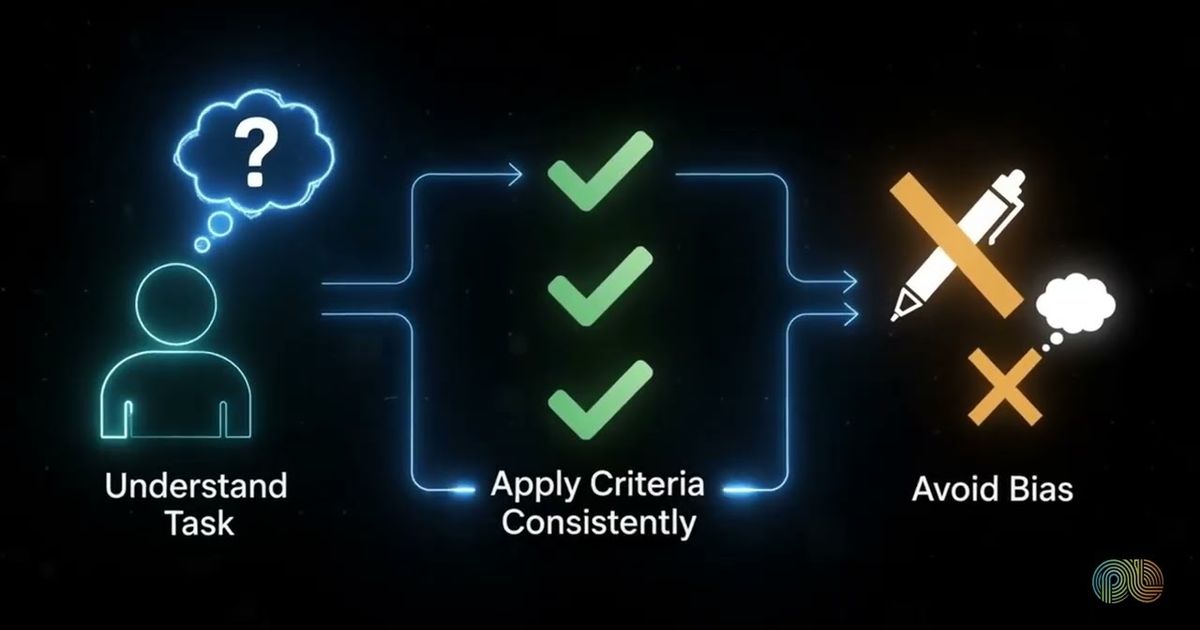
This approach gives researchers a stable benchmark for repeatable AI tasks while recognizing that quality cannot always be reduced to similarity. The short video above walks through the core ideas.
What is reference-based evaluation?
Reference-based evaluation is a method for judging AI outputs against established examples of the expected result. Those examples act as ground truth when a task has known answers, trusted precedents, or outputs that experts have carefully reviewed.
A reference may be a single approved answer or several valid answers that represent different acceptable approaches. It should reflect the evidence and quality standard relevant to the task rather than simply copying a convenient prior output. Building dependable references follows many of the same principles as creating gold standard datasets.
The method focuses on substantive alignment. An evaluator examines whether the generated response:
- Covers the important information in the reference.
- Preserves the correct meaning and relationships between ideas.
- Avoids claims that the evidence does not support.
- Produces conclusions consistent with the reference material.
Surface differences are usually acceptable. An AI response can reorganize information, choose different words, or explain an idea more clearly while still meeting the reference standard.
When should you use reference-based evaluation?
Reference-based evaluation works best for repeatable tasks where reliable examples can be prepared in advance. It is especially useful when outputs must preserve factual content or follow a consistent interpretation of source evidence.
For example, consider an AI system that summarizes research reports. A reviewed reference summary might identify the essential findings, important limitations, and evidence supporting each conclusion. Evaluators can check whether an AI-generated summary represents those elements accurately without adding claims absent from the original report.
Other suitable applications include extracting facts from documents, answering questions with known answers, classifying material into established categories, and producing standardized research deliverables. The task does not need to have only one possible phrasing, but it does need a defensible quality standard.
Reference-based evaluation also supports comparisons across:
- Model versions.
- Prompt designs.
- Workflow changes.
- Evaluation periods.
Because every output is assessed against the same established standard, researchers can identify performance changes more consistently over time. This makes reference-based tests a useful component of broader AI output verification.
How should you compare an AI output with a reference?
Compare meaning and evidence before comparing wording. A useful evaluation separates the reference into important content requirements, then checks whether the generated output represents each requirement accurately.
Start by confirming that the reference itself is trustworthy. It should be based on validated evidence or expert review, cover the task’s essential requirements, and avoid treating stylistic preferences as factual standards.
Next, evaluate the generated output across several dimensions:
- Coverage: Does it include the essential findings or facts?
- Meaning: Does it preserve the intended interpretation and relevant nuance?
- Grounding: Are its claims supported by the source material?
- Consistency: Do its conclusions remain compatible with the trusted answer?
For a research summary, an output that mentions every major finding but omits a critical limitation is incomplete. An output that includes the limitation but invents a supporting statistic is ungrounded. Both problems matter even if the wording otherwise resembles the reference.
Scoring can be binary for tightly defined facts or graduated for dimensions such as completeness and meaning. Whatever method is chosen, evaluators should document the criteria so comparisons remain consistent across outputs and evaluation rounds.

What are the limitations of reference-based evaluation?
Reference-based evaluation can undervalue useful answers when a task allows several equally valid responses. Differences in organization, emphasis, explanation, or level of detail do not necessarily indicate lower quality.
A response may solve the user’s problem effectively without closely resembling the chosen reference. Conversely, an output may echo the reference’s wording while omitting nuance or adding unsupported information. Similarity alone is therefore an incomplete measure of quality.
The reference can also constrain the evaluation if it represents only one acceptable perspective. Researchers should use multiple references when appropriate and update them when evidence, requirements, or quality expectations change.
For open-ended research tasks, combine reference comparison with structured rubrics and human judgment. Rubrics make dimensions such as accuracy, completeness, relevance, and grounding explicit, while human reviewers can recognize valid alternatives and practical usefulness. Together, these methods provide a fuller assessment without giving up the consistency of a shared benchmark.

Key takeaways
- Reference-based evaluation compares AI outputs with trusted answers grounded in expert review or validated evidence.
- Good evaluation rewards accurate meaning and essential content rather than identical wording.
- Stable references support benchmarking across models, prompts, workflows, and evaluation periods.
- Reference similarity cannot fully capture quality when several answers may be equally valid.
- Human judgment and structured rubrics complement reference-based evaluation for open-ended tasks.
How PulseLake helps
PulseLake keeps objectives, methods, evidence, outputs, and decisions in one persistent study context, helping teams evaluate AI work against traceable research evidence. Its calculation mode computes answers against study data, while specialized agents can support analysis and reporting with researchers retaining judgment and approvals. Workflow automation can make QA and review steps repeatable; to discuss an evaluation workflow, talk to our team.
Frequently asked questions
Can reference-based evaluation use more than one trusted answer?
Yes. Multiple trusted answers are useful when a task permits different valid structures, explanations, or conclusions. Each reference should still be supported by validated evidence or expert review. A broader reference set reduces the risk of penalizing a strong output merely because it differs from one preferred example.
How often should reference answers be updated?
Reference answers should be reviewed whenever source evidence, task requirements, or quality standards change. They should also be checked when repeated evaluations reveal valid outputs that the current references fail to represent. Versioning references helps researchers understand whether performance changes come from the AI system or from a revised evaluation standard.
Does low text similarity mean an AI answer is incorrect?
No. Low text similarity may simply reflect different wording, organization, emphasis, or explanation. Evaluators should check whether the response includes the important information, preserves correct meaning, avoids unsupported additions, and reaches conclusions consistent with the evidence. Semantic quality matters more than word-for-word overlap.