Human Preference Evaluation for AI Outputs
Human preference evaluation compares AI outputs with structured human judgment to identify responses that are clearer, grounded, useful, and actionable.

Human preference evaluation is the structured comparison of AI outputs using human judgment. Reviewers apply predefined criteria—including clarity, relevance, completeness, reasoning quality, factual grounding, and usefulness—to determine which response better serves an intended task. It reveals quality differences that correctness scores and automated metrics may miss.
The method matters because two factually similar answers can differ substantially in context, organization, uncertainty, and practical value. Structured judgment helps teams distinguish genuine quality from surface polish. The two-minute video above walks through the core ideas.
What is human preference evaluation?
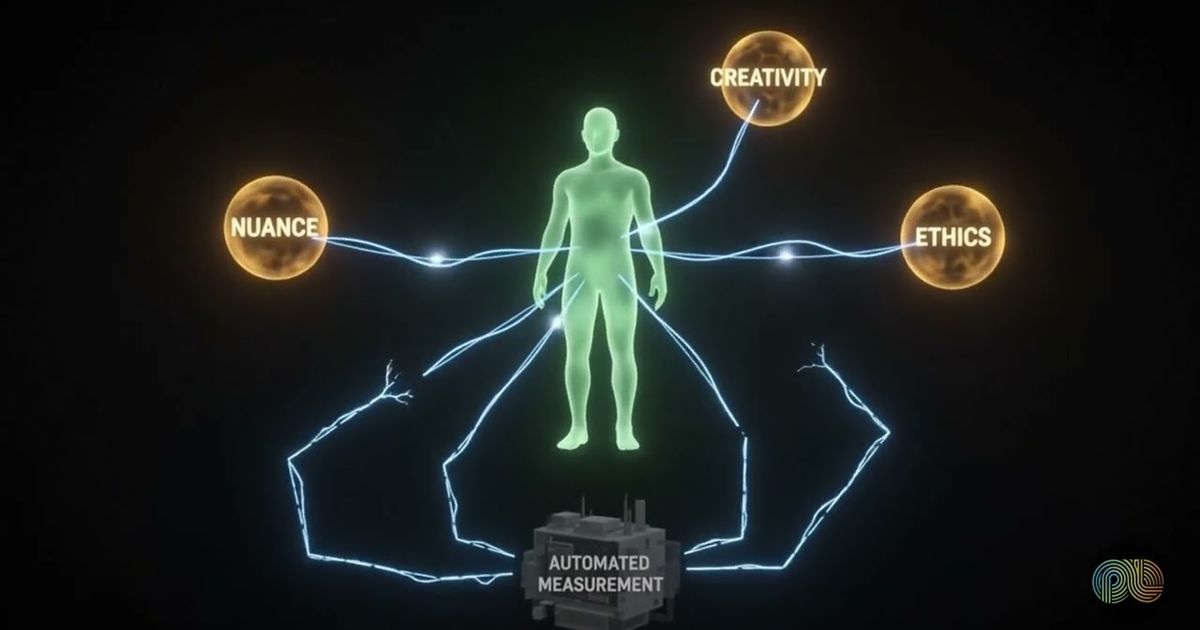
Human preference evaluation asks people to compare AI-generated responses and judge which one better satisfies a defined user need. It complements automated measurement by capturing qualities that are difficult to represent with a numerical score alone.
Teams commonly present reviewers with two or more outputs produced for the same prompt. Reviewers may select the better response, rank several responses, or score each one against a rubric. The task and criteria should remain consistent so the evaluation measures meaningful differences rather than changing expectations.
The objective is not to collect personal favorites. It is to identify recurring characteristics associated with better outcomes across many comparisons. An effective process therefore records why a response was preferred, not only which response won.
Automated checks can still assess measurable properties or flag obvious errors. Human judgment adds the ability to recognize whether an answer preserves context, handles uncertainty appropriately, and gives the user something useful to act on. A broader framework for evaluating LLM outputs can combine both perspectives.

What criteria should human reviewers use?
Reviewers should assess outputs against criteria tied to the intended task. A rubric turns broad ideas about quality into shared standards that can be applied and explained consistently.
Common criteria include:
- Clarity: Is the response understandable, organized, and appropriately direct?
- Relevance: Does it address the actual question without distracting material?
- Completeness: Does it include the information needed for the task without omitting important context?
- Reasoning quality: Do the conclusions follow logically from the available evidence?
- Factual grounding: Are claims supported by the source material or other permitted evidence?
- Usefulness: Can the intended user apply the response to the decision or task at hand?
These criteria often reveal differences between outputs that appear equally accurate. For example, two summaries of the same research report may preserve the main facts, but only one may identify actionable findings, acknowledge uncertainty, and retain qualifications that affect interpretation.
Reviewers should consider writing style only when it affects comprehension or fitness for purpose. A polished answer should not outrank a less elegant response if it contains unsupported conclusions, loses essential evidence, or misrepresents confidence.
How do you run a reliable preference evaluation?
Reliable evaluation requires a clearly defined task, a practical rubric, and review instructions that different evaluators can apply in the same way. Consistency makes preference decisions easier to reproduce and diagnose.
A basic process involves four steps:
- Define the task and user. State what the AI response should accomplish, who will use it, and what evidence it may rely on.
- Create the rubric. Describe each criterion in observable terms and clarify how reviewers should handle trade-offs, such as completeness versus concision.
- Review comparable outputs. Give evaluators the same prompt, source context, criteria, and response format. Hide irrelevant model labels when they could influence judgment.
- Capture decisions and reasons. Record the preference along with a concise explanation tied to the rubric.
Evaluators need enough task knowledge to recognize factual and contextual problems. They should apply the same standards across responses and avoid letting personal opinions, tone preferences, or superficial fluency outweigh evidence quality.
When reviewers disagree, the disagreement can expose an unclear criterion, an ambiguous task, or a genuine trade-off. Teams can examine those cases, refine the rubric, and document how similar decisions should be handled in later evaluations.

How does human preference feedback improve AI systems?
Preference feedback supports continuous improvement by turning repeated judgments into identifiable quality patterns. Teams can use those patterns to improve models, prompts, evaluation rules, and the workflows surrounding AI-generated outputs.
Review explanations may reveal recurring weaknesses such as unsupported conclusions, missing evidence, poor organization, ignored uncertainty, or answers that do not address the intended decision. Those patterns are more actionable than a single overall score because they show what needs to change.
Teams can group feedback by task, criterion, model or prompt version, then compare whether later changes reduce the same failure modes. Preference evaluation can therefore become part of continuous AI evaluation rather than a one-time acceptance test.
Human feedback should remain connected to the original prompt, evidence, rubric, output version, and reviewer rationale. That context makes results auditable and helps teams distinguish a model problem from weak instructions, missing source material, or an unsuitable workflow.
Key takeaways
- Human preference evaluation compares AI outputs according to defined user needs rather than personal taste.
- Reviewers should assess clarity, relevance, completeness, reasoning, factual grounding, and practical usefulness.
- Clear rubrics and consistent instructions reduce variation and make judgments easier to explain.
- Human review captures context, uncertainty, and actionability that automated measurements may miss.
- Recurring feedback patterns can guide model development, prompt refinement, and workflow design.
How PulseLake helps
PulseLake can keep evaluation questions, criteria, evidence, outputs, and decisions within a persistent study context. Its research intelligence, evidence provenance, governance foundations, specialized AI agents, and repeatable workflows can support structured review while researchers retain judgment and approvals. To discuss how this could fit an AI evaluation process, talk to our team.
Frequently asked questions
Can human preference evaluation replace factual accuracy checks?
No. Human preference evaluation complements factual accuracy checks rather than replacing them. Reviewers can determine whether an answer is clearer, more relevant, or more useful, but factual claims still need verification against permitted evidence. A strong evaluation process treats factual grounding as a core criterion and uses automated or manual verification where appropriate.
How can reviewers avoid choosing a polished but unsupported AI answer?
The rubric should explicitly prioritize factual grounding, reasoning quality, and preservation of important context. Reviewers should receive the source material needed to check claims and explain preferences with reference to the criteria. If attractive wording hides unsupported conclusions or overstated certainty, the response should not receive preference based on style alone.
Is pairwise comparison better than scoring each AI response separately?
Pairwise comparison often makes subtle differences easier to recognize because reviewers assess outputs for the same task side by side. Separate scoring can provide criterion-level information and support comparisons across a larger evaluation set. Teams may combine both approaches by choosing a preferred response and recording scores or reasons that explain the decision.
What should teams do when human evaluators disagree?
Disagreement should be examined rather than automatically treated as reviewer error. It may indicate unclear instructions, overlapping criteria, insufficient task context, or a legitimate trade-off between qualities such as concision and completeness. Reviewing the rationales helps teams refine the rubric and document how similar cases should be evaluated in the future.