Pairwise Evaluation for AI Outputs
Pairwise evaluation compares two AI outputs against shared criteria, producing more consistent judgments for prompts, models, and research workflows.

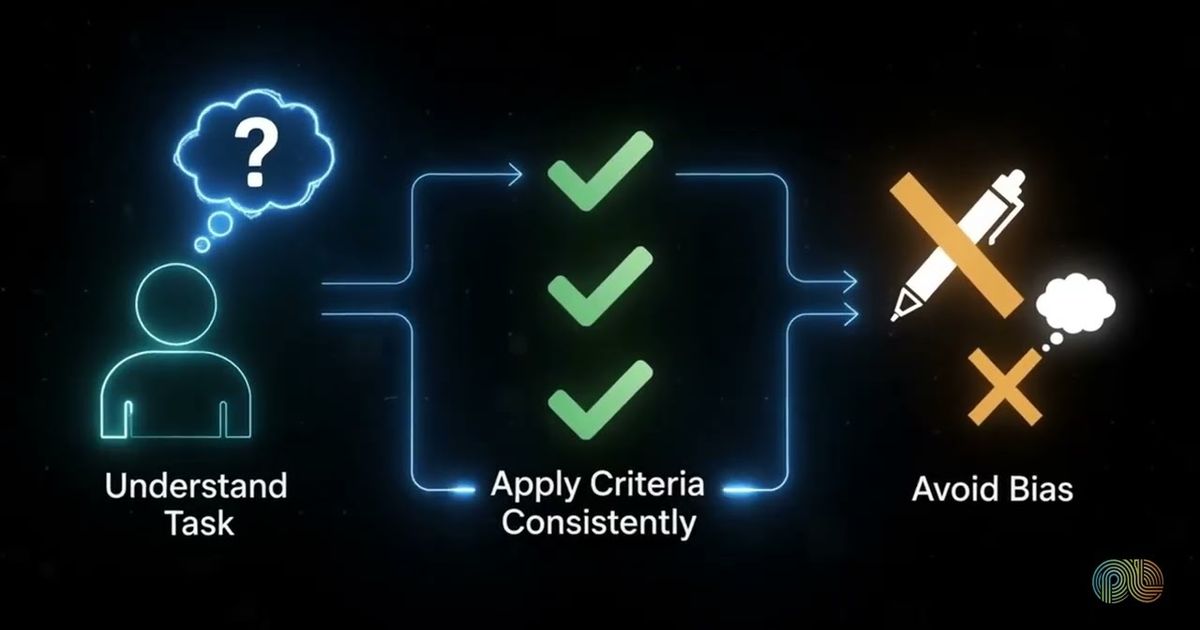
Pairwise evaluation judges AI outputs by showing reviewers two responses to the same task and asking which one better meets shared criteria. Swap separate numerical scores for a relative choice and human judgments about accuracy, completeness, clarity, reasoning, factual grounding and usefulness often become more consistent.
Ask three reviewers what a "4 out of 5" means and you'll get three answers, because "excellent" and "acceptable" mean different things to different people. Put two responses side by side and much of that personal scoring habit drops out.
What's left is feedback that's more useful for improving prompts, models and research workflows.
What is pairwise evaluation?
A reviewer compares two outputs for the same task and picks the stronger one against defined criteria. Neither output gets a standalone number; each is judged against the other.
Take two AI-generated summaries of the same interview data (hypothetically). One is concise but leaves out important themes. The other covers the evidence more completely and adds no unsupported conclusions. Most reviewers can choose between those far more confidently than they could place each on an abstract scale.
The rule that matters: hold the task, source material and relevant conditions constant, so reviewers judge output quality and not differences in inputs. You can compare prompts, model versions, configurations or research workflows this way. It won't make judgment objective. What it does is organize judgment around a simpler question, which response better satisfies the criteria?
What mistakes should you avoid in pairwise evaluation?
Almost all of them are setup mistakes: vague rubrics, mismatched inputs, biased presentation, and conclusions drawn from too few comparisons. Results get hard to read when reviewers judge different qualities, or when the outputs came from materially different conditions.
So don't ask which response is "better" without saying what better means. Don't compare outputs built on different source evidence unless you account for it. Hide model or prompt identities when those labels could bias reviewers, and don't always put one option first (order effects are real). Don't treat a single winning response as proof that an approach is better everywhere, and don't ignore reviewer disagreements or lean only on automated metrics.
Why the variety of test cases matters: performance shifts by task. A system that writes the stronger short summary may not write the stronger detailed synthesis. Repeat the comparison across different tasks and you get a more dependable picture of where each approach succeeds or falls down.
How do you run a pairwise evaluation?
Define the task and the criteria, prepare two comparable outputs, collect the reviewer's choice, then repeat across varied test cases. One matchup proves very little; lots of comparisons show the pattern.
- Define the task and rubric: what the AI should produce and which qualities reviewers must weigh.
- Prepare comparable outputs, with the same task, source evidence and relevant conditions for both.
- Collect structured choices, plus any supporting notes.
- Review patterns across cases, noting where each prompt, model or workflow does well or badly.
The rubric should follow what the output is for. For research outputs, reviewers can ask whether the response represents the available information correctly (accuracy) and covers the important evidence, themes and requirements (completeness). Is it understandable and sensibly organized (clarity)? Does it connect evidence and conclusions coherently (reasoning quality)? Does the source material support its claims (factual grounding)? And does it help the intended audience finish a task or make a decision (usefulness)?
Tell reviewers how to handle trade-offs, too. A concise summary shouldn't win if it drops a major theme, and a comprehensive one shouldn't win if it adds unsupported conclusions. If grounding matters more than style, say so before anyone sees the outputs.
Keep the source material, criteria, outputs, reviewer choices and decisions, so your conclusions stay traceable. That's what turns pairwise evaluation into part of a systematic AI output verification process and keeps it from becoming a one-off contest.

Why is pairwise evaluation more consistent than scoring?
Comparing two concrete alternatives is easier than interpreting a rating scale. Reviewers who'd hand out different numbers will often still agree on which response is better.
Absolute scoring leaves room for personal thresholds even with a detailed scale: one reviewer's "excellent" is another's "acceptable." Pairwise evaluation narrows the decision. Everyone inspects the same alternatives against the same criteria.
The comparison data pays off when you're testing whether a revised prompt improves responses, comparing outputs from different model versions, refining an AI-supported research workflow, or looking for performance patterns across many tasks.
Agreement isn't guaranteed, especially when both outputs are strong in different ways, so reviewers still need clear guidance. We'd always look into disagreements instead of throwing them out. A broader approach to evaluating AI-generated research outputs can tie these comparisons into your overall quality process.

How PulseLake helps
PulseLake keeps research objectives, methodology, source evidence, AI outputs and decisions in one persistent study context. Specialized agents can support design, analysis, reporting and client Q&A while researchers keep judgment and approvals, and workflow automation can make review and QA repeatable. To talk about pairwise evaluation within an AI research workflow, talk to our team.
Frequently asked questions
Can pairwise evaluation replace numerical rating scales entirely?
When your main question is which of two outputs performs better, yes. Numerical ratings still earn their place if you need an absolute quality threshold, and some evaluations use both: relative preference plus performance against a fixed standard.
What should happen when reviewers disagree about the stronger output?
Treat it as evidence, not automatically as reviewer error. The disagreement might point to ambiguous criteria, a hard trade-off or outputs with different strengths. Read the reviewers' reasoning, tighten the rubric and gather more judgments, and keep the original decisions on record.
Is pairwise evaluation suitable for AI-generated research summaries?
Yes, it fits well. Reviewers compare two summaries generated from the same evidence and judge which is more accurate, complete, clear, grounded and useful. It helps most when one summary is concise but incomplete and the other is detailed but may include unsupported conclusions.