Best enterprise market research platforms in 2026
An enterprise research-platform shortlist with practical criteria for methods, governance, AI review, procurement and evidence reuse.
Which is the best enterprise market research platform? The one that supports the studies your organisation actually runs, with the controls you need to reuse their evidence responsibly. Qualtrics, Medallia, Forsta, SurveyMonkey Enterprise, Alchemer, QuestionPro, Sprig, Pollfish and PulseLake each address different parts of that requirement. Your research programme, operating model and the evidence the business needs decide which fits.
Enterprise buying usually opens with a feature checklist several pages long. We'd open somewhere else: name the recurring decisions the platform will support and the teams who make them. Prioritising that checklist gets easy afterwards.

What makes a market research platform enterprise-ready?
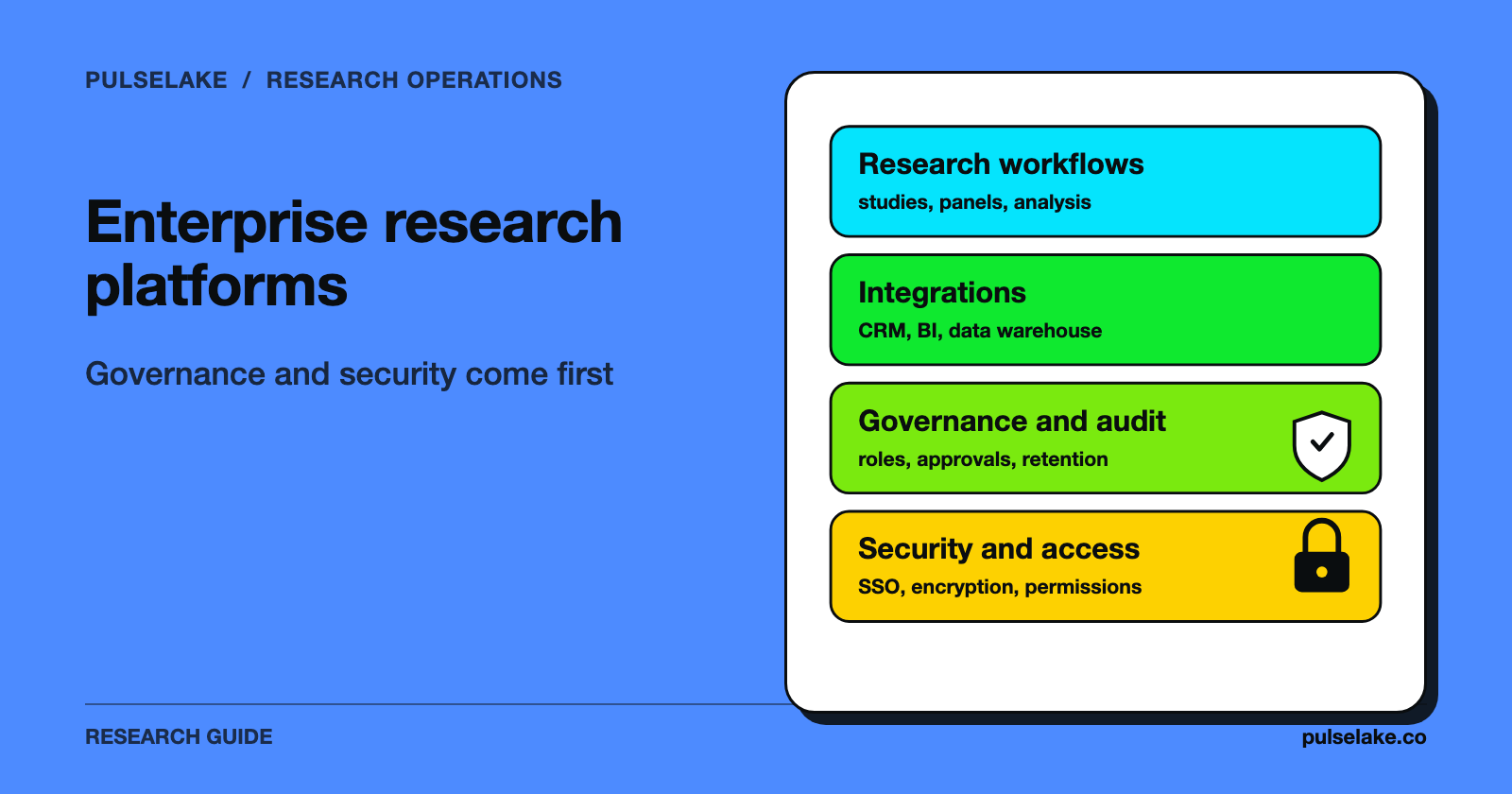
Seat count is the least of it. Ask about identity, project access, procurement, retention, integration, and whether anyone can explain where a finding came from. A large organisation also needs a workable split of responsibility between central specialists and business teams.
Hypothetically, one team builds instruments, another recruits participants and a third reads the reports. Handoffs between them should be easy to follow, so everyone knows whether they're looking at a draft, an approved study or a published finding.
Software can support governance, but it can't make the calls. Somebody has to decide who approves a new method, who can share raw evidence, and who retires an old finding that's no longer current.
How should the buying team be organised?
Include researchers, the people who use the findings, security or privacy reviewers, and whoever owns integration. Then give each group one defined question. If everyone scores every feature, all you get is noise.
Researchers judge methods and evidence; stakeholders judge whether the outputs help them decide. Technical reviewers look at data handling and integration. Procurement sets the commercial scope and the exit conditions.
Write down a short list of non-negotiables before any demo. A persuasive feature can otherwise distract everyone from a basic requirement the product doesn't meet.
Which enterprise platforms should enter the evaluation?
| Platform | Best fit to investigate | Enterprise question |
|---|---|---|
| Qualtrics | Broad research and experience programmes | Which capabilities and administration are in scope? |
| Medallia | Ongoing experience programmes | How does feedback connect to operational action? |
| Forsta | Research and experience delivery | What is software versus managed service? |
| SurveyMonkey Enterprise | Survey programmes across teams | How are access, templates and data managed? |
| Alchemer | Surveys integrated with business workflows | Who owns integrations and follow-up? |
| QuestionPro | Survey-led research programmes | Which methods, audiences and outputs are required? |
| Sprig | Product and enterprise survey work | How is collection tied to product context? |
| Pollfish | Research with audience sourcing | How are recruitment and sample quality documented? |
| PulseLake | Connected research execution and intelligence | How is evidence reused across studies and modes? |
These options aren't interchangeable. Let the workload that dominates your organisation shape the shortlist, along with any complementary tools you're keeping.
When should a broad programme platform lead?
Start with what you mainly need: market studies, ongoing experience measurement, or some mix of the two. Then bring Qualtrics, Medallia and Forsta into a broad programme discussion.
Ask each supplier to demo a complete programme handoff. Can a regional team run the work it's permitted to run, while central researchers keep methods consistent and access boundaries intact?
Services matter too. Even a sophisticated platform may still need implementation specialists, administrators and researchers. Put that operating model in the purchase, so business teams don't discover it after launch.
When are survey-centred platforms sufficient?
When survey research is the core of the programme, SurveyMonkey, Alchemer and QuestionPro are relevant.
Try this: take a representative instrument, with your hardest logic and your real reporting needs, and walk it through setup, approval, collection, analysis and export. Confirm which enterprise functions come with the package you've been quoted.
Reuse is the next test. Can a team start from an approved instrument without losing its definitions? Can an analyst make sense of a study another department built? Consistency across teams is often worth more than a big catalogue of question types nobody uses.
When do Sprig and Pollfish fit?
Sprig suits product and enterprise survey workflows. Pollfish earns a place in a comparison where audience sourcing and survey research are tightly linked.
Judge both against the collection context, because feedback from current users and research recruited from a broader market answer different questions. An enterprise research estate may need both, provided each is clearly labelled and interpreted for what it is.
One more question for either: how will the data reach your wider knowledge system? A good study should still make sense after the team that commissioned it has moved on to something else.
What should the pilot prove?
A real, bounded research question, with approved data and a named decision owner. Define the deliverables, and the evidence you'll need before accepting them.
How much work lands on your team? That's what the pilot should show. Track setup, review, recruitment, analysis and reporting effort separately, since a fast first draft can still need a lot of correction before anyone can use it.
Finally, hand the study to someone who didn't run it. They should be able to find the source behind a conclusion, spot a limitation, and decide whether the finding applies to another audience. We'd weight this test most, because it's a practical check of reuse.
How should AI be governed in enterprise research?
Assistance and authority are different things. Drafting questions, suggesting themes, calculating results and launching fieldwork are separate operations, so say which can run automatically and which need approval.
Consequential claims need visible sources. A report should say whether a statement comes from observed responses, an existing dataset, a simulation or an analyst's recommendation.
Log material changes to models, instructions and coding schemes where they affect interpretation. The aim is explaining the work, not piling up logs nobody reads.
How should costs and exit plans be assessed?
Line proposals up on the same users, study volume, audience needs, methods, integrations and support. Keep subscription or usage charges apart from recruitment, services and implementation.
Don't forget ongoing administration and the work left outside the platform. A broad contract can be worth it if it cuts repeated work, but only when your organisation actually adopts that workflow.
And before you sign, run an export exercise. Instruments, response data, source evidence and relevant metadata should all come out in usable form. An enterprise research programme shouldn't need one particular interface to understand its own findings.
Where does PulseLake fit?
PulseLake is a research operating system that connects study design and evidence collection with structured analysis, interpretation and reporting. Questions and measures live in research frameworks, organised into dimensions and sub-dimensions, which gives the evidence a shared meaning you can use beyond a single response or survey.
For enterprise teams, reusable dimensions and measures help pin down what a result means. PulseLake combines those frameworks with dimension-level analysis, pivots and study-specific calculations. Cross-study comparisons still need compatible definitions and methods.
Test the whole journey: a brief, a reviewed report, then a follow-up question. Does the platform help your team keep hold of the audience, method, assumptions and source evidence that give a finding its meaning?
Human and synthetic outputs call for different treatment. Synthetic respondents are good for speed and early direction, and a synthetic rehearsal can sharpen a study plan. It shouldn't quietly turn into evidence that customers expressed a preference; that takes real respondents. Enterprise governance should keep the distinction intact across reports and exports.
Frequently asked questions
Is the broadest platform always the best enterprise choice?
No. Breadth helps when it matches your programme and your organisation can actually run it. For a clearly defined workload, a narrower platform is often the better fit.
Should all departments use one research tool?
A shared platform can improve consistency, though some methods may need specialist tools. Even if the toolset varies, define the common evidence and governance requirements everyone follows.
What should an enterprise pilot measure?
Method fit, evidence traceability, permissions, handoff quality and the effort it takes to produce an approved finding. Add your own operational and commercial requirements as well.
What should be checked before signing a contract?
The exact scope, usage limits, recruitment costs, support responsibilities, data handling and export process. Then make sure the proposal reflects the workflow you saw demonstrated during the evaluation.