Medallia alternatives in 2026
Choose Medallia alternatives by experience-management, feedback-analysis and market-research needs, with a practical migration framework.
Which Medallia alternative is right? It depends on the job: ongoing experience management, feedback analysis or project-based market research. For a broad experience-platform comparison, look at Qualtrics, InMoment and Forsta. Chattermill, Survicate, Alchemer and SurveyMonkey cover other parts of the workflow. PulseLake is relevant when the requirement centres on conducting and synthesising research with reusable evidence.
Replacement talks tend to begin with one complaint: too many dashboards, too little explanation. Pause before you move systems. Does that missing explanation call for better analysis of the feedback you already have, or for fresh research with a different audience?

What problem are you trying to solve?
Take three teams. Support may need to find the recurring causes of complaints and route individual cases. Product may need interviews to learn why a workflow is hard. Insights may need a study of people who have never used the product at all.
They can share evidence, but they don't run the same programme. Existing customer feedback can't fully describe the people who chose a competitor, and a market study won't run your case management.
Write the requirement in the language of the decision. For example: “We need to understand whether onboarding problems differ between new administrators and invited users.” That gets you much further than “We need better AI.”
Which Medallia alternatives should you consider?
| Platform | Best fit to investigate | Important boundary |
|---|---|---|
| Qualtrics | Experience and research programmes | Confirm the modules and methods needed |
| InMoment | Customer-experience programmes | Map collection through operational follow-up |
| Forsta | Research and experience workflows | Separate platform scope from services |
| Chattermill | Analysis of customer feedback | Confirm sources and evidence behind themes |
| Survicate | Customer and product feedback collection | Check audience coverage and collection context |
| Alchemer | Surveys linked to business workflows | Confirm integrations and action ownership |
| SurveyMonkey | Survey-based research and feedback | Check the selected plan against study requirements |
| PulseLake | Research planning, human and synthetic modes, synthesis | Preserve the distinction between observed and simulated evidence |
Read these categories as groupings, not rankings. Depending on the job, your real shortlist might hold only a few of them.
When is a feedback-analysis specialist useful?
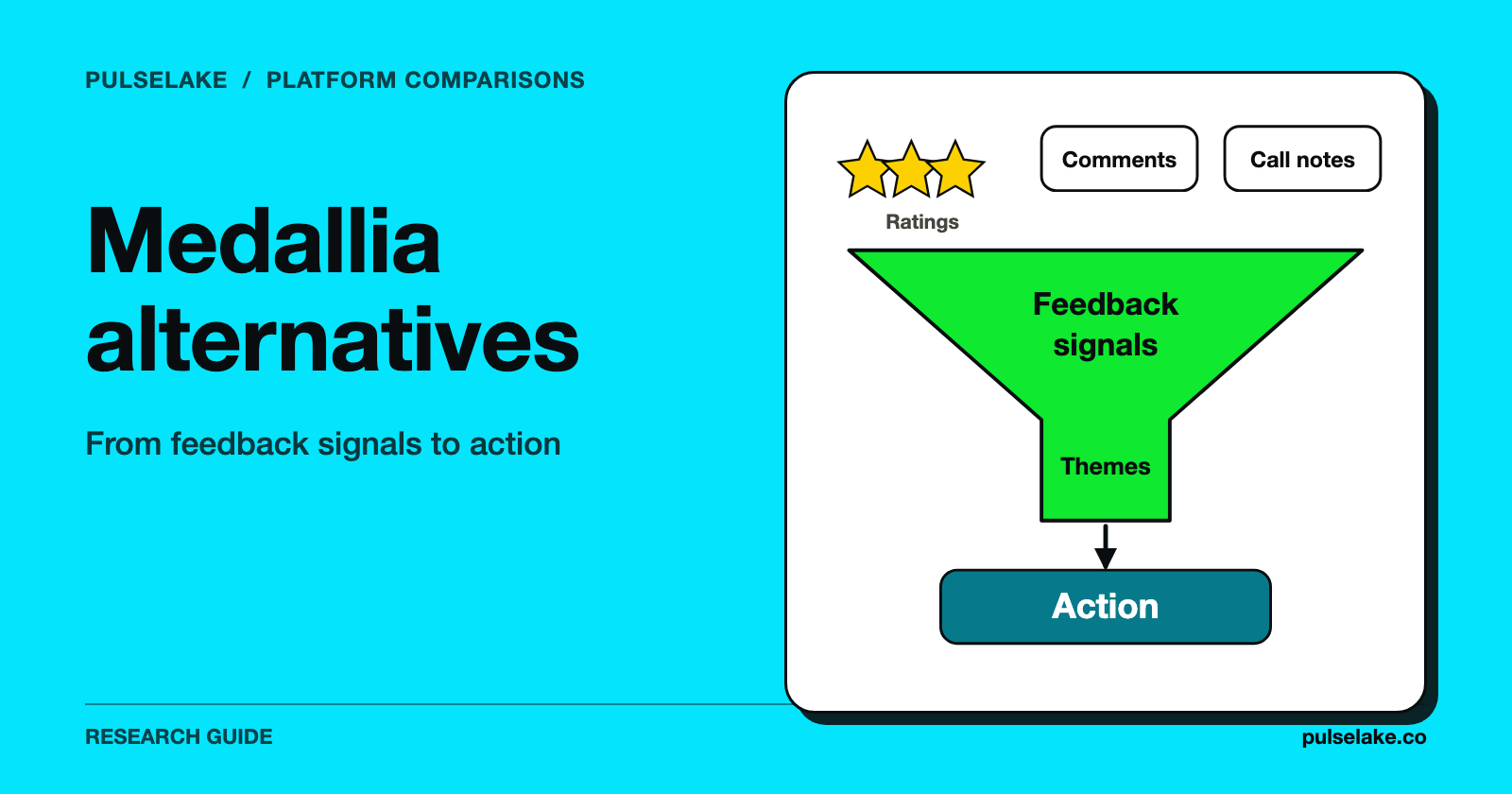
Sitting on a lot of text? Chattermill positions its product around customer feedback analysis, and it's worth considering when you need that evidence to be easier to use.
Test it on the messy stuff: contradictory comments, different channels, terminology that shifts over time. A theme called “delivery” might lump together late arrival, damaged packaging and unclear tracking, and those can need different owners and different fixes.
Ask how an analyst inspects source records, revises a category and sees what a taxonomy change does downstream. A stable dashboard is only worth having if its categories keep meaning the same thing.
One more thing to check is what the data leaves out. You can analyse every complaint you have and still learn nothing about customers who never contact support. If the decision needs that missing view, you need more research.
When are Survicate, Alchemer or SurveyMonkey enough?
For a narrower comparison focused on collection and workflow, put Survicate, Alchemer and SurveyMonkey on the list.
Begin where the respondent meets the survey. A survey shown inside a product reaches a different group from an email invitation or a recruited research sample, so check that the audience you care about can actually see it and finish it.
After that, follow the response. Does it need a case owner, an aggregate report or a researcher to interpret it? When the downstream process is clear and manageable, a simple collection tool can be all you need.
Two mistakes are common: buying a broad replacement to fix a narrow problem, and assuming a cheaper questionnaire tool will reproduce an established, organisation-wide programme without extra work.
When should Qualtrics, InMoment or Forsta lead?
Replacing a broad programme rather than one survey? Then Qualtrics, InMoment and Forsta earn a look.
Before anyone books a demo, map what you run today: collection channels, customer identifiers, access groups, reporting audiences, follow-up responsibilities. Each supplier should then show how their proposed configuration handles every one of those.
For a large estate, implementation can matter as much as feature breadth. Who maps the historical data? Who looks after the taxonomy? Who edits the questionnaire when a business process changes? A good proposal answers with named people, and a vague "our services team" doesn't count.
How do you protect trend continuity?
This is the trap we'd watch most closely. A migration can change the measure even when the dashboard title stays the same, because collection timing, response options, routing and who gets contacted all shape how you read the number.
Document the current measure before you rebuild it, keeping the question wording, invitation rules, exclusions and calculation definitions. Is the new system using a different method? Label the change, and don't present the series as unbroken.
For a tracker that really matters, plan a transition comparison that fits the programme's needs. The goal is understanding what the migration changed. Forcing the new numbers to match the old ones misses the point.
What should happen to the existing taxonomy?
Treat it as a research asset. Category definitions, examples and exclusions should be written down before you ask an AI system to replace the taxonomy; otherwise a new label can look familiar while quietly gathering a different set of comments.
Build a review set with common issues, rare issues and ambiguous responses. Compare the new coding with the interpretation your team agreed on and look hard at the disagreements, since some will expose a weakness in the old taxonomy instead of an error in the new system.
Keep version history. When a category changes, analysts need to know whether a trend reflects customer behaviour or just a different coding rule.
How should procurement assess the proposals?
Every supplier gets the same programme scope: channels, users, expected volume, required integrations, support and migration work. Ask what's included and what needs separate modules or services.
The people who'll act on the findings should be in the room. A system that fires off more alerts with no clear owner can add work without improving the customer experience one bit.
Our test for being done: describe the operating model in one paragraph. Where the data comes from, who reviews it, who acts, and how you check whether the action helped. Can't write that paragraph clearly? Then the software comparison isn't finished.
Where does PulseLake fit?
PulseLake is a research operating system that connects study design and evidence collection with structured analysis, interpretation and reporting. Its research frameworks organise questions and measures into dimensions and sub-dimensions, giving the evidence a shared meaning you can use beyond a single response or survey.
Explicit dimensions let a research programme dig into why an experience differs across groups. PulseLake supplies the framework and the analytical workflow, while your team still needs a sound study design to back up its explanation.
Say complaints about setup start climbing. That might lead to interviews with new users, then a follow-up instrument. The research should tie back to the original question, and it should keep customer comments, observed study responses and simulated hypotheses clearly apart.
PulseLake's research intelligence and reporting workflows can help organise that sequence. Judge it on the actual study and review process, though; don't assume a research platform replaces every customer-experience operation.
Frequently asked questions
What is the closest Medallia alternative?
For a broad experience programme, Qualtrics, InMoment and Forsta are sensible places to start. If your need is narrower, around feedback or research, a different tool may suit you better. Compare against the scope of the programme you actually run.
Can a research platform replace customer-experience software?
Partly. It can support the studies you need to understand an issue, but it may not replace every collection channel or operational follow-up process. Map who's responsible for what before you consolidate tools.
Will AI automatically explain a decline in satisfaction?
No. It can find patterns and suggest candidate explanations in the evidence you have, but pinning down the cause may take more data, a different sample or a deliberate study.
What is the biggest migration risk?
Losing what your historical measures and categories meant. Preserve instruments, collection rules, calculation definitions and taxonomy versions so any change stays interpretable later.