Brand Tracking in 2026: How to Measure Brand Awareness and Perception
How to measure brand awareness and perception with brand tracking and brand health tracking: metrics, survey setup, sample size, and tool options.
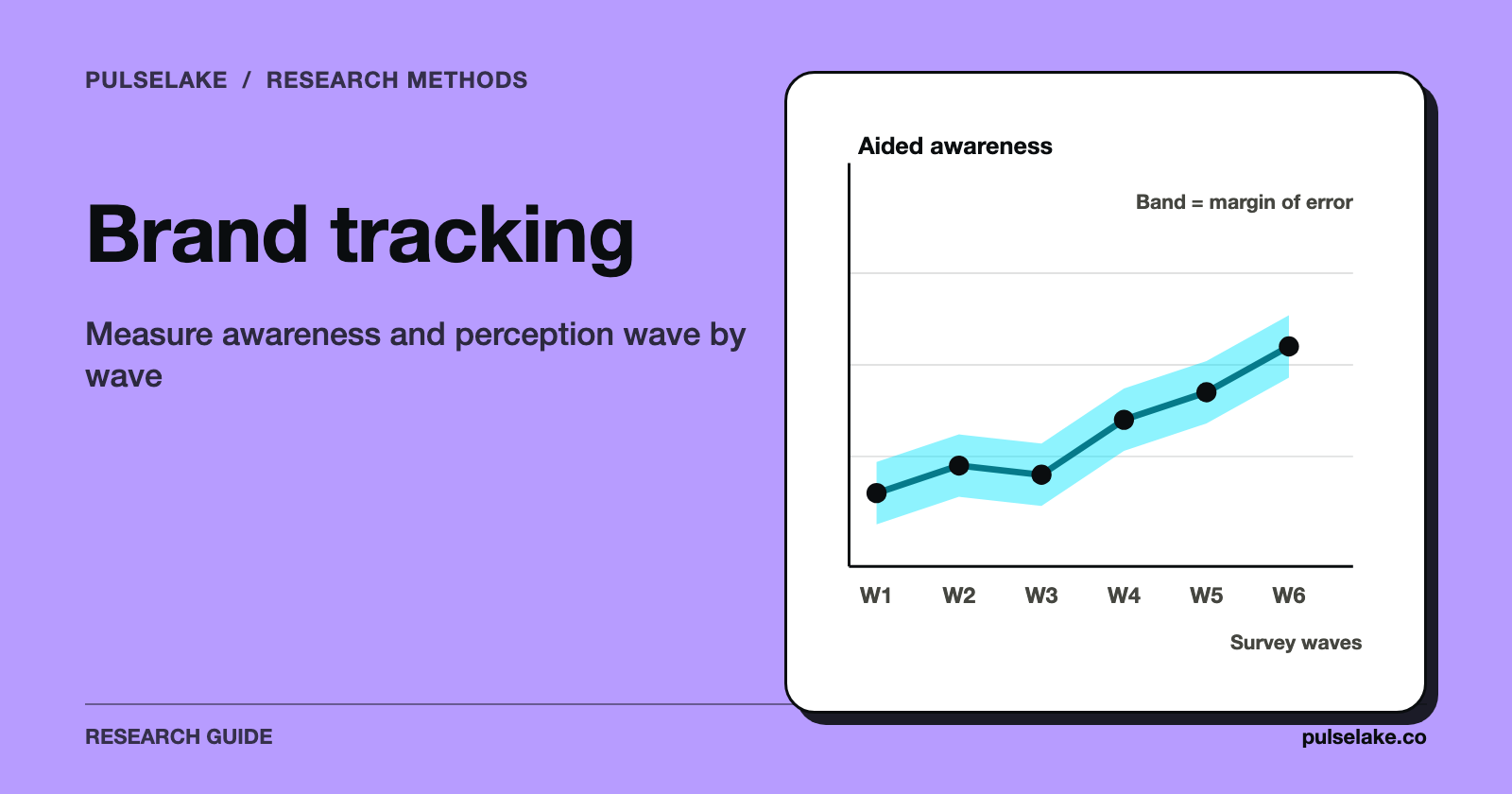
Brand tracking means asking the same questions of a comparable sample of people at regular intervals, so you can see whether awareness, perception and preference are moving. Start with a handful of metrics (unaided and aided awareness, consideration, a few perception attributes, and loyalty), survey a consistent audience that includes non-customers and competitors, and change nothing in the questionnaire between waves unless you label the break.
We make PulseLake, a research platform, and mention it briefly below. The method here applies whichever tool you use.

What is brand tracking, and what does it measure?
Brand tracking is an ongoing measurement of how a market sees a brand over time. Unlike a one-off brand study, its value comes from comparison: this quarter against last quarter, you against two named competitors. Savanta describes seven areas: awareness, perception, usage, loyalty, equity, competitive benchmarking and communications effectiveness. Most programs only need the first four plus a competitor view.
That is also the answer to "how do you measure brand awareness and perception". Awareness is a question about memory ("which brands come to mind?"). Perception is a question about meaning ("which words fit this brand?"). They need different question types.
How do you measure brand awareness?
Use two questions, in this order.
- Unaided awareness (recall). "When you think of [category], which brands come to mind?" Open text, no list. Ask it first, before the respondent sees any brand name.
- Aided awareness (recognition). Show a list or logos and ask which they have heard of. Include a few brands from the same category that you do not expect people to know, to catch over-claiming.
The gap between the two is informative. A brand with high aided and low unaided awareness is recognised but not remembered at the moment of choice.
Attest separates brand recall from recognition in the same way, and also lists branded search and the Net Promoter Score question among its brand health metrics. Branded search is useful as a behavioural cross-check, but it is not a substitute for asking.
How do you measure brand perception?
Show respondents a fixed list of attributes and ask which apply to each brand they know. Write the list from your category, not from a template: "easy to set up", "worth the money" and "trusted with sensitive data" tell you more than "innovative". Savanta's page lists reliability, value, personality traits and emotional connection as the usual perception themes.
Three practical points:
- Ask perception only about brands the respondent says they know, or the answers reflect guesses.
- Randomise the order of brands and attributes.
- Keep neutral and negative options available. Attest advises measuring all perceptions, positive and negative, not only the flattering ones.
Attribute wording matters as much as the list. Our guide to writing survey questions that don't bias responses covers leading wording and order effects.
Which brand tracking metrics should you include?
Order the questionnaire as a funnel, and keep earlier questions from priming later ones. Neurons recommends moving from awareness, to perception and behaviour, to loyalty.
| Stage | Metric | Typical question |
|---|---|---|
| Awareness | Unaided, aided | Which brands come to mind? Which have you heard of? |
| Perception | Attributes | Which of these describe each brand? |
| Consideration | Would consider | Which would you consider next time? |
| Preference or intent | First choice, purchase intent | Which would you choose first? |
| Usage | Current and past use | Which have you used in the past 3 months? |
| Loyalty | Net Promoter Score, repeat purchase | How likely are you to recommend...? |
| Communications | Ad or message recall | Which brands have you seen advertised recently? |
More metrics is not better. Each added question lengthens the survey and the wave-to-wave workload. If a measure does not change a decision, drop it.
How do you set up a brand tracking study?
- Name the decision first. For example: "Should we keep funding the awareness campaign in the mid-market segment?" The decision picks the metrics and the audience.
- Define the audience. Include current customers, non-customers who buy in the category, and customers of competitors. A tracker that only samples customers can only tell you what customers think. Neurons makes the same recommendation about covering several audience segments.
- Choose the competitor set. Three to six brands is usual. Tracking a brand in isolation gives little context.
- Pick the cadence. Quarterly is common. Attest says high-spend or fast-moving brands often track monthly. Qualtrics describes quarterly or bi-annual waves alongside always-on tracking. Slower-moving categories can use fewer waves.
- Set the sample. See the next section.
- Freeze the questionnaire. Record exact wording, answer options, routing and exclusions. Changing any of them breaks comparability, and Neurons lists inconsistent surveys among the common pitfalls.
- Plan the readout. Decide who reads each wave and what change would trigger action before you see the data.
How big should each wave be?
Larger samples make small changes easier to detect, but consistency matters as much as size. Latana, a tracking provider, recommends at least 1,000 respondents per wave, with a minimum of 500 for core segments. One guide on quantilope's site advises keeping the sample consistent across waves so results are comparable.
Here is the arithmetic, which is our calculation rather than a vendor claim. At 95% confidence and a simple random sample, the margin of error is about plus or minus 3.1 points at 1,000 respondents and 4.4 points at 500.
A hypothetical example: unaided awareness reads 18% in wave one and 22% in wave two, with 500 respondents each. The margin on the difference between the two waves is roughly 5 points at these percentages, so the 4-point rise could be noise. Before you report it as growth, check the next wave, or pool waves into a rolling average.
Online samples are rarely simple random samples, so margins are wider once weighting is applied. See survey weighting without the jargon.
What is brand health tracking, and how does it differ?
Brand health tracking is the same discipline with a wider lens. In practice, "brand health" adds a summary view on top of the funnel: an index, or a small scorecard.
Which brand health metrics matter?
A workable scorecard has five parts:
- Reach: unaided and aided awareness, advertising or message recall.
- Perception: three to six attributes that matter in your category, plus trust or reputation.
- Conversion: consideration, preference, purchase intent.
- Loyalty: Net Promoter Score, repeat purchase or retention where you have the data.
- Distinctiveness: whether the brand comes to mind in specific buying situations. Quantilope's tracker is built on this idea, which it calls mental availability and category entry points, drawing on the work of Jenni Romaniuk.
Digital signals such as search interest, reviews and social sentiment belong alongside survey results, not instead of them. They show what people who choose to speak up are saying. They do not describe the market.
Which brand health tracking software and providers should you consider?
These are not rankings. Each line reflects what the provider says on its own public pages, and you should confirm current details with them.
| Provider | Our read | What its page says (as of October 2026) |
|---|---|---|
| YouGov BrandIndex | Teams that want always-on tracking of their brand and competitors | Tracks 16 core metrics across media and communication, perception and the purchase funnel, with daily tracking |
| Qualtrics | Organisations that want brand metrics inside a broader experience platform | Describes continuous brand health tracking, automated alerts, and the same metrics measured for your brand and competitors; self-serve or with its research services |
| Attest | Teams that want a wave-based tracker with research-manager support | Says it reaches 150M+ consumers in 59 markets, supports a custom cadence, and pairs tracking with AI interviews to explain scores |
| quantilope | Teams that want a mental availability approach | Offers pre-built templates for a category entry points pre-study and a main tracker, reported in a real-time dashboard |
| Conjointly Brand Tracker | Teams that want a ready-made monthly data product | Describes monthly US waves of roughly 1,400 respondents, recruited by quota and raking-weighted; says it is not a market research service |
Where another approach fits better: if you need an always-on daily read across a very wide set of brands, a standing syndicated panel such as YouGov's is built for that. If you need a bespoke questionnaire with your own audience definitions, a custom tracker from Attest, Qualtrics or quantilope, or one you run yourself, fits better. If you only have a small number of questions and a small budget, a single survey tool run on a regular schedule can be enough, provided you hold the sample and wording steady.
Social listening tools answer a different question, since they report what is said online, not what a representative sample thinks. Treat them as a supplement.
How do surveys, templates and AI fit into brand tracking?
A tracking survey template should have five blocks: screener (category buyer, age, region), unaided awareness, aided awareness and usage, perception and consideration for known brands, and demographics. Put the screener and awareness questions first.
AI helps in three places:
- Open-ended answers. Unaided recall and "why" comments can be coded at scale. Spot-check a sample against human coding before trusting the categories.
- Explaining the score. AI-moderated interviews can ask a smaller group why their view changed. Attest and PulseLake both offer AI-led interviews, with different scope, so check what each includes.
- AI answer engines as a new place brands appear. Tools such as Keyword.com now run a set of prompts you choose through ChatGPT on a daily, weekly or monthly schedule and record whether your brand appears in the answers or citations. Keyword.com notes that ChatGPT has no native analytics for this, and that coverage depends on the prompts you choose. This measures what AI systems say, not what people think, so keep it separate from survey results.
Synthetic respondents are a different matter. They can help test a questionnaire before fielding, but they do not replace a real sample for tracking. Read how accurate synthetic respondents are before using them for anything you will report.
Where does PulseLake fit?
PulseLake is a research platform for running surveys and AI-led interviews with real participants. Those are the parts a tracking program needs: a stable instrument, repeat waves, and a consistent readout. It is not a substitute for a standing syndicated panel. Check how you will source the sample before choosing any tool, ours included.
Frequently asked questions
How often should you run brand tracking?
Quarterly is a common standard. High-growth markets or heavy advertising spend often justify monthly waves, and slower categories may track less often. Choose the cadence by how quickly the decision it informs can change.
How do you measure brand awareness?
Ask unaided awareness first (open text, no list), then aided awareness from a list that includes a few unfamiliar brands. Report both, and look at the gap.
How do you measure brand perception?
Give respondents a fixed list of attributes from your category and ask which apply to each brand they know. Randomise order and keep negative options.
What is the difference between brand tracking and brand health tracking?
Brand tracking measures awareness, perception and preference over time. Brand health tracking uses the same data but adds a summary scorecard or index and often includes loyalty and digital signals. Providers use the terms loosely, so check the metrics, not the label.
What sample size do you need for a brand tracking study?
One provider recommends at least 1,000 respondents per wave and 500 for core segments. At those sizes, the 95% margin of error is roughly 3.1 and 4.4 points respectively, before weighting.
Can you use AI for brand tracking?
Yes, for coding open-ended answers and running follow-up interviews. AI visibility tools also track how AI answers mention your brand. None of these replace a consistent survey of a real sample.