Annotation Rubrics: Template, Examples and Quality Checks
Build an annotation rubric with clear labels, evidence rules and ambiguity handling, using a hypothetical example and a practical reviewer calibration process.

Annotation rubrics are structured decision frameworks that tell reviewers how to weigh evidence before they assign a label. They define what separates one category from another, what evidence each decision needs and how to handle ambiguous, incomplete or conflicting cases. Because the reasoning is written down, every reviewer follows the same repeatable path from observation to annotation.
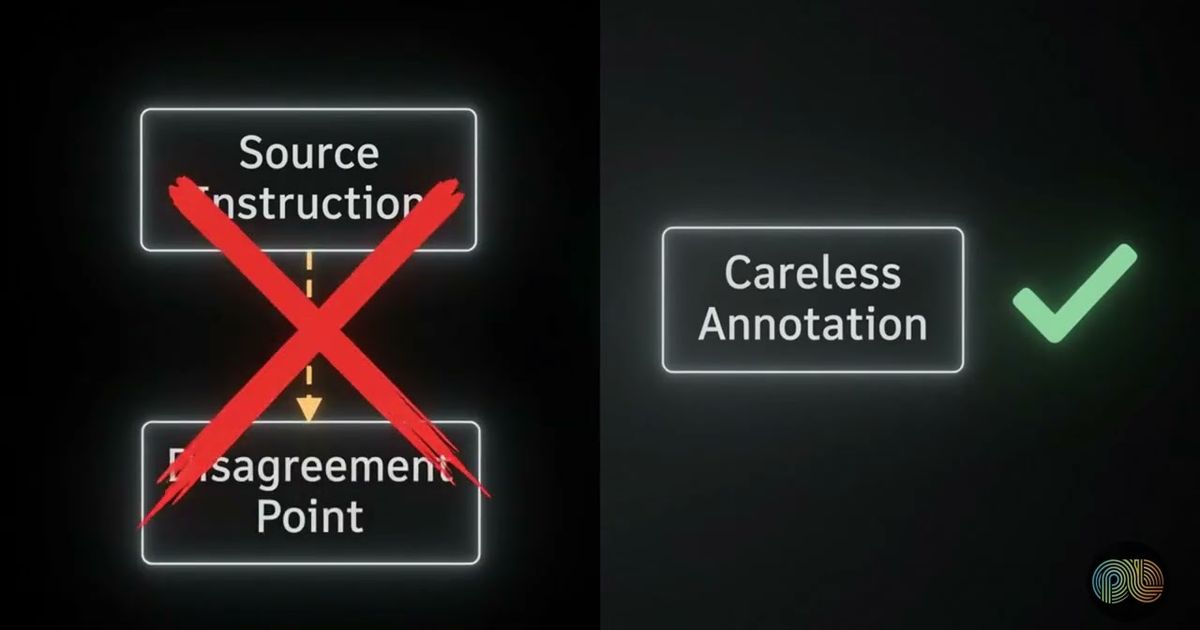
Two careful reviewers can read the same comment, label it differently and both defend their choice. Neither one is being sloppy.
Rubric-based annotation is how you get them reasoning the same way, and that makes annotation quality much more predictable when several people are working through complex data.
What is an annotation rubric?
Defining categories is the easy half. An annotation rubric explains how a reviewer should reason before picking a label: the criteria for telling similar labels apart, and for judging the cases that aren't clear.
Take sentiment. A simple label definition might say what "positive sentiment" means. A rubric for annotations goes further. Which language counts as evidence? How do you treat mixed statements? Which details don't matter, and how much support do you need before applying the label? It links what the reviewer saw to a decision they can defend.
You'll still want annotation guidelines. Guidelines usually cover the task, the labels, the workflow and examples; the rubric spells out the evaluation logic. The two work together.

How do you build an annotation rubric?
Look at the decisions reviewers actually face, then define the evidence and reasoning each one needs. You're after a rubric specific enough to guide the hard cases and still easy to use. Four steps get you most of the way:
- Separate similar labels. What distinguishes the categories reviewers could easily mix up?
- Specify supporting evidence. What has to be present, and when is it enough to justify a label?
- Exclude irrelevant signals. Say what shouldn't sway the decision, even if it looks related at first glance.
- Address uncertainty. Incomplete evidence, conflicting signals, overlapping categories, cases nobody can resolve confidently: say how to handle each.
Then test the draft on realistic examples, messy ones included. Obvious cases tell you nothing. Ask several reviewers to explain how they got to their labels, and compare the reasoning. A disagreement might point to an unclear criterion, a missing exception or different assumptions about how much evidence is enough.

How should annotation rubrics evolve?
Recurring disagreements are your best editing notes. Use them to sharpen boundaries, clarify evidence thresholds and add hard examples. Recalibrate reviewers whenever a decision rule changes. That supports annotation quality control without spawning a new label for every ambiguous case.
What is a practical annotation rubric template?
Below are some hypothetical rubric category labels for a statement about a product task. They're here to illustrate a rubric. They aren't a validated scale or a universal standard.
- Task barrier: include an explicit inability to complete the task; exclude a request alone. Example: "I could not find the export button, so I stopped."
- Improvement request: include a request without an explicit task failure. Example: "I would like a keyboard shortcut for export."
- Insufficient context: use when the task or outcome is unclear. Example: "It was confusing."
Decide the annotation unit before you apply any of it. A sentence, a full answer and a whole interview can justify different labels. Here, quote the relevant statement and keep the question around it, so reviewers can check what "it" refers to. And don't infer a task failure from negative sentiment alone.
How should reviewers calibrate this rubric?
Give reviewers the same pilot material. They label it independently and note the evidence behind each choice. Then you talk through the disagreements against the inclusion and exclusion rules.
What if one statement holds both a barrier and a request? Decide outright whether the project allows multiple labels or needs a precedence rule, and write that choice down before the rubric goes wider.
Keep a version, change date, owner and rationale with the rubric. When a rule changes, work out which earlier annotations might need another look; otherwise the same label quietly means different things across batches. Keep the hard examples as a reference set. The unresolved ones too.
How do you check whether the rubric is useful?
Look at the labels chosen and at the reasoning behind them. Reviewers can agree for the wrong reason (treating every negative statement as a task barrier, say). Watch for unsupported inference, inconsistent units and ambiguity that keeps coming back. Set acceptance criteria based on the decision and what's riding on it.
For related evaluation work, see the rubric-based evaluation guide, and use annotation quality control for the review process around it.
How PulseLake helps
PulseLake keeps research objectives, methodology, evidence and decisions in one persistent study context, so the reasoning behind annotation work doesn't get lost. Its governance, lineage, ontology and reusable IP capabilities can support shared methods across studies. Specialized agents can help with qualitative analysis under researcher judgment and approval. To see how this could fit your research workflow, talk to our team.
Frequently asked questions
What should an annotation rubric template include?
The annotation unit, label definitions, inclusion and exclusion rules, examples, how to handle ambiguity and a review owner. Add a version and change record so reviewers can tell which rules apply to which batch. Treat the hypothetical template above as a starting point, and calibrate it against your own evidence.
What should reviewers do when evidence supports two labels?
Follow the rubric's criteria for overlapping or conflicting evidence, and leave personal preference out of it. Depending on the rubric, that might mean a priority rule, a minimum level of evidence, multiple labels or marking the case unresolved. If no rule covers it, the case should feed the rubric's next revision.
How detailed should an annotation rubric be?
Detailed enough to separate similar categories, tell relevant evidence from irrelevant evidence and guide the ambiguous cases. It doesn't have to predict every possible example. Too much detail makes a rubric harder to apply, so add clarification where real reviewer decisions show uncertainty.
Why do annotation rubrics matter for AI training data?
Because AI training and evaluation depend on labels that reflect a consistent decision process. When human reviewers apply different unstated standards, the data ends up encoding those inconsistencies. A clear rubric makes the labeling logic steadier and easier to explain and maintain, while keeping a defined role for human judgment in uncertain cases.