Creating Training Data for Reliable AI Systems
Creating training data requires clear objectives, representative examples, consistent labels, and ongoing quality control to build dependable AI systems.

Creating training data means building a curated set of examples that teaches an AI system the patterns, relationships, or decision rules required for a specific task. Reliable datasets begin with a clear objective, use consistent labels, represent real operating conditions, and improve over time as errors and new scenarios emerge.
Training data matters because even sophisticated algorithms will struggle when their examples are incomplete, inconsistent, or disconnected from the situations encountered after deployment. Careful preparation improves generalization, evaluation, and confidence in operational use. The two-minute video above walks through the core ideas.
What is training data?
Training data is a curated collection of examples used to teach an AI system how to recognize patterns or produce a desired output. In supervised tasks, those examples typically pair an input with a label, category, score, annotation, or other target response.
The purpose is not merely to collect as much information as possible. Each example should help the system learn behavior that reflects the intended research task. For example, a model that categorizes customer feedback needs examples that represent the language, topics, ambiguities, and response formats it will encounter in practice.
A useful dataset usually includes:
- Common cases that establish the task’s core patterns.
- Uncommon scenarios that occur less frequently but still matter.
- Edge conditions where categories overlap or normal rules become difficult to apply.
- Meaningful variation across users, contexts, language, channels, and problem types.
This coverage helps a model generalize rather than memorize a narrow set of examples. The relevant form of variation depends on the task, so researchers must connect every inclusion decision to the model’s intended use.
How do you create high-quality training data?
High-quality training data begins with a precise definition of what the model should learn. Researchers should settle the objective, unit of analysis, taxonomy, labeling rules, and quality criteria before assembling or annotating examples.
A practical creation process includes four connected steps:
- Define the objective. Specify the expected model behavior, intended users, operating context, and boundaries of the task.
- Select examples. Gather cases that resemble real inputs and cover the situations the model must handle.
- Label consistently. Apply a stable taxonomy and document how annotators should treat ambiguity, overlap, and exceptions.
- Review quality. Check labels, investigate disagreements, correct errors, and record decisions that affect future work.
Clear annotation guidelines turn an abstract taxonomy into repeatable decisions. They should define each label, provide representative examples, distinguish easily confused categories, and explain when an annotator should escalate an uncertain case.
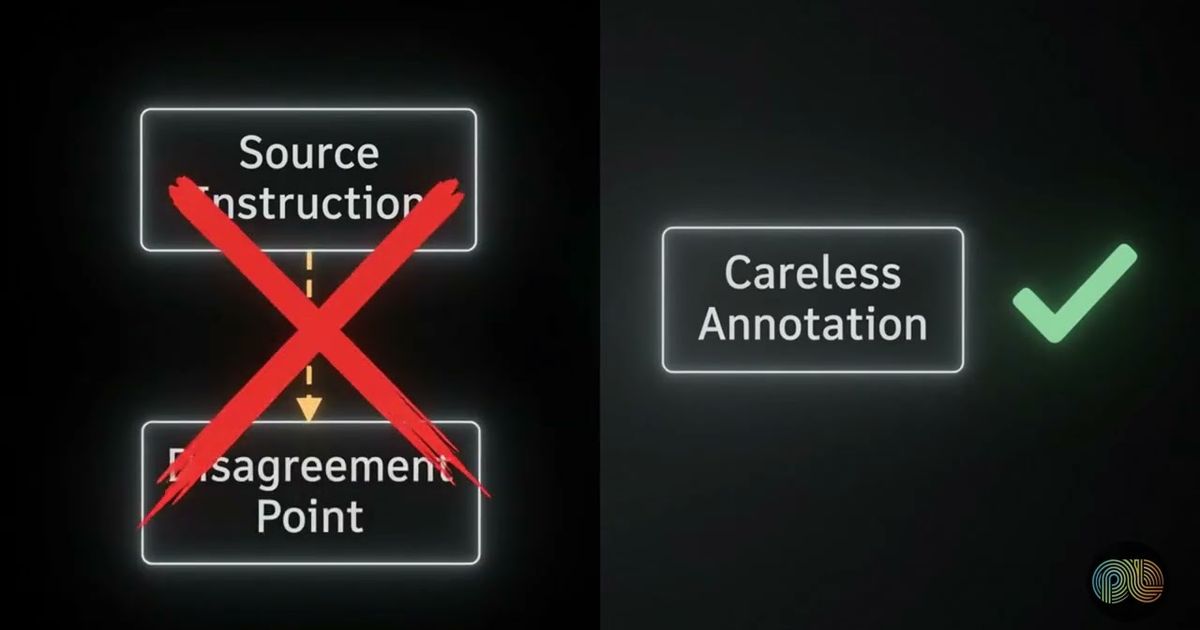
Quality control should continue throughout development and evaluation rather than occur only at the end. Reviewing disagreements can reveal unclear definitions, missing categories, inconsistent examples, or task boundaries that need refinement.

How do you make training data representative?
Representative training data reflects the range of situations an AI system is likely to encounter after deployment. Researchers need thoughtful sampling across relevant user groups, research contexts, problem types, and difficult cases rather than relying only on the easiest available records.
A dataset can look successful during testing yet fail in real operations if the training and test examples share the same omissions. Important gaps may include underrepresented users, emerging terminology, unusual input formats, rare but consequential scenarios, or contexts in which the same label has a different meaning.
Researchers should deliberately check for four forms of coverage:
- Common cases: Include routine examples that establish the dominant patterns.
- Uncommon scenarios: Preserve less frequent situations instead of removing them as noise.
- Edge conditions: Include ambiguous and boundary cases that test how the labeling rules work.
- Meaningful variation: Represent the users, contexts, language, and problem types relevant to deployment.
Representative does not necessarily mean that every category appears in equal numbers. It means the dataset’s composition supports the intended task and that sampling choices are explicit. Applying the principles used for avoiding sampling bias can help teams identify who or what is systematically missing.

How should training datasets improve over time?
Training datasets should be maintained as evolving research assets rather than treated as one-time project inputs. New examples, corrected labels, operational failures, and emerging scenarios can all improve coverage, provided changes remain consistent and traceable.
Updates require discipline. Teams should preserve dataset versions, document changes to taxonomies and annotation rules, and retain the reasoning behind corrected labels. When definitions change, researchers must determine whether earlier examples need to be reviewed so the dataset does not combine incompatible labeling standards.
Feedback from evaluation and deployment should guide maintenance. A recurring error may indicate a missing example type, an unclear label, weak representation, or a genuine limit in the task definition. Adding examples without diagnosing the cause can increase dataset size without improving its teaching value.
Continuous maintenance also helps training data reflect growing organizational knowledge. Over time, the dataset becomes reusable intellectual property that captures not only examples, but also the definitions, exceptions, and quality decisions needed to interpret them.
Key takeaways
- Effective training data teaches a clearly defined behavior rather than simply maximizing the number of examples.
- Datasets should cover common cases, uncommon scenarios, edge conditions, and meaningful real-world variation.
- Consistent taxonomies, detailed annotation guidelines, and ongoing quality control make labels more dependable.
- Thoughtful sampling reduces gaps between controlled evaluation and real operational conditions.
- Versioned updates allow training data to improve without losing consistency or decision history.
How PulseLake helps
PulseLake keeps objectives, methodology, evidence, and decisions within a persistent study context, supported by ontology, governance, and lineage. Research teams can use specialized agents for research design and analysis while retaining judgment and approvals, then package methods, assessments, workflows, and other research IP for reuse. To discuss how these capabilities can support training-data operations, talk to our team.
Frequently asked questions
How much training data does an AI model need?
There is no universally correct number of examples because the requirement depends on the task’s complexity, the range of expected inputs, label quality, and the model being used. A smaller, carefully curated dataset may teach a bounded task better than a larger collection of inconsistent records. Teams should evaluate performance across relevant cases and add data to address identified gaps.
What is the difference between training data and evaluation data?
Training data teaches the model, while evaluation data measures how well it performs on examples it did not learn from directly. The evaluation set should reflect intended operating conditions and remain separate enough to provide a meaningful test. If duplicates or closely related records appear in both sets, results may overstate the model’s ability to generalize.
Who should review training-data labels?
Reviewers should understand both the annotation rules and the real context in which the model will operate. Depending on the task, that may require researchers, subject-matter experts, data specialists, or a combination of roles. The important requirements are documented decisions, a process for resolving disagreements, and researcher approval for changes that affect the dataset’s meaning.