Market Segmentation Guide: Types, Examples, and Targeting (2026)
Market segmentation explained: the main types, how segmentation research works step by step, how to judge a segment, and the four targeting strategies.
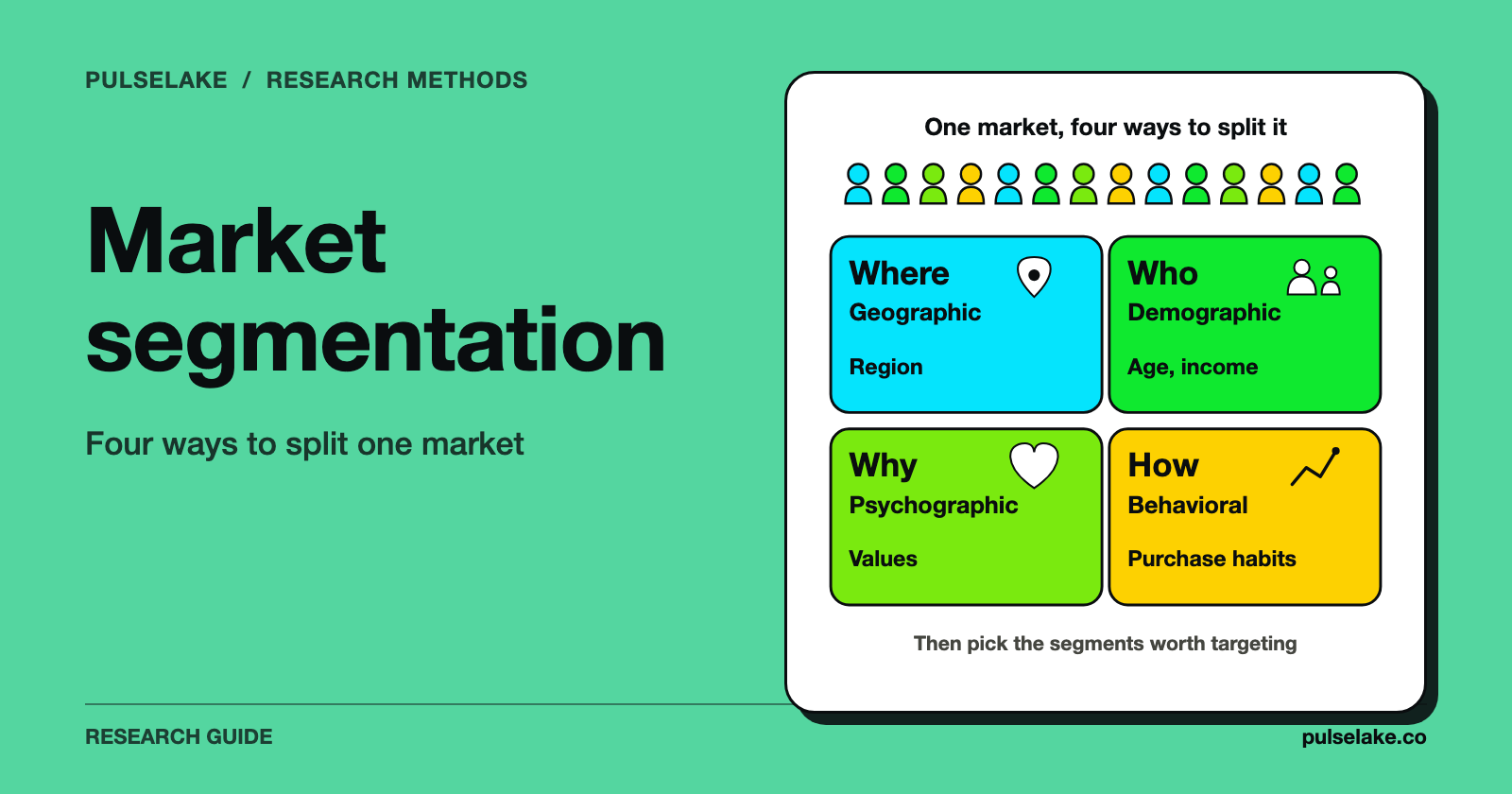
Market segmentation means splitting a market into groups of buyers who share something that matters to your decision, then choosing which groups to serve and how. The common bases are geographic, demographic, psychographic, behavioral and, for business buyers, firmographic. Segmentation research is the work of finding those groups with data, usually a survey analysed with methods such as cross-tabulation and cluster analysis.
We make PulseLake, a research platform. It's mentioned once in this guide, in the section on running segmentation research.

What is market segmentation?
Almost no market is a single crowd wanting the same thing. Segmentation carves it into smaller groups whose members resemble each other more than they resemble the market as a whole. You can then match product, price, message and channel to each group.
People mix up three terms. Segmentation is the dividing. Targeting is choosing which segment or segments to go after. Positioning is deciding how the chosen segment should see your offer.
This guide goes deep on the first two and touches the third. Still working out who your buyers are? Start with our answer on how to find the right audience for a product.
What are the main types of market segmentation?
Guides disagree on the count, though the same core set keeps coming back. The descriptions below follow Wikipedia, Semrush and Sogolytics (Wikipedia, Semrush, Sogolytics).
| Type | Groups buyers by | Typical variables |
|---|---|---|
| Geographic | Where they are | Country, region, city size, climate |
| Demographic | Who they are | Age, income, education, family stage |
| Psychographic | How they think | Lifestyle, interests, values, opinions |
| Behavioral | What they do | Usage rate, loyalty, buying stage |
| Firmographic (B2B) | What kind of company | Industry, size, location, revenue |
Some sources add more bases. Semrush lists media preference and benefit (the outcomes customers want) (Semrush). Wikipedia also describes contextual, generational, cultural and hybrid segmentation, where hybrid means combining two or more bases (Wikipedia).
Geographic segmentation
Location is the basis. It matters when needs vary by place (language, climate, regulation) or when you can only deliver in certain areas.
Demographic segmentation
Measurable population traits make up demographic variables, which makes them easy to collect and easy to buy media against. The weakness: they describe who someone is, not why they buy.
Psychographic segmentation
Values, interests and attitudes are what psychographics capture. Sogolytics says this research usually requires survey methods, because these factors aren't captured in conventional transactional data (Sogolytics).
Behavioral segmentation
Here the basis is observed or reported action: how often people buy, how loyal they are, what they want from the product, how ready they are to buy. Product and CRM data often cover part of this with no survey at all.
Firmographic segmentation for B2B
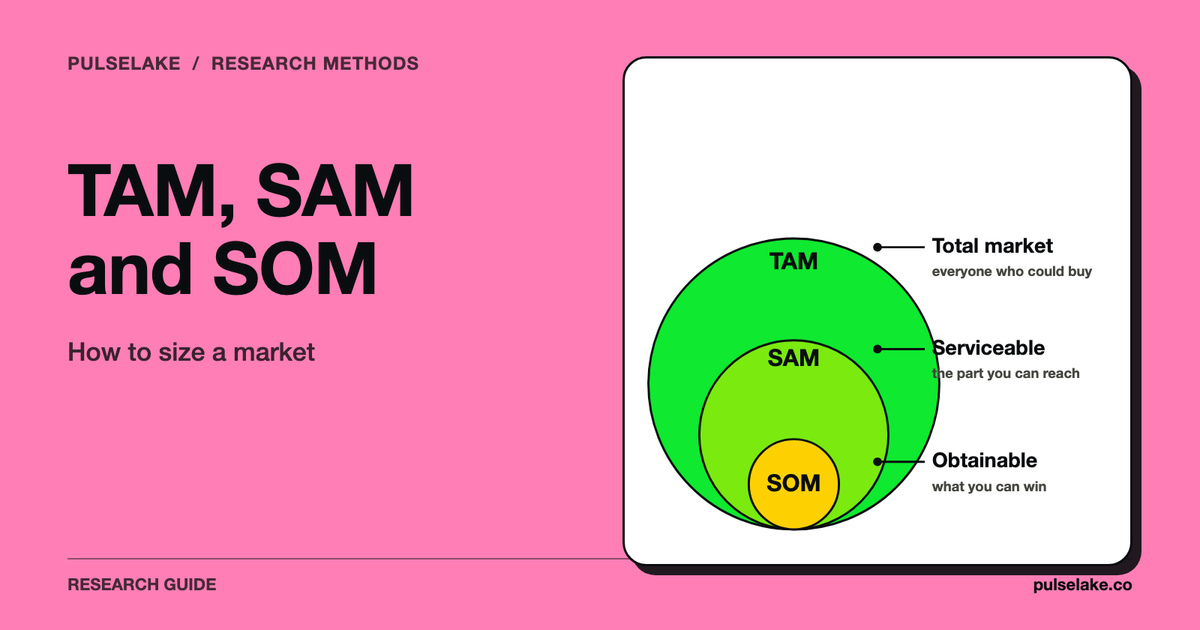
Think of firmographics as the business equivalent of demographics (Wikipedia). In B2B they're a sensible place to start. But two firms of the same size and industry can buy for completely different reasons, so most B2B work layers behavioral or needs-based questions on top. Sizing each firmographic group comes next, and our market sizing guide covers it.
What are examples of market segmentation?
These are hypothetical illustrations of each base, and they don't describe real companies.
A meal-kit service launches first in three dense cities where it can deliver within a day: geographic. A savings app builds a separate onboarding for students, whose income and goals differ from those of retirees: demographic. An outdoor brand speaks to people who value sustainability, whatever their age or income: psychographic.
A gym sends different offers to lapsed members and long-term members (behavioral). A payroll vendor builds separate packages for companies under 50 employees and for companies over 500 (firmographic). And a toothpaste maker sells separate products for whitening, sensitivity and cavity prevention, because people want different outcomes. That last one is benefit-based.
What makes a good segment?
Start with the common checklist, MASS. Sogolytics says strong segments are measurable, accessible, substantial and actionable (Sogolytics). In plain terms: you can estimate its size and buying potential; you can reach it through channels you already have; it's big enough to justify the investment; and your organization can build a strategy for it.
Semrush adds practical selection criteria: size, growth potential, purchasing power, needs and wants, and competition. It also cites Hooley's framework, which scores segments on both attractiveness and your own resource strength (Semrush). An attractive segment can still be wrong for you if you can't serve it.
Sogolytics warns that segments can also get too narrow to scale (Sogolytics). Can't size or reach one? Merge it with a neighbor.
What is customer segmentation research?
Segmentation research (also called customer segmentation research) is the study that produces the segments instead of assuming them. It comes in two broad kinds.
A priori segmentation picks the bases first, such as company size or age band, and measures each group; it's quick and easy to explain. Post hoc (data-driven) segmentation works the other way round: collect data on needs, attitudes and behavior, then let a statistical method find the groups. That can surface segments you'd never have named up front, but it needs more data and more judgment.
For the data-driven route, Sogolytics lists surveys among the data sources, with analysts then looking for groups using methods such as cross-tabulation and cluster analysis (Sogolytics). Cluster analysis is a family of methods that sort respondents into groups so that members of a group are more similar to each other than to other groups; k-means and hierarchical clustering are two common examples (Wikipedia).
One caveat we'd want every stakeholder to hear: Wikipedia notes that no single clustering is objectively correct, and results depend on the algorithm, the distance measure and parameters such as the number of clusters (Wikipedia). So judge a segmentation by whether the groups are stable, distinct and useful. A good statistic alone doesn't settle it.
How do you do segmentation research step by step?
Seven steps, in this order.
Define the decision first. What changes depending on the segments: the product roadmap, the message, the channel mix? Our guide to defining research problems and objectives helps here.
Next, choose candidate variables, including some descriptors (who they are) and some drivers (needs, attitudes, behavior). Groups built only on descriptors often look tidy and still fail to predict what people want.
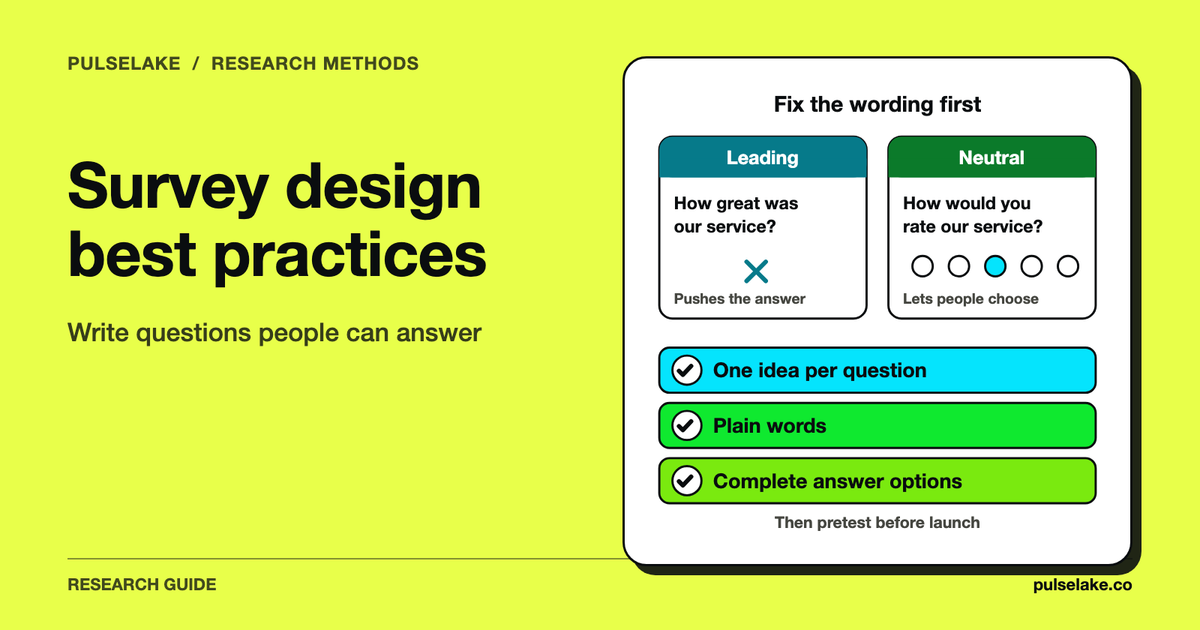
Third, collect the data, from a survey, existing customer data, or both. Write neutral questions (writing questions that do not bias responses) and watch for sampling bias.
Fourth, find the groups. Cross-tabulate by the obvious variables first; if you need data-driven groups, try cluster analysis with a few different cluster counts and compare the results.
Fifth, profile each segment: size, needs, behavior and how to reach them, plus a short, plain name. Sixth, check the segments against the criteria in the section above, and decide whom to target. Seventh, test and refine: validate with a follow-up study or a live test before you commit budget.
A hypothetical example
The numbers below are invented to show the arithmetic. They don't come from a real study.
Say a software company surveys 1,000 small-business owners about how they handle scheduling, and a cluster analysis produces four groups:
| Segment (hypothetical) | Share | Respondents |
|---|---|---|
| Paper and phone loyalists | 38% | 380 |
| Cost-conscious DIYers | 27% | 270 |
| Growth-minded adopters | 20% | 200 |
| Compliance-driven | 15% | 150 |
The shares add to 100% (38 + 27 + 20 + 15) and the counts add to 1,000 (380 + 270 + 200 + 150). If the product suits growth-minded adopters best, that group is 20% of the sample. Apply that to a hypothetical market of 20,000 businesses, assume the sample is representative, and you get 20,000 x 0.20 = 4,000 businesses. Treat it as a starting estimate: sample error, the representativeness assumption and the clustering choices all move it.
What are the market segmentation targeting strategies?
After segmenting comes the question of how many segments to pursue. Wikipedia describes the main strategic approaches like this (Wikipedia):
| Strategy | What it means |
|---|---|
| Undifferentiated | One offer for the whole market, no segmentation |
| Differentiated | Two or more segments, a separate offer for each |
| Focus (niche) | One small, tightly defined segment |
| Hypersegmentation | One-to-one marketing: the offer is customized for each customer |
Our read is this. Undifferentiated suits a product that really does serve everyone the same way. Focus suits a small team that wants to win one group first. Differentiated needs the budget to run several offers, and hypersegmentation depends on good customer data.
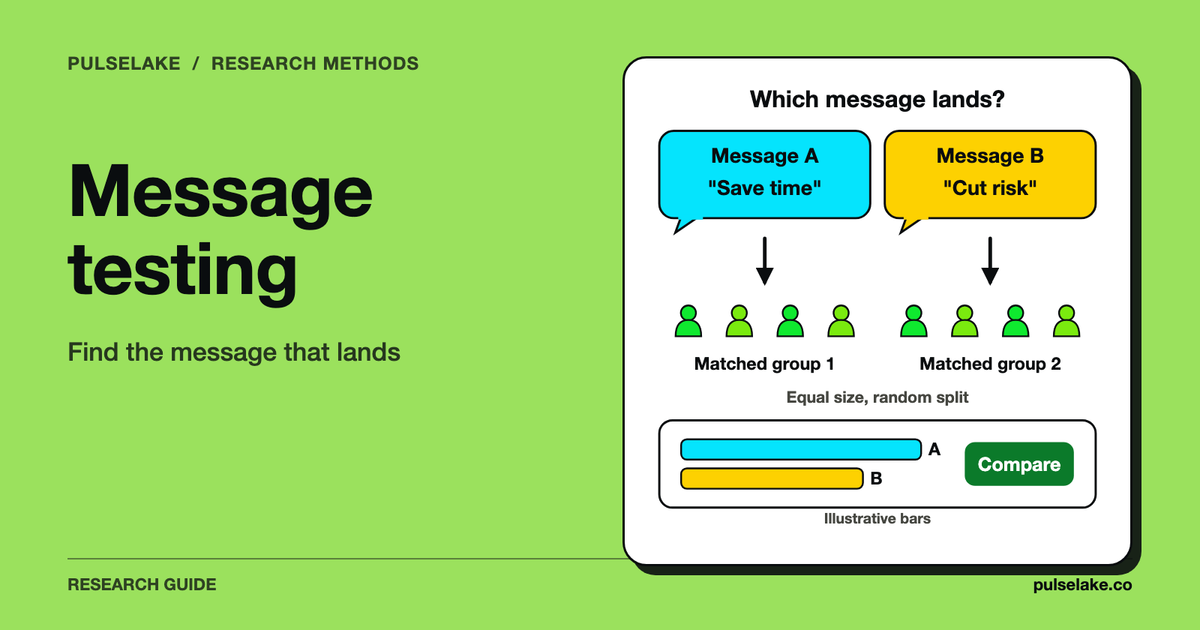
Once you've picked a segment, Semrush recommends tailoring three things to it: the offer, the messaging and the venues where you reach it (Semrush). Testing the message with each segment before launch is covered in our guide to marketing message testing.
How do you run segmentation research in practice?
You can manage with a spreadsheet and a survey tool, plus a statistics package for clustering. PulseLake supports survey-based research, with the study objectives and evidence kept together, so you can run and document a segmentation study in one place. It doesn't replace the judgment calls above, though. Choosing variables, deciding how many clusters to keep and naming segments are still the researcher's job. For other ways to learn about customers, see customer research methods.
Frequently asked questions
What are the 4 types of market segmentation?
The four most often listed are geographic, demographic, psychographic and behavioral. Many guides add firmographic segmentation for B2B, which makes five.
What is the difference between market segmentation and customer segmentation?
People often use the two interchangeably. Strictly, market segmentation divides a whole market, including people who don't buy from you yet, while customer segmentation usually divides existing customers, often using purchase and usage data.
What is segmentation research and which methods does it use?
It's research designed to find and describe segments. Surveys are a common data source, and analysts use methods such as cross-tabulation and cluster analysis to find groups (Sogolytics).
How many segments should I have?
There's no standard number. You want enough to be meaningfully different, and few enough that you can name, size and reach each one. Check each against the MASS criteria and merge any you can't act on.
What is the difference between segmentation, targeting and positioning?
Segmentation divides the market. Targeting selects which segments to serve, and positioning defines how the chosen segment should perceive the offer.
How often should I update my segmentation?
Whenever markets or customers change materially. Semrush advises reviewing segmentation regularly because audiences change over time (Semrush).