Survey Design Best Practices: How to Write Effective Questionnaires
How to design a survey: set the decision, write neutral one-idea questions, label scales, order sensibly and pretest. Includes rewrite examples and an FAQ.
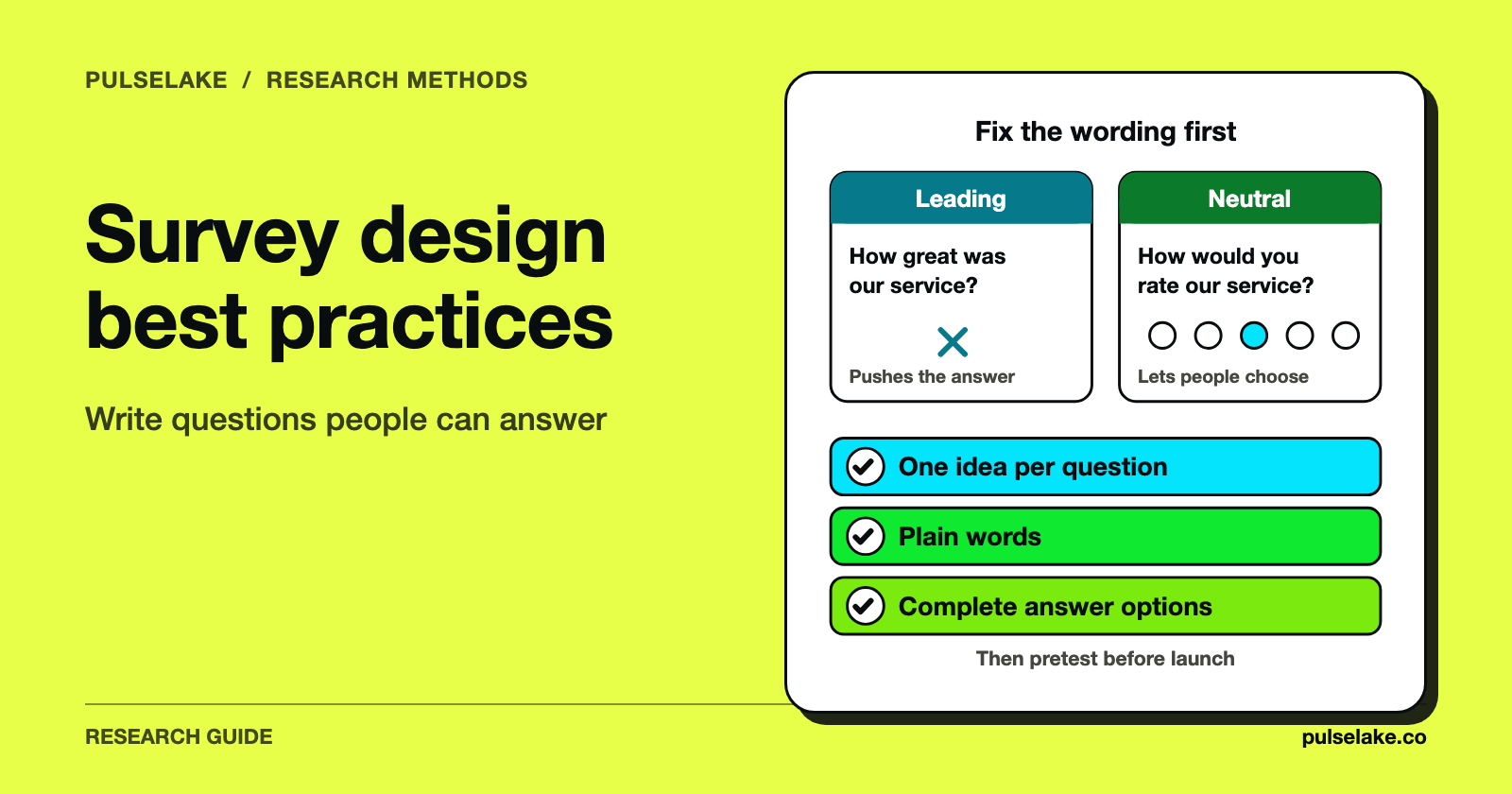
Effective survey design works backwards from a written decision the survey must inform. Pick the people you need to hear from, write short neutral questions that ask one thing each, order them from easy to sensitive, and pretest the questionnaire with a few members of your audience before launch. Vague goals, loaded wording and skipped testing cause most data-quality problems. The survey tool is rarely the culprit.
We make PulseLake, a research platform. It's mentioned once in this guide, near the end.

What makes a survey well designed?
Two tests: can you act on the answers, and can you defend them? Passing both takes three things. The questions measure what you meant them to measure. The people answering represent the people you care about. And the questionnaire is short and clear enough that people finish it and answer honestly.
On the basics, education researchers, polling organizations and survey vendors all agree: define a clear goal before writing anything, use plain language, keep each question to one idea, and test before distributing (Pew Research Center, Qualtrics). Everything below is those four habits in more detail.
How do you write good survey questions?
Ask one thing, in plain words
Pew advises simple, concrete language and one question at a time; a question that evaluates two concepts at once is hard to answer and hard to interpret (Pew Research Center). SurveyMonkey's example of a double-barreled question asks about price and quality together, and the fix is to split it (SurveyMonkey).
Avoid leading and loaded wording
Tiny wording changes can move results a long way. In a 2003 poll Pew reports, support for military action in Iraq fell from 68% to 43% once the question added a mention of possible casualties (Pew Research Center). Qualtrics also warns against leading questions and against absolutes such as "always", "every" and "all" (Qualtrics). More on this in writing survey questions that don't bias responses.
Be careful with agree/disagree statements
They invite acquiescence bias, says Pew, and offering a choice between alternative statements is better practice. Imperial College London's questionnaire guidance likewise recommends wording items as questions and using topic-specific response labels instead of agree/disagree (Imperial College London). Only one habit to break? We'd pick this one.
Rewrite examples (hypothetical)
These examples are invented for illustration.
| Weak question | Problem | Better version |
|---|---|---|
| "How much do you love our fast, friendly support?" | Leading and double-barreled | "How satisfied are you with the speed of our support?" then separately "...with the friendliness of our support?" |
| "Do you often use the app?" | "Often" is vague | "In the past 7 days, on how many days did you open the app?" |
| "The checkout was easy. (Agree / Disagree)" | Agree/disagree statement | "How easy or difficult was checkout?" with labelled options from very easy to very difficult |
| "Do you never skip our newsletter?" | Absolute and a double negative | "How often do you read our newsletter?" |
Qualtrics also recommends dropping vague words such as "frequently" or "usually" in favour of something countable (Qualtrics).
Make response options complete and clear
Five rules cover most of it:
- Make options exhaustive and mutually exclusive, so every respondent fits exactly one (Pew Research Center).
- Label every point on a scale in words, not just the endpoints (Imperial College London), and keep ordinal scales (for example excellent to poor) in their natural order.
- How many options? Imperial's guidance says about five response options is a sweet spot and recommends at least five; SurveyMonkey describes 5- and 7-point scales as a good way to offer a neutral option. Pew suggests keeping closed lists to "four or perhaps five at most", with longer lists acceptable for objective facts or demographics.
- Randomize unordered lists. Respondents may favor items by position, and randomization spreads that effect around (Pew Research Center).
- Prefer forced choice to select-all-that-apply where you can; Pew found it yields more accurate answers, especially on sensitive topics.
Want standard wording, scales and sources to start from? The survey question bank collects commonly used questions you can copy.
When should you use open-ended questions?
When you can't list the possible answers. When you want the respondent's own words. When a closed question might prime the answer. Format changes results, as Pew notes: in a 2008 poll, 58% chose the economy when it was offered as a closed option, versus 35% when respondents volunteered it (Pew Research Center). The gap is a reminder that the two formats measure slightly different things.
Use only a few. SurveyMonkey suggests about two, placed near the end, where they're optional; Qualtrics suggests one or two near the end. See when open-ended questions create better insights.
How should you order the questions?
Open with something simple and engaging, then move to the specific and sensitive. Pew advises avoiding several difficult questions in a row, and demographics usually go later unless you need them for screening or routing. Put the important items early, while respondents are still focused (Imperial College London).
Earlier questions can change later answers, pushing results apart (contrast) or together (assimilation) (Pew Research Center). A specific question placed before a general one can produce contrast effects, so choose the order on purpose, and keep it fixed if you're tracking.
Two more habits. Use screeners and skip logic so people only see questions that apply to them. And on sensitive questions, explain how the data will be used and offer a "prefer not to answer" option (Qualtrics).
How long should a survey be?
No universal limit exists. SurveyMonkey, one vendor, recommends a one-page survey of 10 or fewer questions as a general guide, and advises telling respondents how long it will take. Call that a starting point. A customer-satisfaction pulse should be far shorter than a pricing or segmentation study, which can justify more questions if the topic matters to respondents.
Cut anything that doesn't feed the decision. Avoid big matrix grids (SurveyMonkey suggests five or fewer items, partly because they invite straightlining), and watch for fatigue. See eliminating survey fatigue and measuring cognitive load in surveys.
How do you design a questionnaire, step by step?
- Write the decision first, in one sentence: "We will decide whether to X, and this survey tells us Y." A question that doesn't feed that decision gets cut. See defining research problems and objectives.
- Define the audience and sample. Who must answer, and how will you reach them? Good wording can't fix a sampling error. See avoiding sampling bias.
- List what you need to measure. Turn the decision into a short list of constructs (satisfaction, purchase intent, awareness) and decide the output you want for each, such as a percentage, a mean or a comparison between groups. Choose a question type for each: closed-ended for things you'll count or compare, open-ended where you don't know the answer options in advance.
- Draft with the wording rules above, and order with the flow rules above.
- Pretest, revise, then launch.
What are the main types of survey?
In quantitative market research, the design question usually comes down to timing and purpose.
A descriptive (cross-sectional) survey measures a population once, such as brand awareness this quarter. Aim for clean, comparable questions and a sample big enough for the subgroups you need to compare.
A tracking (repeated) survey asks the same questions on a schedule, and consistency beats perfection here. Pew notes that changing wording, context or survey mode can shift a trend line for reasons unrelated to real change (Pew Research Center). Change a question only when you accept a break in the series.
An experimental or comparative survey shows different respondents different versions of a concept, price or message. Keeping the groups comparable, so the only difference is the thing you're testing, is the hard part. See concept testing and marketing message testing.
Customer experience surveys (satisfaction, effort, loyalty) usually come right after an interaction and have to be very short. See the voice of the customer program guide.
How do you pretest a survey?
Pew calls pretesting an essential step in questionnaire design, used to see how people respond to the whole questionnaire and to individual questions, especially new ones (Pew Research Center). A simple version:
- Ask a handful of people from your target audience to complete it. Qualtrics suggests about five (Qualtrics).
- Note how long it took and ask which questions were confusing or hard to answer.
- Have people explain each key question in their own words, which is where misreadings surface.
- Test all the logic, and the layout on desktop and mobile (SurveyMonkey).
- Revise, and retest if you changed anything substantial.
After launch, screen the data for rushed or inattentive responses; see detecting low-quality survey responses.
What survey design tools and templates help?
Any survey tool can run a well-designed questionnaire; none of them does the design work. A question bank or template saves drafting time, but you still adapt it to your audience and decision. PulseLake supports survey-based research as one of its research modes, and publishes free browser-based tools, including the survey question bank linked above. PulseLake doesn't remove the need for a clear goal, a sound sample and a pretest.
Frequently asked questions
What are the key principles of survey design?
Start from the decision, and ask one thing per question in plain language. Avoid leading wording, give complete and clearly labelled response options, and order questions from easy to sensitive. Then pretest before launch.
How many questions should a survey have?
It depends on the audience and purpose. SurveyMonkey's general guide is 10 or fewer questions on one page. Short post-interaction surveys should be shorter, and deeper studies can run longer if respondents are motivated. Either way, cut every question that doesn't feed a decision.
How do you avoid bias in survey questions?
Strip out loaded words and absolutes, split double-barreled questions, and skip agree/disagree statements where a direct question works. Randomize unordered options and watch question order. A pretest catches the misunderstandings you can't see yourself.
What is the difference between open-ended and closed-ended questions?
Closed-ended questions offer fixed options, so they're easy to count and compare. Open-ended ones let people answer in their own words, which suits discovery but takes more effort to analyze. Most surveys are mostly closed questions plus one or two open ones.
How do you design a customer survey?
Tie it to one decision and send it close to the experience. Keep it short, avoid leading preambles, use a full labelled response range, and pair any rating with an open follow-up asking why (SurveyMonkey gives this advice for NPS).
How do you design a survey for quantitative market research?
Define the audience and sample first. Then write closed-ended questions that produce comparable numbers, and keep wording and order fixed across waves if you track. Check the sample is big enough for the subgroups you'll compare.