Concept Testing Guide: Methods, Questionnaire Examples & Survey Questions (2026)
Concept testing methods (monadic, sequential monadic, comparative, protomonadic), a sample questionnaire, survey questions and how to analyze results.
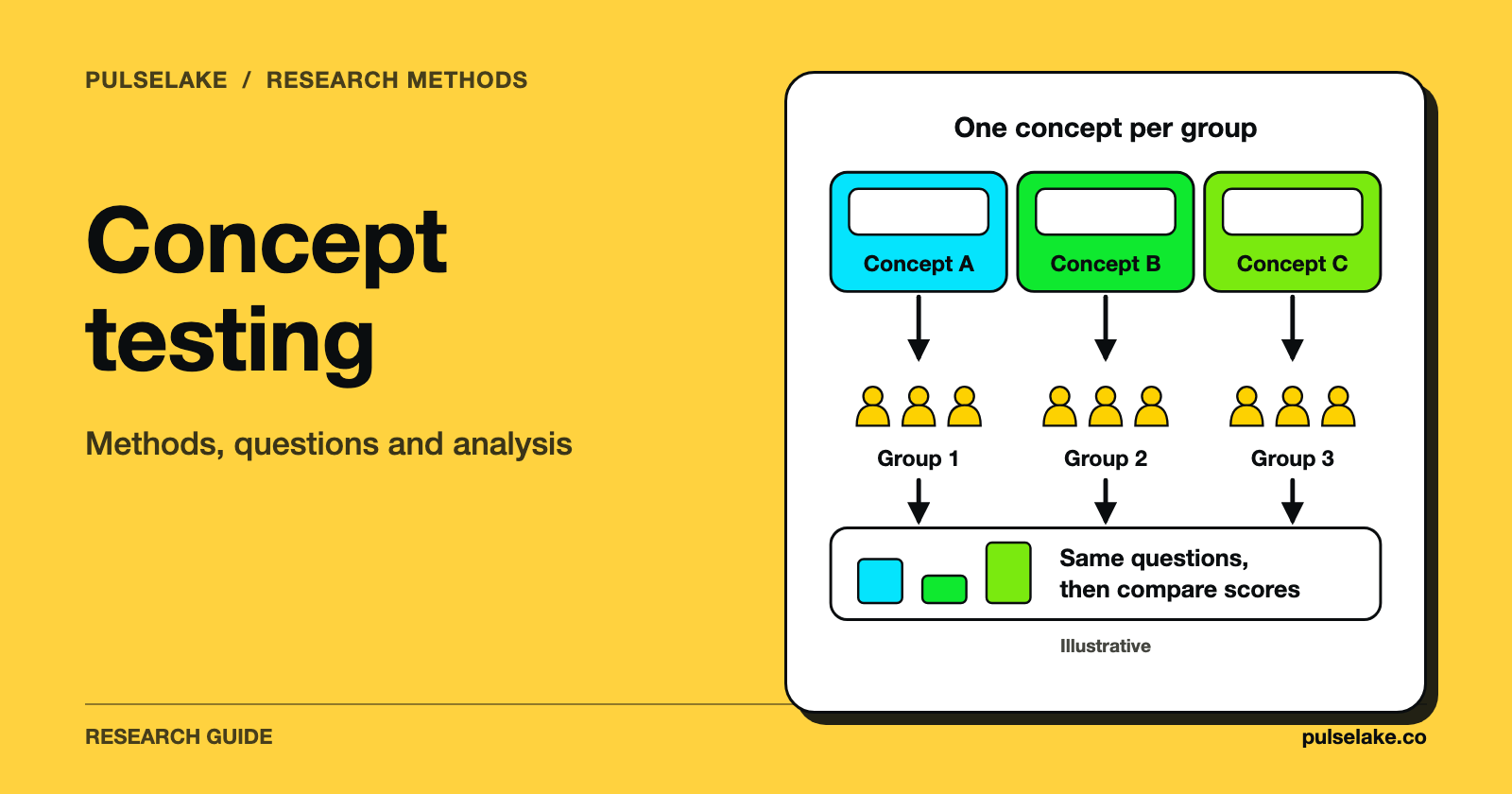
Concept testing shows a target audience a description or mock-up of an idea before it's built or launched, then measures how they react. The core choices are the design (monadic, sequential monadic, comparative or protomonadic), the audience, and a short questionnaire covering appeal, relevance, uniqueness and likelihood to buy, plus open-ended "why" questions.
We make PulseLake, a research platform. It's mentioned once in this guide, near the end.

What is concept testing?
Concept testing is a research method for gauging customer acceptance of an idea before launch, so a team can refine the idea, prioritize features and reduce the risk of failure (QuestionPro). The "concept" might be a product, a feature, a service, a name, a pack design or a positioning statement. You can show it as text, a sketch, a storyboard or a clickable prototype.
It answers questions like these. Do people understand it? Do they want it? Is it different enough from what they use now? Which of our options is strongest? What it can't tell you is what the market will do after launch, because nobody answering a survey is spending money. So read results as a ranking and a diagnosis. They aren't a forecast.
This guide is the hub for the topic. Narrower questions live elsewhere: what questions to ask in a concept test, how to test a concept before fieldwork, and testing a concept on a small budget. We won't repeat them here.
What are the main concept testing methods?
SurveyMonkey and Contentsquare describe four designs consistently. The difference is how many concepts each person sees, and how.
| Method | What respondents do | Main trade-off |
|---|---|---|
| Monadic | See one concept and answer the full battery | Clean read; needs more total respondents |
| Sequential monadic | See several concepts one at a time | Fewer respondents; order effects |
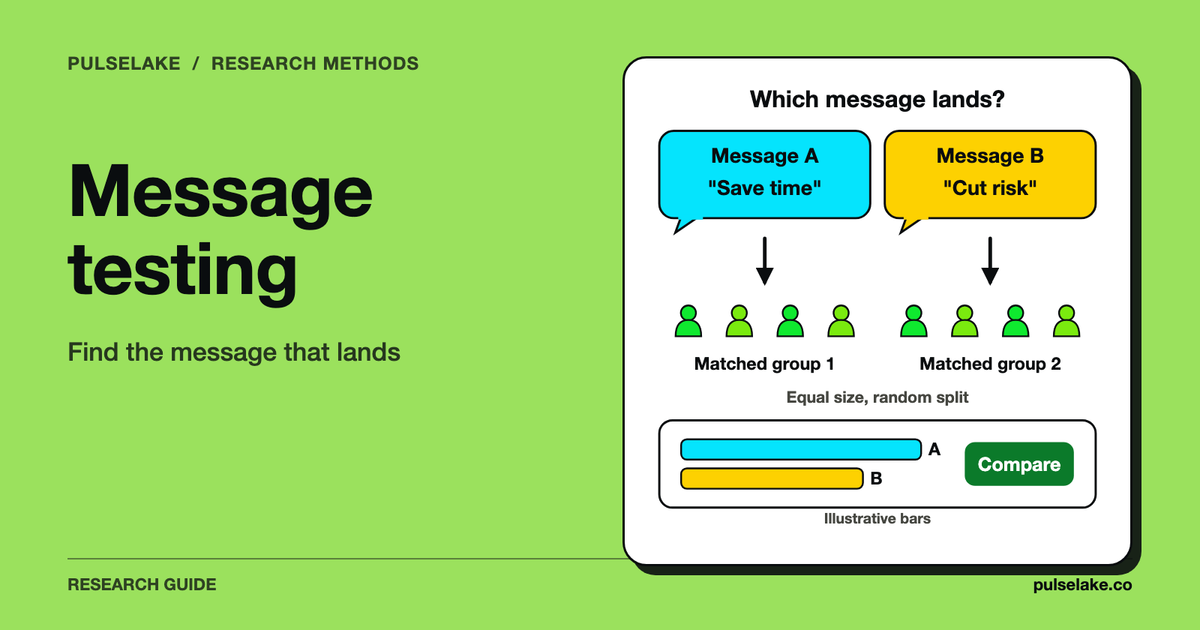
| Comparative | See two or three side by side and choose | Clear preference; no standalone scores |
| Protomonadic | Rate concepts one at a time, then choose | Richer data; longer survey |
Definitions follow SurveyMonkey: in monadic testing "one respondent sees one concept and answers your full metric battery on it"; in sequential monadic one respondent sees several concepts one at a time in randomized order; comparative shows two or three side by side; protomonadic is a hybrid with sequential evaluation first and a forced choice at the end.
Monadic testing
Each respondent sees just one concept, so nobody's comparing. Attest says this avoids comparison effects but typically needs a larger sample (Attest). Brandspeak suggests monadic suits later stages, when you want to see how a concept performs on its own (Brandspeak). Contentsquare suggests saving it for medium- or high-fidelity mock-ups, not rough sketches (Contentsquare).
Sequential monadic testing
Here each respondent sees several concepts one after another and answers the same questions after each. You need fewer people. The catch is that order can change how concepts come across, so rotate or randomize the order across respondents (Contentsquare; Attest). Brandspeak describes it as suited to early screening and says its output is better read as a relative ranking of preference (Brandspeak). It also warns that respondents can become desensitised after several concepts.
Comparative and protomonadic testing
Comparative testing gives you a direct preference and works with a small sample. Contentsquare advises limiting it to two or three concepts, because more can overwhelm people. Protomonadic combines sequential ratings with a final choice; the same source notes richer data, but harder design and a risk of survey fatigue.
Qualitative methods
You don't have to use a survey. Contentsquare notes concept tests can run through one-to-one interviews, focus groups or surveys. A common sequence is a few interviews first, to learn whether the concept is understood and what words people use, then a survey to measure and compare. See customer research methods for how these fit together.
How do you choose a concept testing method?
Work back from your decision.
- If you have many ideas and need a shortlist, use sequential monadic, rotated, with few metrics.
- If you have one or two finalists and need a go/no-go read, use monadic, with a larger sample per concept.
- If two options are close and you need a pick, go comparative, or protomonadic if you also want standalone scores.
- If you don't yet know why an idea might fail, run interviews first and the survey second.
How many respondents do you need?
No universal number exists. SurveyMonkey's guide gives about 200 completes per concept for monadic (so 400 for two concepts) and 200 total for sequential monadic with two to four concepts, rising to 400 with split rotation for six (SurveyMonkey). That's one vendor's planning guide, not a standard. Your sample size should come from the difference you need to detect and the subgroups you need to read.
Here's a hypothetical comparison using that guide's figures. Three concepts tested monadically at 200 each need 3 x 200 = 600 completes. The same three tested sequential monadically need 200 completes in total, but each person answers three batteries instead of one, so the concept section runs roughly three times as long. You're trading sample cost for respondent effort and order effects.
How do you design the concept stimulus?
The stimulus is what you show. Keep it comparable across concepts.
- Give every concept the same length, format and level of finish. A polished mock-up will beat a rough sketch for reasons that have nothing to do with the idea.
- Describe the benefit and the user, not just the features.
- Show only what a buyer would see at the point of choice. If price is part of the real offer, decide whether to show it, and make the same choice for every concept. For price-specific research, see Gabor-Granger vs Van Westendorp.
- Pilot it with a handful of people to catch confusing wording before fieldwork.
What does a concept testing questionnaire look like?
Here's a typical flow, based on the metrics SurveyMonkey lists (appeal, uniqueness, purchase intent and relevance on five- or seven-point scales, limited to three or four metrics) and the open-ended prompts in QuestionPro's guide:
- Screener and category questions confirm the respondent is in your target audience and uses or buys in the category.
- Concept exposure: show the stimulus. You can enforce a minimum viewing time if you like.
- An open-ended first reaction, for example "What is your first impression of this concept?" (QuestionPro's example asks about the respondent's first impression.)
- Core scaled questions, one per metric, on the same scale each time.
- Diagnostics: what they like or dislike, and why.
- A choice or ranking, in comparative and protomonadic designs only.
- Demographics for subgroup reads.
Concept testing survey questions you can adapt
These are illustrative examples written for this guide. They aren't a validated instrument.
| Metric | Example question | Scale |
|---|---|---|
| Appeal | How appealing is this idea to you? | 1 (not at all) to 5 (extremely) |
| Relevance | How relevant is this to your needs? | 1 to 5 |
| Uniqueness | How different is this from what you use now? | 1 to 5 |
| Purchase intent | How likely would you be to buy this if it were available? | 1 to 5 |
| Clarity | In your own words, what is this product? | Open text |
| Likes | What, if anything, do you like most? | Open text |
| Concerns | What, if anything, would stop you from using it? | Open text |
| Use | How could you see yourself using it? | Open text |
The "how could you see yourself using this" and "would you consider buying this, why or why not" prompts are adapted from QuestionPro's examples ("How do you picture yourself using this product?" and "Would you consider buying it, and what's the reason for your answer?"). For the wording of each question and common pitfalls, see what questions to ask in a concept test. For scale options, see advanced scale design.
How do you analyze concept test results?
Most teams report "top-box" scores. SurveyMonkey defines Top 2 Box as the share of respondents choosing the top two points on an appeal or purchase intent scale. On a five-point scale that's the 4s and 5s, which QuestionPro also describes as top-box scores.
Compare concepts on the same metric, then use the diagnostics to explain the gaps. A hypothetical example: in a monadic test with 200 respondents per concept, 90 people give Concept A a 4 or 5 on purchase intent and 70 do for Concept B. Top 2 Box is 90 / 200 = 45% for A and 70 / 200 = 35% for B.
Is A the winner? Not so fast. A ten-point gap on a sample this size can be noise, so check significance before declaring anything. Using the standard approximation at a 40% share and 200 per group, the 95% margin of error is 1.96 x sqrt(0.4 x 0.6 / 200), about 6.8 points. That gives roughly 38% to 52% for A and 28% to 42% for B, so the intervals overlap. Overlap is only a rough, conservative check, though: a two-proportion z-test on these numbers gives z of about 2.05, which is borderline significant at the 95% level. Either way it isn't clear-cut, and that's exactly why you set the sample size before the test, not after. Read the open-ended answers too. A concept with a lower score may be failing for one fixable reason.
Be wary of stated purchase intent. Survey answers reflect what people say they'd do, and the figures work best for comparing concepts with one another, or against a past concept you tested the same way. When it really matters, validate with behaviour, such as a pre-order page or a pilot.
What concept testing mistakes should you avoid?
- Testing the wrong audience. Recruit people who could actually buy. See avoiding sampling bias.
- Mixing fidelity across concepts, so the presentation drives the score instead of the idea.
- Using too many metrics. SurveyMonkey recommends three or four.
- Forgetting to rotate order in sequential designs.
- Treating a single survey as a go/no-go by itself. Pair it with qualitative evidence.
Where does PulseLake fit?
PulseLake supports survey-based research, AI-led interviews and synthetic research, where versioned synthetic personas can be used to test instruments and concepts with a path into human validation. We see synthetic respondents as a tool for speed and early direction: pressure-testing a questionnaire and early ideas. They don't replace asking real buyers, who are still how you validate; see how accurate synthetic respondents are. Pick the design and the sample source from your decision, not from a tool.
Frequently asked questions
What is concept testing in market research?
Concept testing means showing a target audience an idea in draft form and measuring their reaction before launch. The team then refines it, chooses between options, or drops it.
What is the difference between monadic and sequential monadic testing?
In monadic testing, each respondent sees one concept. In sequential monadic, each sees several, one at a time, in randomized order. Monadic avoids comparison and order effects but needs more respondents.
What survey questions should a concept test include?
Cover appeal, relevance, uniqueness and purchase intent on a consistent scale. Then add open-ended questions on first reaction, likes, concerns and use, and keep the scaled metrics to three or four.
How many respondents do I need for a concept test?
That depends on the difference you need to detect. SurveyMonkey's guide uses about 200 completes per concept for monadic tests, which is one vendor's planning figure, not a rule.
What is a good purchase intent score?
There's no universal threshold. Compare concepts tested the same way, or benchmark against a past concept you tested on the same scale and audience.
Can I test a concept with AI or synthetic respondents?
Yes, for early work. They can stress-test wording and early ideas cheaply, but they don't replace reactions from real buyers, so validate important decisions with human respondents.