Retrieval Augmented Research Explained
Retrieval augmented research grounds AI analysis in trusted organizational evidence, making findings more accurate, transparent, traceable, and explainable.

Retrieval augmented research is an architectural pattern that retrieves the most relevant organizational evidence before AI synthesizes or interprets an answer. It grounds generated outputs in trusted observations, findings, transcripts, documents, and structured research objects, making conclusions more accurate, transparent, traceable, and open to human review.
This matters because growing research repositories can help AI produce better answers only when the right evidence reaches the model at the right moment. Without effective retrieval, valuable knowledge remains disconnected from the analytical process. The two-minute video above walks through the core ideas.
What is retrieval augmented research?
Retrieval augmented research combines intelligent evidence retrieval with analytical reasoning. Instead of asking an AI system to answer from its internal model memory alone, it first supplies material relevant to the research question.
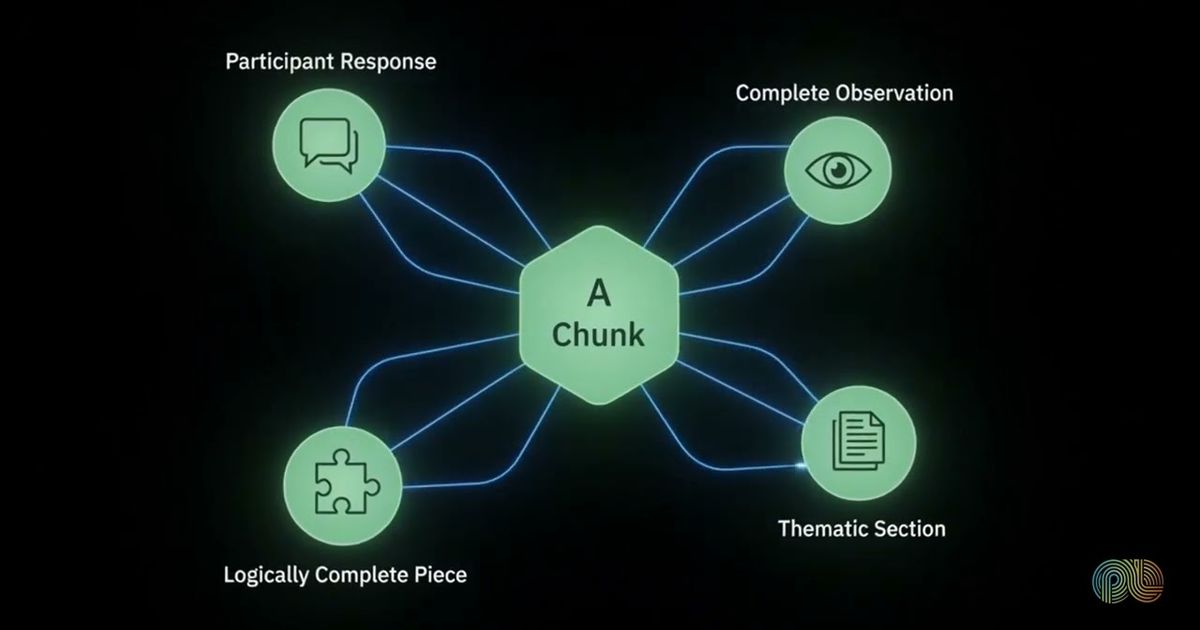
That material can include participant observations, study findings, interview transcripts, reports, documents, survey data, or structured research objects. These retrieved sources become the working context for synthesis and interpretation.
The approach applies the same principle researchers have always followed: gather appropriate evidence before reaching a conclusion. AI still performs tasks such as summarizing, comparing, or interpreting, but its response is anchored in organizational knowledge rather than generated only from general patterns learned during training.
Retrieval augmented research is therefore broader than a single search feature or AI tool. It is an architectural pattern that keeps evidence at the center of the analytical process.
How does retrieval augmented research work?
The process starts with a research question and retrieves relevant evidence before generating an answer. The system then analyzes that evidence, preserves its context, and produces a response connected to the supporting material.
A typical sequence includes:
- Frame the question. Define the topic, population, decision, or research problem that determines what evidence is relevant.
- Retrieve evidence. Find matching observations, findings, transcripts, documents, datasets, and other research objects.
- Assess the context. Consider source relevance, study conditions, provenance, and relationships among the retrieved materials.
- Synthesize the answer. Compare and interpret the evidence while maintaining a connection between claims and sources.
Retrieval must occur before synthesis. If the system generates a conclusion first and searches for support afterward, it risks selecting evidence that merely confirms the initial answer. A retrieval-first process instead gives analysis an explicit evidentiary foundation.

What makes retrieval augmented research reliable?
Reliable retrieval depends on the quality and organization of the underlying knowledge system. AI reasoning improves when it receives richer, more relevant context with clear provenance.
Several foundations affect retrieval quality:
- Structured metadata describes studies by topic, audience, method, date, market, product, and other useful dimensions.
- Semantic relationships connect related concepts, findings, studies, participants, and decisions even when they use different wording.
- Evidence lineage shows where a claim originated and how it moved from raw evidence to a finding or recommendation. Strong evidence lineage supports verification and reuse.
- Well-organized research objects give observations, themes, findings, and conclusions distinct identities rather than leaving everything buried in files.
A research knowledge graph can make these relationships machine-readable while preserving their context. This supports more precise retrieval across studies, as explained in knowledge graphs for research.
Poor organization limits even capable AI. Inconsistent metadata, disconnected files, missing provenance, and duplicated findings can cause the system to retrieve incomplete or misleading context.

How does retrieval improve accuracy and human oversight?
Retrieval improves accuracy by constraining analysis to relevant organizational evidence, while source visibility improves transparency. Researchers can inspect what informed an AI-generated summary instead of accepting an unsupported conclusion.
This visibility also helps teams evaluate whether the evidence fits the question. A retrieved study may be credible but outdated, based on a different audience, or conducted under conditions that do not apply to the present decision. Human review remains necessary to judge those limitations.
When studies disagree, the system should present the conflict rather than hide it behind one confident answer. Researchers can then examine differences in methods, samples, timing, or context. Retrieval therefore strengthens oversight: AI organizes and interprets the available material, while people assess relevance, uncertainty, and consequences.
What mistakes should researchers avoid?
The main mistake is treating retrieval augmented research as a plug-in that can compensate for disorganized knowledge. Its effectiveness depends on research structure, governance, and evidence quality as much as on the retrieval technology.
Researchers should also avoid:
- Assuming the highest-ranked result is automatically the strongest evidence.
- Removing citations or provenance from generated outputs.
- Combining contradictory findings into a false consensus.
- Treating retrieval as proof that a conclusion is correct.
- Ignoring gaps when the repository does not contain enough relevant evidence.
Retrieval can identify and assemble supporting material, but researchers must still evaluate its quality and applicability. A grounded answer can be traceable and still require qualification, further research, or human validation.
Key takeaways
- Retrieval augmented research retrieves relevant evidence before AI begins synthesis or interpretation.
- Generated outputs remain connected to organizational knowledge instead of relying only on model memory.
- Structured metadata, semantic relationships, evidence lineage, and organized research objects improve retrieval quality.
- Visible sources and conflicting findings make AI-assisted analysis more transparent and reviewable.
- Retrieval supports human judgment rather than replacing it.
How PulseLake helps
PulseLake keeps objectives, methodology, evidence, and decisions in a persistent study context supported by a research knowledge graph. Cross-study search and deep research retrieve organizational evidence, while provenance helps researchers trace answers back to their sources. Calculation mode computes answers against study data, and specialized agents support analysis while researchers retain judgment and approvals. To discuss retrieval-grounded research for your organization, talk to our team.
Frequently asked questions
Is retrieval augmented research the same as RAG?
Retrieval-augmented generation, commonly called RAG, generally describes retrieving external information to ground a generated response. Retrieval augmented research applies that pattern to the research process, including observations, findings, transcripts, structured data, evidence relationships, conflicting studies, and human review. It emphasizes research quality and traceability, not only response generation.
Can retrieval augmented research prevent AI hallucinations?
It can reduce unsupported generation by giving AI relevant evidence to work from, but it cannot guarantee that every answer is correct. Retrieval may miss important sources, return irrelevant material, or surface evidence that does not fit the current question. Researchers should review both the generated claims and the evidence used to support them.
What types of evidence can a retrieval system use?
A retrieval system can use qualitative observations, interview transcripts, survey findings, reports, documents, datasets, study summaries, and structured research objects. The useful formats depend on the research question and how well the organization has described and connected its knowledge. Clear metadata and provenance make different evidence types easier to find and evaluate together.
How should researchers handle conflicting retrieved evidence?
Conflicting evidence should remain visible rather than being collapsed into a single confident conclusion. Researchers should compare the studies’ populations, methods, timing, conditions, and underlying assumptions to understand why results differ. The final synthesis can explain the disagreement, identify what remains uncertain, and specify what additional evidence may be needed.