Voice of the Customer in Six Sigma: CTQ & VoC Translation Guide
How to turn voice of the customer into CTQ requirements in Six Sigma: CTQ tree, step-by-step translation, a hypothetical DPMO example, Kano and QFD.
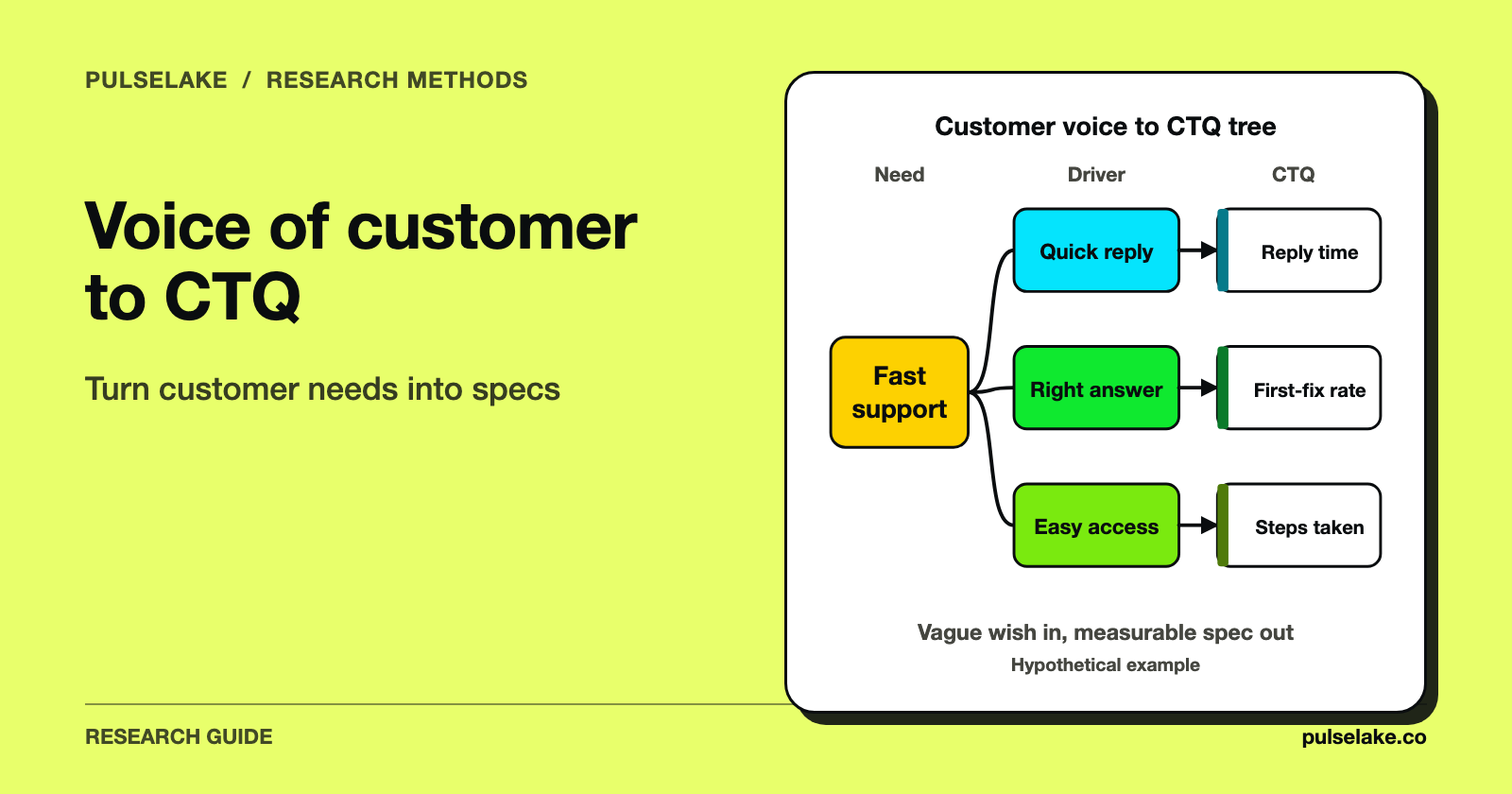
In Six Sigma, voice of the customer (VoC) is the raw input: what customers say they need, in their own words. A critical-to-quality (CTQ) requirement is the output, a measurable, specific target your process can be held to. Getting from one to the other is a chain of steps, usually drawn as a CTQ tree, that runs from a customer statement to a need, then to a quality driver, then to a measurable requirement with a limit.
We make PulseLake, a research platform. It's mentioned once, near the end, with a note on where it doesn't apply.

Where does voice of the customer fit in Six Sigma?
Right at the start. Six Sigma projects usually follow DMAIC: Define, Measure, Analyze, Improve, Control, and VoC belongs to the first phase. In Define, the team states the problem, identifies the customers (the page lists SIPOC, a high-level process view, as a Define tool), and captures voice of the customer and the critical process outputs, the CTQs (Wikipedia: DMAIC). A practitioner guide says the same: Six Sigma teams usually start with VoC data in Define (Six Sigma Study Guide). In the sister method DMADV, used for designing new products or processes, CTQs are identified in the Measure phase (Wikipedia: Six Sigma).
If you need the research side first, our guides to VoC frameworks and research methods and to building a VoC program explain how to collect the input. This article picks up where they leave off. You've got customer statements, and you need to turn them into something a process owner can measure.
What is a CTQ?
A critical-to-quality requirement is a measurable characteristic of a product or service that the customer considers important, stated with a target or limit. "Measurable" is the whole point: two people can look at the same output and agree whether it met the requirement.
Compare these two:
- VoC: "Your support team takes forever to get back to me."
- CTQ: "First reply sent within 4 business hours of the ticket being opened."
You can't audit the first one. It's a feeling. The second can be counted, and any reply that lands after the limit is a defect by definition. Clear defect definitions are one of the benefits one guide lists for CTQ trees (Six Sigma Study Guide).
What is a CTQ tree?
A CTQ tree is a diagram that breaks a broad customer need into smaller parts until the leaves are measurable. The Six Sigma Study Guide describes three levels (source):
| Level | What it holds | Example (hypothetical) |
|---|---|---|
| Need | What the customer receives | Good support |
| Driver | A quality factor that must be present | Speed of first response |
| Requirement | A measurable metric for the driver | First reply within 4 business hours |
Some guides add an intermediate step, critical to customer (CTC). There, a need is first restated as a customer-side measure with ranges and tolerances, and only then converted into an internal CTQ the process can control. The same guide lists the sequence as: identify customers, gather VoC, understand needs, translate to CTC measures, identify drivers, set internal parameters (the CTQs), and validate the requirements with customers.
How do you translate VoC into CTQs, step by step?
- Identify which customers. Buyers, users and internal downstream teams can want different things, so decide whose voice defines quality for this project.
- Collect VoC in their words. The guide above names surveys, interviews, Gemba walks (observation on site) and focus group analyses as techniques; complaints, support tickets and reviews are common raw material too. Keep the verbatim quotes. A translation is much easier to defend when the original words sit right next to it.
- Group statements into needs. Lots of quotes say the same thing. Cluster them and note how often each need comes up and how strongly people feel it. A Pareto chart of need frequency is one way to prioritize.
- Ask "what would have to be true?" For each need, list the drivers, the factors that decide whether the customer gets it. Keep asking until the answer is something you can count or time.
- Write the requirement with a limit: a metric, a unit, a target and a tolerance. "Within 4 business hours" is a requirement. "Fast" isn't.
- Define the defect and the opportunity. What counts as a miss, and how many chances per unit of work are there to miss?
- Validate with customers. Show them the requirement and ask whether hitting it would satisfy them. It's the last step in the guide's sequence, and it's where translation errors tend to show up.
In our experience step four is where teams get lazy, and it's the step that decides whether the CTQ is any good.
A worked example (hypothetical)
The numbers below are invented to show the method. They aren't data from any company.
A B2B software firm collects 300 customer comments about support. Suppose sorting them gives three needs: reply speed, problems solved first time, and clear explanations.
| Need | Driver | CTQ requirement (hypothetical) |
|---|---|---|
| Quick help | First-response time | First reply within 4 business hours |
| Problems fixed once | Resolution on first contact | Ticket not reopened within 7 days |
| Clear answers | Understandable replies | 85% or more of post-ticket ratings of "clear" or better |
Now measure the first CTQ. Say that last month the team handled 600 tickets, and 48 got a first reply after the 4-hour limit. With one opportunity per ticket (the first reply), defects per million opportunities (DPMO) is:
48 / 600 = 0.08, and 0.08 x 1,000,000 = 80,000 DPMO
Six Sigma's commonly cited benchmark is about 3.4 DPMO at the "six sigma" level, and that figure assumes a long-term 1.5 sigma drift in the process mean; the same source notes that not every process needs to reach it (Wikipedia: Six Sigma). Set your target from what customers value and what the process can actually reach. The benchmark on its own shouldn't decide it.
How does the Kano model help rank CTQs?
Requirements don't all affect satisfaction the same way. The Kano model, developed by Noriaki Kano in the 1980s, groups features into must-be (basic expectations: little credit when present, strong dissatisfaction when missing), one-dimensional (more is better), attractive (unexpected, delights when present, no penalty when absent), indifferent and reverse (Wikipedia: Kano model).
For each feature the survey asks two questions. How would you feel if the product had it? And how would you feel if it didn't? The pair of answers places the feature in a category. In CTQ work, that tells you which requirements are non-negotiable (must-be), which to improve competitively (one-dimensional), and which are optional extras. Our Kano analysis explainer covers the survey in detail.
What is the difference between a CTQ tree and QFD or the House of Quality?
A CTQ tree breaks one need down into measurable parts. Quality function deployment (QFD) is a design method that translates customer needs into engineering characteristics, developed by Yoji Akao in Japan beginning in 1966 (Wikipedia: QFD). Its House of Quality lists the customer wants (the "WHATs"), rates their importance, lists the technical features that could address them (the "HOWs"), and uses a relationship matrix to show how strongly each feature affects each want. The weighted totals show which technical characteristics matter most.
So which do you use? A CTQ tree when you're improving an existing process and need a clear defect definition. QFD when you're designing a product or service and have to trade many customer wants against many technical choices. Both start from the same input: the voice of the customer.
What are common mistakes when translating VoC?
- Skipping the customer's words. Start from internal metrics and you'll get CTQs the customer never asked for.
- Stopping at "fast" or "reliable". A requirement with no unit and no limit is still a need.
- Treating the loudest complaints as the whole picture. Complaints are a biased sample of customers, so check them against a survey of a wider group. See avoiding sampling bias.
- Mixing customers. A buyer's CTQ and a daily user's CTQ can differ, so keep them on separate branches.
- Not validating. If the customer wouldn't recognize a requirement as theirs, hitting it won't move satisfaction.
- Leading questions in the VoC itself. Badly worded questions put your assumptions into the customer's mouth. See writing questions that don't bias responses.
Can research software help with the VoC step?
The slow part of VoC is often reading hundreds of open-ended comments and grouping them into needs. PulseLake supports survey and interview research and analysis of qualitative responses, and our article on AI-assisted theme extraction describes the method. It's a research tool, not a Six Sigma project tool. It doesn't draw CTQ trees, track DPMO or capture process data, so those steps stay in your quality tools or a spreadsheet. And a researcher should still check the groupings against the original quotes.
Frequently asked questions
What is VoC in Six Sigma?
Voice of the customer is the collected set of customer needs, expectations and complaints, ideally in the customers' own words. Six Sigma teams usually gather it in the Define phase of DMAIC and use it to set project goals and CTQs.
What does CTQ stand for?
It stands for critical to quality. A CTQ is a measurable requirement, with a target or limit, that reflects something the customer values.
How do you convert VoC into CTQs?
Group customer statements into needs, work out the drivers behind each need, then state each driver as a measurable requirement with a unit and a limit. Validate the result with customers. Most teams draw this as a CTQ tree.
What is the difference between CTQ and CTC?
Critical to customer (CTC) is the requirement expressed from the customer's side, with ranges and tolerances. A CTQ is the internal parameter the process is controlled against to meet it. Not every guide uses both terms.
What is a CTQ example?
In a support process, "first reply within 4 business hours" is a CTQ for the need "quick help". The example in this article is hypothetical, but the pattern holds for most service processes.
Which tools help prioritize CTQs?
Pareto analysis for frequency, the Kano model for how requirements affect satisfaction, and QFD or the House of Quality when design trade-offs come into play.