Building an Evidence Graph
Evidence graph design links raw research evidence to findings and decisions, making every conclusion easier to trace, verify, challenge, and reuse.
In the full article
Read the video transcript
This transcript was generated from captions and may contain recognition errors.
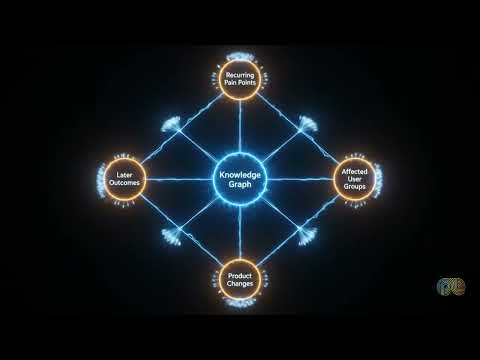
Every important research conclusion should answer one simple question. What evidence supports this claim? If that answer cannot be found quickly, confidence begins to depend on memory instead of verification. An evidence graph solves this challenge by making every conclusion traceable through connected pieces of supporting information. An evidence graph is a structured network that links raw observations to progressively higher levels of interpretation. Interview excerpts, survey responses, behavioral events, usability observations, documents, and experimental results become connected to themes, findings, insights, and recommendations through explicit relationships. Each connection explains why one piece of information supports another. Unlike a traditional report, an evidence graph preserves the path from original data to final conclusion. Anyone reviewing a recommendation can follow its supporting chain back to the underlying observations without relying on summaries alone. This transparency makes research easier to validate, challenge, and improve over time. Building an evidence graph begins with identifying reusable research objects rather than complete documents. Individual observations, themes, evidence statements, questions, findings, and decisions become separate nodes connected through meaningful relationships. Consistent identifiers, metadata, and semantic definitions ensure these connections remain reliable as the repository grows. AI systems also benefit because structured evidence provides stronger grounding than isolated reports. Retrieval becomes more precise, synthesis becomes easier to verify, and generated answers can remain connected to their supporting information instead of becoming detached summaries. As organizations accumulate more research, the evidence graph evolves into a continuously expanding network where every new study strengthens existing knowledge while preserving the reasoning behind every important conclusion.