Knowledge Graphs for Research
Knowledge graphs for research connect evidence, findings, themes, and decisions so teams and AI can discover context, trace sources, and reuse insights.
In the full article
Read the video transcript
This transcript was generated from captions and may contain recognition errors.
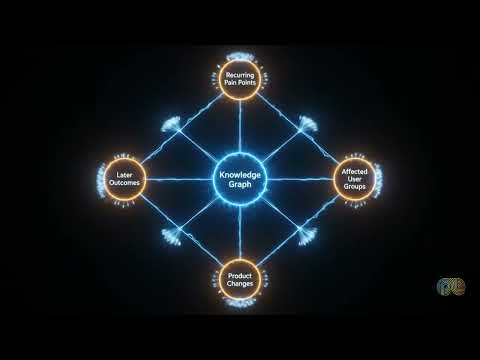
Research rarely fails because organizations lack evidence. [music] It fails because valuable evidence remains scattered across reports, presentations, interview notes, and data sets [music] that never become part of the same conversation. A knowledge graph changes that by turning isolated research assets into an interconnected network that reflects how knowledge actually develops. A knowledge graph represents information as entities connected through meaningful relationships. [music] Instead of storing every report as an independent document, it links research questions, participants, products, [music] behaviors, themes, findings, assumptions, and recommendations into a living structure. [music] Every connection carries meaning, allowing both people and AI systems to navigate knowledge beyond simple document boundaries. [music] Imagine investigating why customers struggle with a particular feature. Rather than opening dozens of studies individually, a knowledge graph lets you move directly from the feature to every related observation supporting quote [music] contradictory finding affected customer segment and design recommendation. [music] The graph becomes a map of accumulated organizational understanding instead of a library of [music] disconnected files. This structure also makes AI considerably more effective. [music] Retrieval can follow semantic relationships instead of relying only on matching keywords. Evidence from different studies can be combined while preserving its original context and source. Contradictions become easier to identify because competing findings remain visibly connected [music] instead of being buried inside separate reports. Knowledge graphs continue improving as new research arrives. Every additional study strengthens existing relationships or introduces new ones without replacing previous knowledge. [music] Over time, the graph becomes an evolving memory system that supports discovery, reasoning, traceability, [music] and continuous learning. Instead of searching for documents, researchers begin exploring knowledge itself, making every new project benefit from everything the organization has already learned.