 PulseLake
AI Confidence Estimation: How to Judge Reliability
AI confidence estimation separates persuasive language from reliable conclusions by evaluating evidence quality, retrieval, agreement and uncertainty.

AI confidence estimation assesses how much trust should be placed in an AI-generated response by examining its evidence and production conditions. It separates fluent, persuasive language from reliable conclusions, focusing on evidence quality, retrieval completeness, source agreement, reasoning consistency, and known uncertainty rather than the model’s tone.
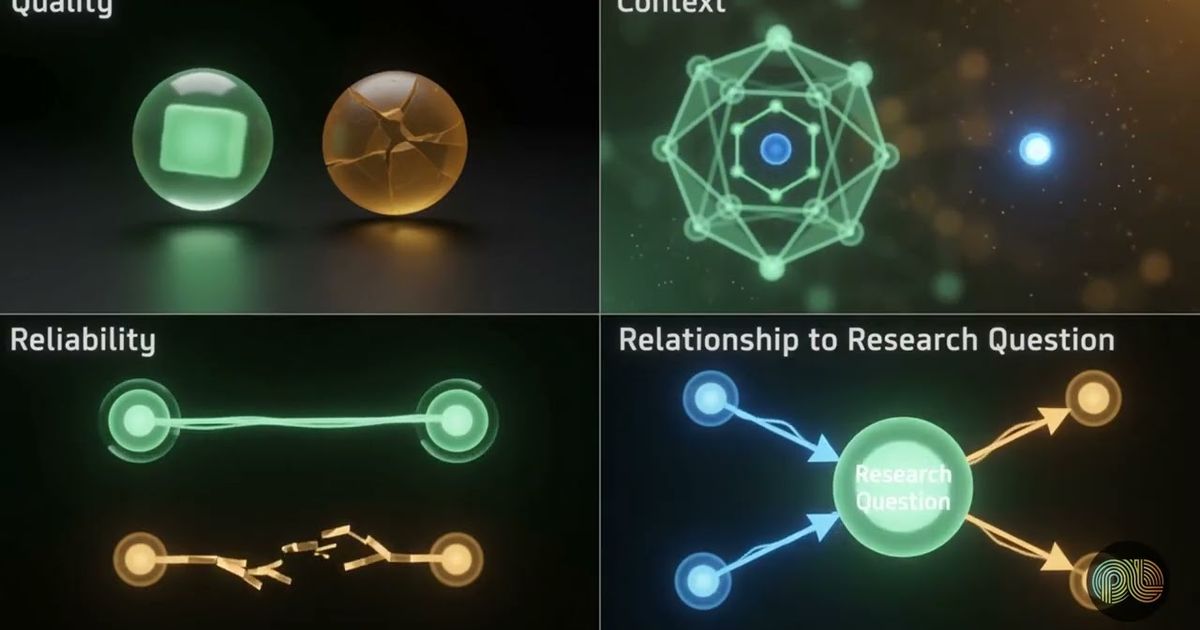
Reliable confidence signals help decision-makers recognize when an answer is well supported, when it needs qualification, and when more investigation is necessary. This reduces the risk of treating polished but insufficiently supported output as established fact. The short video above walks through the core ideas.
What does AI confidence estimation measure?
AI confidence estimation measures whether the available evidence and the process used to interpret it justify trusting a conclusion. It does not measure how confident, detailed, or authoritative the generated language sounds.
A useful assessment considers several connected factors:
- Evidence quality: Are the underlying sources credible, relevant, current enough for the question, and appropriate for the intended decision?
- Retrieval completeness: Did the system find the important available evidence, or might omitted material substantially change the answer?
- Source agreement: Do independent sources point toward a similar conclusion, or do they conflict in meaningful ways?
- Reasoning consistency: Does the conclusion follow from the evidence without contradictions, unsupported leaps, or shifting assumptions?
- Uncertainty and scope: Does the question fit the available information, and are important limitations or unknowns acknowledged?
For example, an AI system summarizing several research studies may deserve relatively high confidence when relevant evidence is comprehensive and the studies reach compatible conclusions. Confidence should fall when studies disagree, important sources are missing, or the question extends beyond what the evidence can answer.
How should AI confidence be assessed?
Confidence should be assessed across the complete path from source evidence to final answer. Reviewing only the generated text cannot reveal whether retrieval was incomplete, evidence was weak, or conflicting information was omitted.
A practical assessment can follow four stages:
- Trace the evidence. Identify which sources support each material claim and preserve their lineage, context, and limitations.
- Evaluate retrieval. Check whether the search covered the relevant studies, records, time periods, populations, and opposing evidence available to the system.
- Compare and validate. Look for agreement, contradiction, missing data, and claims that cannot be reproduced from the cited material.
- Apply human review. Have a qualified researcher examine consequential conclusions, ambiguous evidence, and assumptions requiring judgment.
Validation checks may test whether claims match their sources, calculations are correct, and repeated analyses produce materially consistent conclusions. These controls align with broader practices for evaluating AI-generated research outputs.
The goal is not necessarily to produce an exact numerical score. Labels such as higher, moderate, or lower confidence can be more meaningful when paired with a transparent rationale explaining the evidence, gaps, conflicts, and validation completed.

Why separate evidence confidence from model confidence?
Evidence confidence and model confidence answer different questions. Evidence confidence concerns the strength and coverage of the available information, while model confidence concerns how faithfully and consistently the AI transforms that information into an answer.
Strong evidence does not guarantee a strong AI response. A model can omit qualifications, distort a finding, use inconsistent reasoning, or summarize a sound body of research poorly. In that case, confidence in the evidence may be high while confidence in the generated answer remains lower.
The reverse is equally important. An AI can explain weak, incomplete, or conflicting evidence with impressive clarity, but fluent writing cannot make that evidence reliable. Teams should therefore evaluate both dimensions and report which one limits the conclusion.
This separation also keeps the researcher’s role clear. AI can support synthesis and checking, but consequential judgments still require accountable review, as explained in using AI as a research assistant rather than a decision-maker.

What mistakes should teams avoid?
Teams should avoid treating confidence as a stylistic quality or a single unexplained score. Useful confidence communication shows why a conclusion is or is not reliable.
Common mistakes include:
- Trusting confident language: Assertive wording may conceal weak evidence, incomplete retrieval, or unsupported inference.
- Using false precision: A precise-looking score can imply more certainty than the assessment process can justify.
- Ignoring contradictory evidence: Disagreement between credible sources is a signal to qualify the conclusion, not a reason to select the most convenient result.
- Hiding evidence gaps: Missing populations, studies, time periods, or contextual information should lower confidence and remain visible.
- Skipping human review: High-impact, ambiguous, or contested conclusions need qualified judgment and approval.
- Combining all uncertainty: Teams should state whether uncertainty comes from the evidence, retrieval process, model output, or research question itself.
Confidence should guide the next action. A higher-confidence conclusion may support a decision, while moderate confidence may call for caveats and monitoring. Lower confidence often indicates a need for better retrieval, additional research, human validation, or a narrower claim.
Key takeaways
- AI confidence estimation evaluates support for a conclusion, not how certain the AI sounds.
- Evidence quality, retrieval completeness, source agreement, reasoning consistency, and uncertainty all affect confidence.
- Confidence in the underlying evidence should be assessed separately from confidence in the model’s output.
- Transparent explanations are often more useful than exact but poorly justified numerical scores.
- Human review remains important when evidence is conflicting, incomplete, ambiguous, or consequential.
How PulseLake helps
PulseLake keeps objectives, methodology, evidence, decisions, and lineage within a persistent study context, helping researchers inspect the basis of AI-supported conclusions. Its research intelligence supports cross-study search, evidence provenance, natural-language questions, and a calculation mode that computes answers against study data, while specialized agents operate with researcher judgment and approvals. To discuss how these capabilities can support transparent confidence assessment, talk to our team.
Frequently asked questions
Can an AI confidence score guarantee that an answer is correct?
No. A confidence score summarizes an assessment of reliability under specific evidence and operating conditions; it does not prove that a conclusion is true. Important evidence may still be unavailable, assumptions may be wrong, or the model may mishandle strong sources. Confidence should therefore be accompanied by provenance, limitations, validation results, and an explanation of what could change the conclusion.
How should AI confidence be communicated to decision-makers?
Communicate confidence with a clear label and a short rationale covering evidence strength, retrieval coverage, source agreement, known gaps, and completed validation. Avoid unexplained percentages that suggest false precision. The communication should also identify the appropriate next action, such as proceeding with caveats, seeking human review, gathering more evidence, or narrowing the claim.
What lowers confidence in an AI-generated research synthesis?
Confidence should decrease when relevant studies are missing, sources disagree, evidence quality is uncertain, or the research question falls outside the available material. It should also decrease when claims cannot be traced to sources, reasoning is inconsistent, or the model omits important qualifications. Clear and persuasive writing does not offset any of these weaknesses.