Focus Group Research: Methodology, Online Platforms & Interviewing
How to run focus group research: group size, recruiting, discussion guide, moderation, analysis, online formats and platforms, with limits and FAQs.
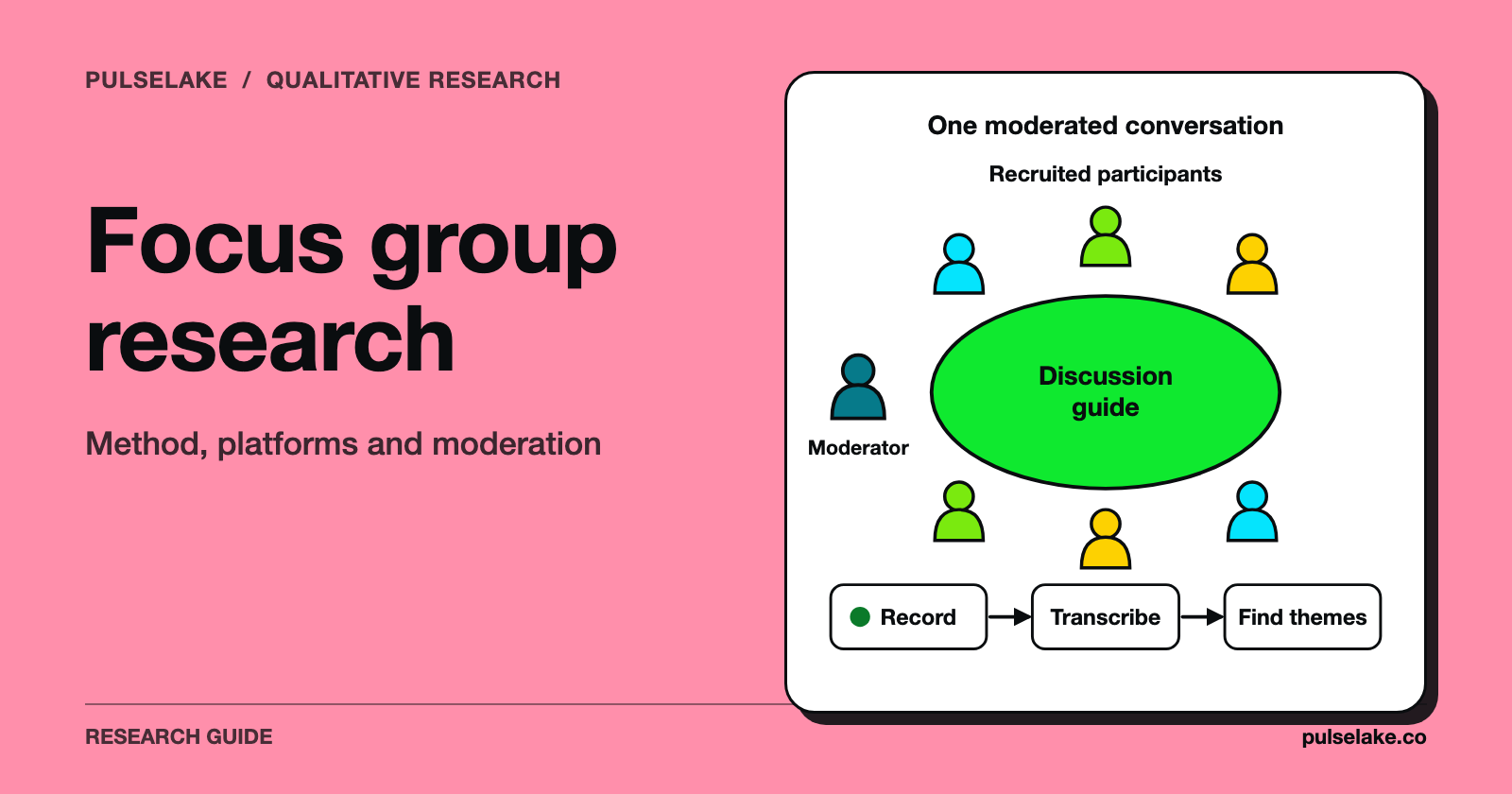
A focus group is a planned discussion in which a trained moderator guides roughly 6 to 10 purposively recruited people through semi-structured questions, and the interaction between them is the main data. It's a qualitative method: it explains why people hold views and how they talk about them, not how many share them. The method runs in six steps: define the question, recruit with a screener, write a discussion guide, moderate, record and transcribe, then code themes across groups.
We make PulseLake, a research platform. It comes up once in this guide, near the end, and we say plainly where it doesn't apply.

What is focus group research?
It's how you hear a target audience's attitudes, beliefs, perceptions and vocabulary through facilitated group conversation. MAXQDA's research guide describes group interaction as the primary data source and lists typical uses: exploring perceptions, reacting to concepts, ads or packaging before quantitative testing, and explaining the reasons behind survey results (MAXQDA).
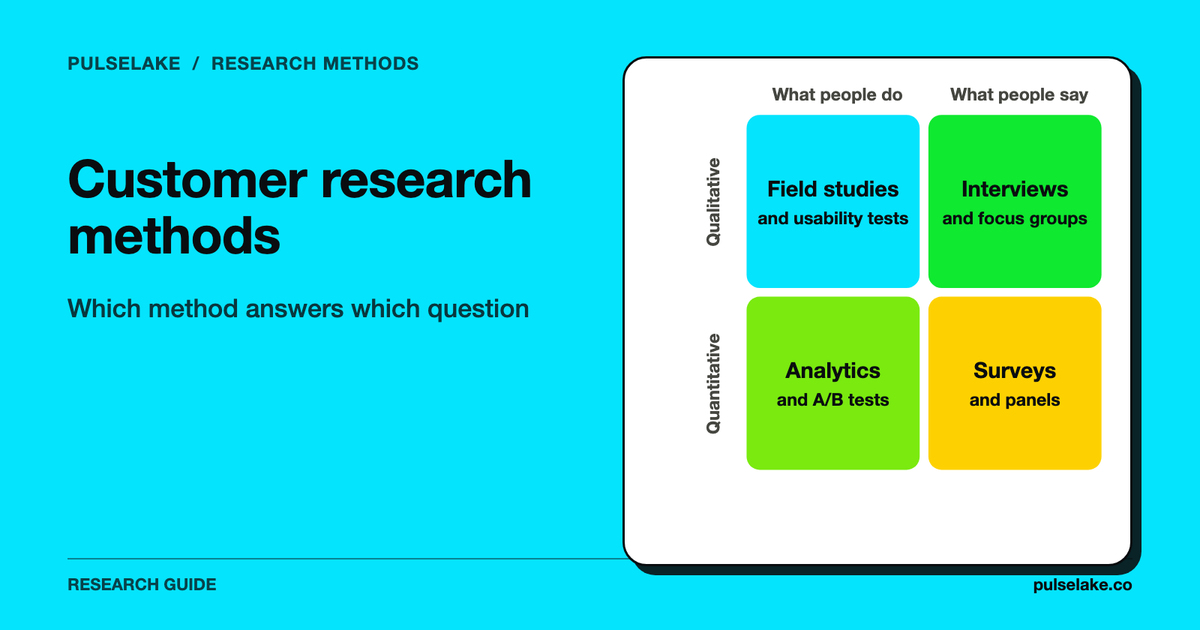
Samples are small and purposive, so the findings can't be generalized statistically to a population (MAXQDA). Need a prevalence number, like "what share of buyers prefer option B?" Run a survey. Our piece on qualitative vs quantitative research covers how the two fit together.
When should you use a focus group instead of interviews or a survey?
| Method | Use it when | Weak at |
|---|---|---|
| Focus group | Group reactions and shared language matter | Sensitive topics, prevalence |
| In-depth interview | You need one person's detailed story | Seeing group dynamics |
| Survey | You need counts and comparisons | Explaining the "why" |
MAXQDA gives group synergy yielding richer data as the reason to prefer a group over individual interviews, and cautions against groups where authority relationships among participants may produce conformity (MAXQDA). The classic one to avoid is a group of employees with their manager in the room.
What does focus group methodology look like step by step?
1. Define the research question
Before anything else, settle which decision the findings will inform. MAXQDA suggests three to five research questions, which stops a single session from sprawling (MAXQDA). Our guide to defining research problems and objectives helps with this step.
2. Plan the number and size of groups
Published ranges differ, so take them as starting points, not rules:
- Great Question gives 6 to 10 participants as standard, 4 or 5 for "mini groups" on sensitive or complex topics, and three to six groups per audience segment, stopping when new groups stop producing new insight (Great Question).
- MAXQDA reports 6 to 10 as typical, 3 to 5 for complex topics and up to 12 for simple ones, and gives 3 to 4 groups per segment as a common starting point, noting that two can suffice with well-composed groups and a skilled moderator (MAXQDA).
What they share: plan several groups per segment, and use saturation (new groups add little that's new) as your signal to stop.
3. Recruit with a screener
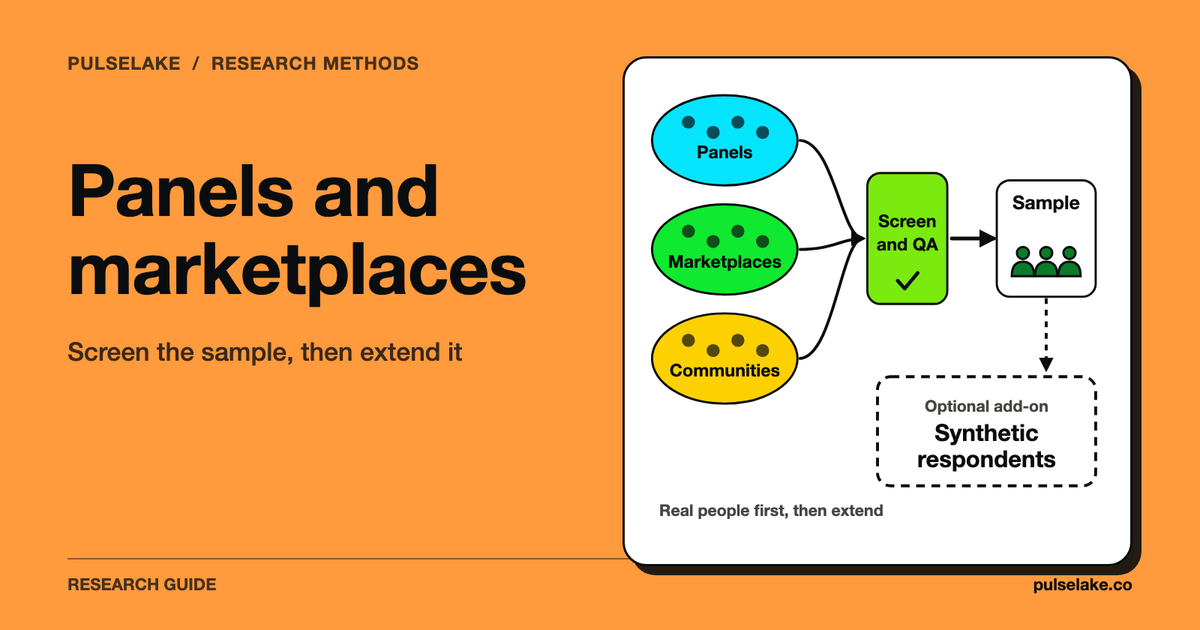
A screener is a short questionnaire that checks candidates against your criteria before you give them a seat. MAXQDA suggests 5 to 15 questions (MAXQDA). Recruit people who share the trait relevant to your question, and keep groups fairly homogeneous so people feel comfortable disagreeing. See avoiding sampling bias for how recruitment choices skew results.
Over-recruit to cover no-shows. Great Question suggests 20% to 30% more people than you need and a confirmation 24 to 48 hours ahead (Great Question); MAXQDA says 20% and 48 hours (MAXQDA).
Hypothetical example (invented numbers): you want 8 people per group across 3 groups. At 25% over-recruitment, that's 8 x 1.25 = 10 confirmed recruits per group, so 10 x 3 = 30 recruits for 24 seats.
4. Write the discussion guide
Think of the guide as a roadmap. It isn't a script. Great Question recommends open-ended prompts such as "Walk me through how you...", moving from broad to specific, and leaving time for follow-ups on unexpected points (Great Question). MAXQDA suggests three to five key questions (MAXQDA). A typical shape (our summary):
- Welcome, ground rules, consent to record.
- Warm-up: an easy question every person answers.
- Core topics, broad first, then specific.
- Stimulus: a concept, ad or prototype (concept testing guide and message testing cover this).
- Closing round: "Is there anything we did not ask that we should have?"
Steer clear of leading wording. Everything in writing questions that don't bias responses applies to a discussion guide too.
5. Moderate the session
A good moderator guides without dominating. Great Question advises setting ground rules such as one speaker at a time, using neutral follow-ups such as "Can you tell me more?", avoiding praise or agreement with particular answers, drawing out quieter people, redirecting dominant ones, and watching for groupthink (Great Question). Some practical habits:
- Ask the group to hold a question for later instead of cutting a speaker off.
- Go round the table on key questions so everyone commits to an answer before hearing the others.
- Dig into disagreement. Don't smooth it over.
That last one is our strongest opinion here. The disagreements are usually where the insight is.
6. Record, transcribe and analyze
Get recording consent in writing beforehand and verbally at the start (Great Question). MAXQDA recommends a hot debrief within 30 minutes of the session ending, while impressions are still fresh (MAXQDA).
For analysis, Great Question suggests transcribing, reviewing several times, tagging comments with themes, noting where opinions differ, backing each finding with quotes and checking back against the original objective (Great Question). MAXQDA adds that deductive (predefined) and inductive (emergent) coding are typically combined, and advises against analyzing individual opinions in isolation from group dynamics (MAXQDA). Compare themes across groups as well as within them. For larger transcript sets, see qualitative coding at scale and AI-assisted theme extraction; a human should still review the codes.
What are the limitations of focus groups?
- Groupthink, where people converge on a shared view out of politeness or because one voice dominates.
- Social desirability, where people give answers that look good in front of others.
- Moderator influence on tone and direction.
- Harder analysis, because interaction data is more complex than individual answers.
- Recruiting effort, since getting the right people in one place at one time is hard.
MAXQDA lists all five (MAXQDA). The fixes are mostly design choices: homogeneous groups, a skilled moderator, written pre-work before the session, and follow-up interviews for sensitive subjects.
What are online focus groups?
An online focus group is a qualitative session held over the internet with dedicated software (QuestionPro). It comes in two formats.
| Synchronous | Asynchronous | |
|---|---|---|
| Timing | Live, at a set time | Respond when convenient |
| Length | 30 to 90 minutes (QuestionPro) | Days to weeks or longer |
| Size | 6 to 10 (QuestionPro) | 15 to 20 start (iTracks) |
| Suits | Concept and product reactions | Diaries, co-creation, tracking |
QuestionPro puts synchronous sessions at 30 to 90 minutes with 6 to 10 participants, and describes asynchronous (bulletin board) groups as running over days, weeks or even years (QuestionPro). MAXQDA gives 60 to 90 minutes for online synchronous sessions and 2 to 5 days for asynchronous (MAXQDA). iTracks says the most common asynchronous run is 2 to 3 days, with 15 to 20 participants per group as a starting point, and says larger groups are easier to manage because participants don't all speak at once (iTracks).
Great Question's take on online versus in person: online is more convenient, cheaper and easier to schedule, and suits dispersed audiences and topics that don't involve handling a physical product. In person gives richer nonverbal cues and suits physical product testing (Great Question).
Which online focus group platforms are there?
As of October 2026, here's what three vendors say on their own public pages. It isn't a ranking, and we give no prices. The "Our read" lines summarize each page.
| Platform | What its page says | Our read |
|---|---|---|
| iTracks | Live video focus groups and interviews, asynchronous text, and discussion boards, diaries and communities over multiple days | Covers live and asynchronous in one offering |
| Recollective | Online focus groups, bulletin-board studies, diaries and ethnography; live video plus self-paced tasks | Mixes live and asynchronous work |
| Discuss.io | Focus groups and IDIs in more than 100 markets, with an observer room and live translation into English | Live sessions across many markets |
How to choose? Decide synchronous or asynchronous first. Then check recruitment support, observer access, recording and transcription, language needs and data handling. A general video-call tool can work for a small project, but it won't manage recruitment or analysis for you.
How does AI change moderation?
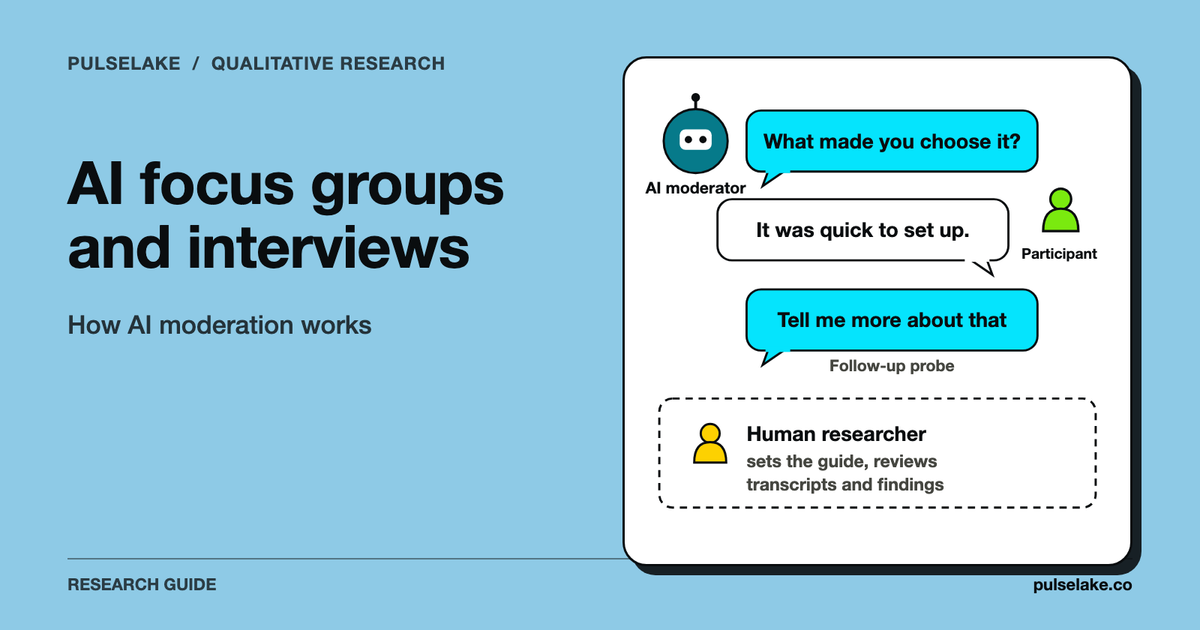
Some platforms now offer AI-moderated interviews, which run one-to-one conversations instead of live groups. That's a different method with different trade-offs, covered in our guide to AI focus groups and AI-moderated interviews and the short answer on what an AI-moderated interview is. This page sticks to human-moderated groups.
Where PulseLake fits: its public materials describe traditional research including qualitative research, and AI-led interviews with real participants. This guide doesn't claim PulseLake runs live, human-moderated group video sessions. For those, use a dedicated platform like the ones above.
Frequently asked questions
How many people should be in a focus group?
Six to 10 is what most sources give. Great Question suggests 4 or 5 for sensitive or complex topics, MAXQDA says 3 to 5 for complex topics, and MAXQDA allows up to 12 for simple ones.
How many focus groups do you need?
Plan several per audience segment. Great Question suggests three to six per segment and stopping when new groups add little; MAXQDA gives 3 to 4 per segment as a common starting point and says two can suffice with well-composed groups and a skilled moderator.
How long should a focus group last?
MAXQDA gives 60 to 120 minutes in person and 60 to 90 minutes for live online sessions. QuestionPro puts synchronous online sessions at 30 to 90 minutes.
What is the difference between a focus group and an in-depth interview?
A focus group studies how people discuss a topic together and treats their interaction as data. An in-depth interview explores one person's experience. Pick interviews for sensitive topics, or whenever group pressure would distort answers.
Are online focus groups as good as in-person ones?
They're good at different jobs. Online is cheaper and easier to schedule for dispersed audiences, while in person gives richer nonverbal cues and suits physical products (Great Question).
Can focus group results be generalized?
No. Samples are small and purposive, so findings can't be statistically generalized (MAXQDA). Use them to form hypotheses, then test those with a survey.