Multi-Annotator Agreement Explained
Multi-annotator agreement measures labeling consistency, reveals unclear guidelines, and helps teams build reliable datasets for research and AI systems.

Multi-annotator agreement measures how consistently multiple reviewers apply the same labels to the same data under shared instructions. It helps teams judge whether annotation guidelines and decision rules produce sufficiently reliable results for the intended task, while recognizing that some disagreement is normal and may reflect genuine ambiguity rather than reviewer failure.
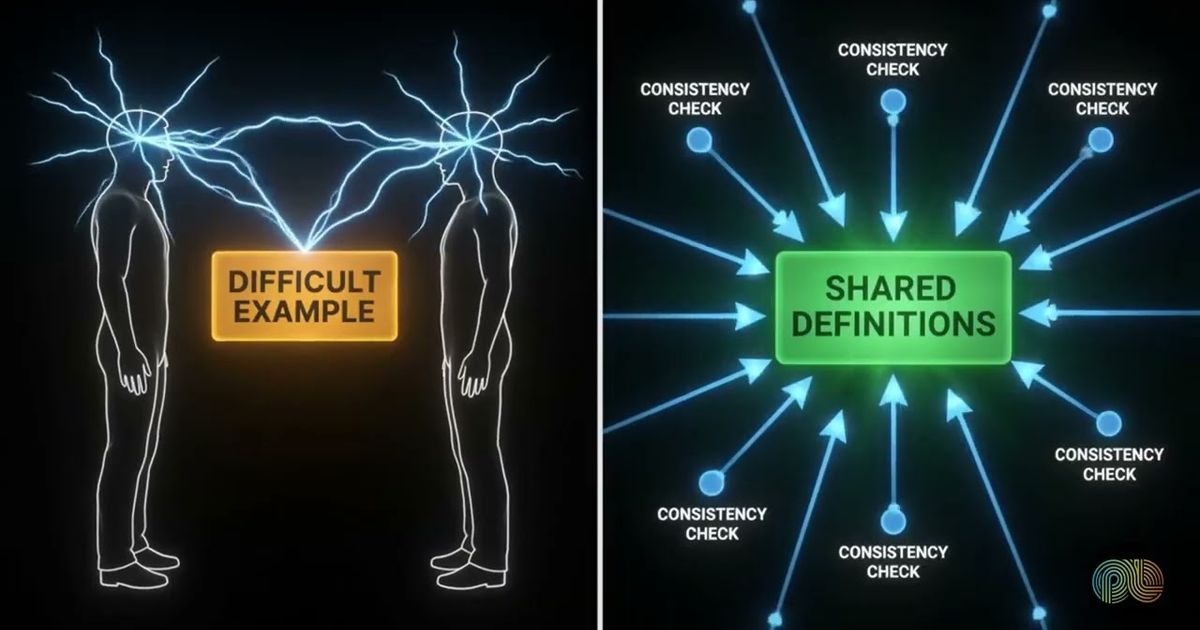
Reliable agreement supports credible analysis, exposes weaknesses before they spread across a larger dataset, and improves data used in research operations, AI training, and AI evaluation. The two-minute video above walks through the core ideas.
What is multi-annotator agreement?
Multi-annotator agreement is the degree to which several reviewers make consistent labeling decisions when given the same examples and instructions. It tests the reliability of the annotation process rather than simply evaluating individual annotators.
For example, several reviewers might classify customer feedback into product usability themes. If they repeatedly assign the same themes to the same comments, confidence in the resulting dataset increases. Frequent differences suggest that the team should examine the labeling framework, instructions, training, or source material.
Agreement can be measured with simple percent agreement or with measures that account for agreement occurring by chance. Teams may also inspect agreement by category, reviewer pair, or type of example. No single metric tells the whole story, so numerical results should be reviewed alongside the actual disagreements and the task’s intended use.
High agreement usually indicates that the task is well defined and reviewers interpret the instructions similarly. It does not prove that the labels are correct, however. Annotators can consistently apply a flawed definition, which is why agreement should be combined with expert review and broader annotation quality control.
How should annotator agreement be interpreted?
Agreement should be interpreted against the nature, complexity, and consequences of the task. The objective is sufficient consistency for reliable analysis, not perfect agreement in every situation.
Straightforward classification tasks generally warrant higher consistency because categories should have clear boundaries. Open-ended qualitative interpretation may reasonably produce more variation because a passage can support multiple perspectives or themes. Multi-label tasks can also generate partial agreement when reviewers identify some of the same concepts but not all of them.
Teams should define what acceptable agreement means before scaling annotation. That decision should reflect:
- Whether labels are mutually exclusive or can overlap.
- How much judgment the task requires.
- Whether disagreements could materially change analysis or model evaluation.
- Whether ambiguous cases can be escalated or adjudicated.
- Whether consistency changes across labels, reviewers, or data segments.
A single overall score can conceal important patterns. Strong agreement on common categories may coexist with confusion around rare or closely related labels. Reviewing category-level results and disagreement examples makes the assessment more useful.
What causes low multi-annotator agreement?
Low agreement often points to unclear definitions, overlapping categories, insufficient training, or genuinely ambiguous data. It should trigger investigation rather than an automatic conclusion that reviewers performed poorly.
Unclear definitions leave reviewers to fill gaps using personal assumptions. Overlapping categories create cases in which two labels both appear defensible. Missing decision rules make it difficult to handle edge cases consistently, even when the main label descriptions seem clear.
Training can also be insufficient when annotators see instructions but do not practice on representative examples or compare their reasoning. Well-designed annotation guidelines should include definitions, boundaries, positive and negative examples, and rules for difficult cases.
Sometimes the research material itself is the source of disagreement. Customer comments may be vague, contain several themes, or require context that is unavailable. In these situations, disagreement reveals a limitation of the data or labeling framework rather than a simple process failure.

How can teams improve annotator consistency?
Teams improve consistency by assessing agreement regularly, examining why reviewers differ, refining the framework, and testing the revisions. Disagreements are useful evidence about where the annotation system needs attention.
A practical improvement cycle includes four steps:
- Calibrate reviewers. Ask annotators to label the same representative sample independently before full production begins.
- Review disagreements. Compare decisions and reasoning to identify confusing terminology, overlapping categories, missing context, and absent decision rules.
- Revise the framework. Clarify definitions, add examples, separate or combine labels where appropriate, and document how edge cases should be handled.
- Reassess agreement. Repeat the exercise with fresh examples to determine whether the changes improved consistency without merely teaching answers to the initial sample.
Regular checks are especially important as datasets, labeling needs, and reviewer groups change. Teams should preserve important decisions so later annotators can apply the same interpretation. Treating disagreement as a source of learning creates a dependable annotation process instead of hiding ambiguity behind an aggregate score.

Key takeaways
- Multi-annotator agreement measures whether reviewers consistently apply shared labels and instructions.
- High agreement supports confidence in a dataset but does not independently prove that its labels are valid.
- Low agreement may reveal unclear definitions, overlapping categories, insufficient training, or ambiguous source material.
- Acceptable agreement depends on the task, with straightforward classification generally requiring more consistency than open-ended interpretation.
- Regular disagreement reviews help teams improve guidelines and prevent quality problems from spreading.
How PulseLake helps
PulseLake keeps methodology, evidence, ontology, governance, and lineage within a persistent study context, helping teams preserve annotation definitions and decisions. Its research intelligence and qualitative analysis agents can support evidence review, while approvals and QA can be organized as repeatable workflows with researchers retaining judgment. To discuss how these capabilities fit your research operations, talk to our team.
Frequently asked questions
What level of multi-annotator agreement is acceptable?
There is no universal acceptable level for every annotation task. The threshold should reflect category clarity, task complexity, intended use, and the consequences of inconsistent labels. A simple classification task normally calls for stronger consistency than exploratory qualitative coding, where several interpretations may be reasonable.
Does low agreement mean the annotators are performing poorly?
Not necessarily. Low agreement can result from unclear instructions, overlapping labels, missing decision rules, inadequate training, or ambiguous examples. Reviewing the disputed cases and asking annotators to explain their reasoning helps determine whether the issue comes from reviewer performance, the framework, or the data itself.
Should every item be labeled by multiple annotators?
Not always. Teams can use overlapping annotation on a representative sample to calibrate reviewers and monitor consistency, then decide whether the remaining data needs duplicate review based on risk and complexity. High-stakes, ambiguous, or evaluation-critical items may justify broader overlap and formal adjudication.
Can agreement be assessed for open-ended qualitative coding?
Yes, but qualitative agreement should account for the interpretive nature of the task. Reviewers may identify different but defensible themes, especially when responses contain several ideas. Teams should examine both overall consistency and the substance of disagreements rather than expecting the same uniformity required for straightforward classification.