Semantic Relationships in Research Explained
Semantic relationships in research connect evidence, findings, questions and decisions so knowledge is easier to trace, retrieve, synthesize and reuse.

Semantic relationships in research explicitly describe how evidence, findings, questions, recommendations, and decisions connect by meaning. They show whether one concept supports, answers, explains, depends on, expands, or contradicts another, turning a collection of reports into a traceable knowledge network that people and AI systems can navigate.
Relationships matter because they preserve the chain from raw observation to interpretation and action. Without that chain, reports may remain searchable while the reasoning behind them stays hidden. Explicit links make knowledge easier to examine, compare, and reuse. The two-minute video above walks through the core ideas.
What are semantic relationships in research?
A semantic relationship is a defined, meaningful connection between two research concepts. It records how the concepts relate, not merely that they appear in the same document or share similar words.
Common relationships include:
- An observation supports or challenges a finding.
- A finding answers a research question or contributes to a theme.
- A recommendation depends on several findings or pieces of evidence.
- An insight contradicts or expands an insight from another study.
These connections create context around each research item. From a single finding, a researcher might navigate to supporting evidence, the question it answers, related themes, competing interpretations, downstream decisions, and unresolved questions.
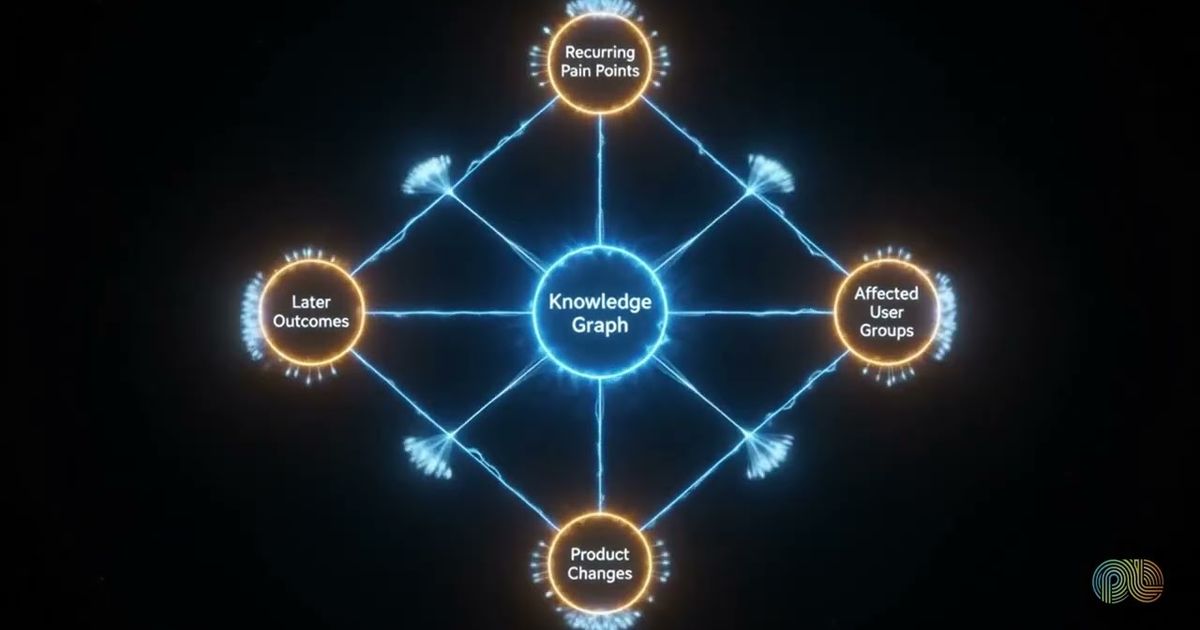
This model is closely related to knowledge graphs for research, which represent concepts as connected entities rather than isolated files. The result is a richer account of what an organization knows and why it believes that knowledge is credible or useful.

How do semantic relationships improve research discovery?
Semantic relationships let researchers explore knowledge by meaning and connection, not just by document title or keyword. They make relevant context discoverable even when studies use different terminology or live in separate projects.
Traditional document search might find every report containing “onboarding.” A relationship-aware system can go further by revealing which onboarding findings were supported by interviews, which themes appeared across products, which recommendations followed, and whether later research confirmed or contradicted the original interpretation.
Researchers can follow connections across:
- Projects and recurring studies.
- Qualitative and quantitative methods.
- Products, audiences, and customer segments.
- Earlier and later periods.
- Evidence, interpretations, recommendations, and decisions.
This structure also supports reuse. Instead of starting with a blank search or reading every report again, a team can begin with a known finding and follow its relationships to relevant context. New studies then strengthen the network by adding evidence, updating interpretations, or exposing unanswered questions.
How do semantic relationships help AI systems?
Semantic relationships give AI systems explicit context for retrieval, synthesis, and reasoning. Rather than relying only on keyword similarity, an AI system can follow established links between questions, evidence, findings, and decisions.
This improves three important research tasks. First, retrieval can prioritize information connected by meaning. Second, synthesis can preserve the evidence supporting a conclusion instead of presenting an isolated summary. Third, reasoning can follow recorded relationships rather than inventing an unsupported connection between separate facts.
For example, when asked why a recommendation was made, a relationship-aware system could retrieve the recommendation, the findings on which it depends, and the observations supporting those findings. That chain provides a stronger basis for review than a response assembled from passages that happen to contain similar words.
Semantic relationships do not remove the need for human judgment. Researchers must still assess the quality of evidence, resolve competing interpretations, and decide whether a relationship is valid. Clear evidence lineage makes those judgments easier to inspect.
Which semantic relationships should you model?
Model relationships that improve understanding, traceability, discovery, or reuse. Attempting to connect every item to everything else creates noise and makes the structure harder to maintain.
Start with a small vocabulary of relationships tied to real research work. Useful examples include “supports,” “challenges,” “answers,” “depends on,” “relates to,” “contradicts,” and “informs.” Define what each relationship means so researchers apply it consistently.
A practical modeling process is:
- Identify the research concepts people regularly need to trace, such as evidence, findings, questions, recommendations, and decisions.
- Define the relationships that explain how those concepts influence one another.
- Record direction where it matters: evidence supports a finding, while a finding is supported by evidence.
- Review and refine the model as new studies reveal genuinely useful connection types.
Avoid treating simple co-occurrence as a meaningful link. Two concepts appearing in the same report may be unrelated. The relationship should express a defensible interpretation and retain enough provenance for another researcher to understand where it came from.

Key takeaways
- Semantic relationships describe how research concepts support, challenge, answer, explain, or depend on one another.
- Explicit connections turn disconnected reports into a navigable organizational knowledge network.
- Relationship-aware discovery can surface related evidence, themes, interpretations, decisions, and open questions across studies.
- AI systems can use semantic connections to retrieve and synthesize research with more context and traceability.
- Teams should model only relationships that provide clear value and can be applied consistently.
How PulseLake helps
PulseLake preserves objectives, methodology, evidence, findings, and decisions in a persistent study context. Its research knowledge graph, cross-study search, evidence provenance, ontology, and governance foundations help teams connect research across projects while retaining traceability. To explore how this can support your research system, talk to our team.
Frequently asked questions
What is the difference between semantic relationships and research tags?
Tags classify an item by assigning a label such as a product, audience, method, or theme. Semantic relationships explicitly describe how two items connect, such as evidence supporting a finding or a finding informing a decision. Tags help group similar material, while relationships preserve the meaning and direction of a connection.
Can semantic relationships connect qualitative and quantitative research?
Yes. Semantic relationships can connect concepts across methods when the relationship is meaningful and traceable. For example, an interview theme might explain a survey pattern, while a quantitative result might support or challenge an interpretation from qualitative research. The relationship should not imply that unlike evidence is interchangeable; it should clarify how the sources contribute to understanding.
Does a research repository need a graph database to use semantic relationships?
No. Semantic relationships are primarily an information-modeling approach and can be implemented in different technical systems. What matters is that concepts and relationship types are consistently defined, searchable, and traceable to their sources. Graph-based technology can make complex connections easier to navigate, but the underlying semantic discipline comes first.
How should teams maintain semantic relationships over time?
Teams should use defined relationship types, preserve provenance, and review connections when evidence or interpretations change. They should also retire redundant links and add new relationship types only when those types solve a recurring research need. This keeps the knowledge network useful without turning maintenance into an exhaustive documentation exercise.