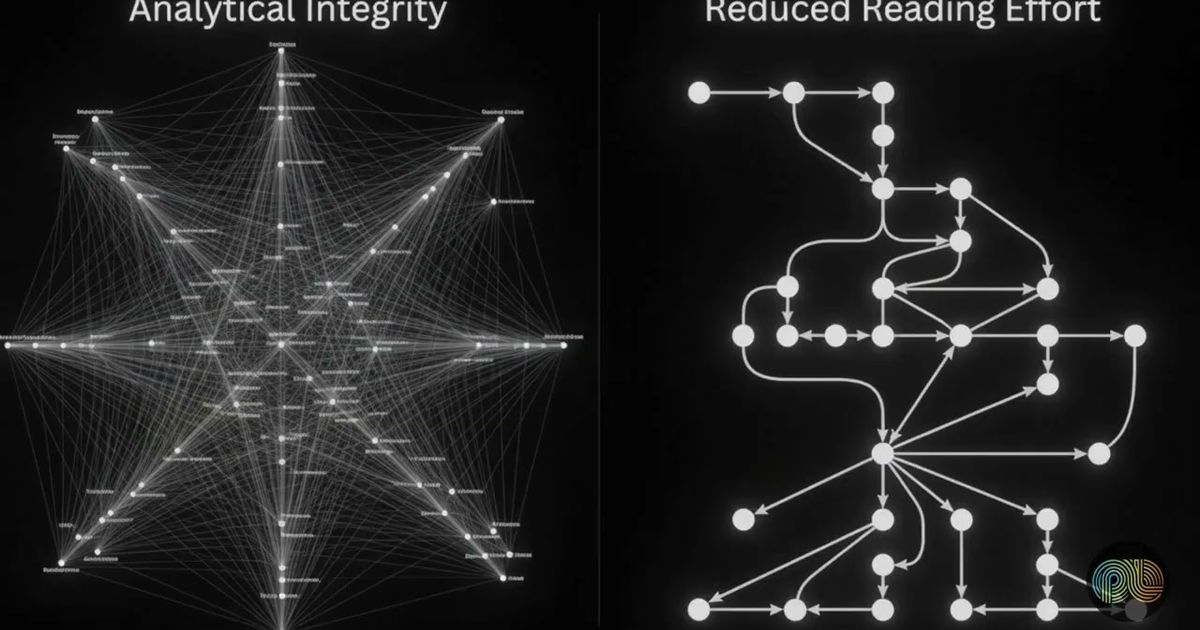
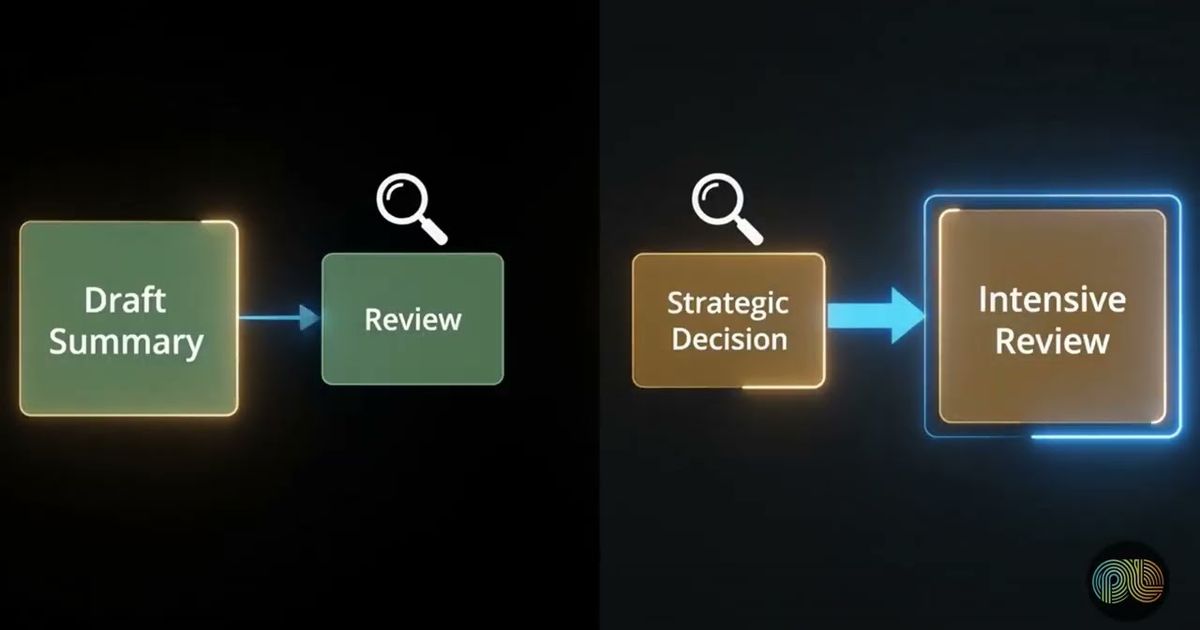
Validating AI Summaries
Validating AI summaries requires tracing claims to source evidence, preserving uncertainty and balance, and applying human review before publication.

Validating AI summaries means checking that an AI-generated summary faithfully reflects its source material. Reviewers trace major claims to evidence, confirm that key findings and limitations remain intact, preserve uncertainty and competing perspectives, and remove unsupported statements. The goal is a concise account that is accurate, balanced, transparent, and safe to reuse.
Without validation, an elegant summary can omit important findings, distort meaning, or present tentative evidence as a confident claim. These errors can spread when summaries enter reports, repositories, or decision workflows. The two-minute video above walks through the core ideas.
What does validating an AI summary mean?
Validation confirms that a summary represents the source material without changing its meaning. It evaluates accuracy, completeness, balance, uncertainty, and support for every significant claim.
A reviewer should be able to connect each major statement to specific source evidence. That connection may lead to an interview passage, survey result, coded theme, analysis output, or documented finding. Strong evidence lineage makes this relationship visible rather than asking readers to trust polished prose.
Validation also asks whether the summary reflects the research objectives and methodological context. A statement can sound reasonable but still be inappropriate if it ignores the study population, research design, or limits of the data.
The review should answer four basic questions:
- Are the important findings included?
- Is the evidence represented fairly?
- Are uncertainty and limitations preserved?
- Has the AI introduced any unsupported claim?
A summary that fails any of these tests remains a draft, regardless of how concise or readable it appears.
How should you validate an AI-generated summary?
Start by comparing every major statement with the original research. Reviewers should prioritize central findings, causal language, quantified claims, recommendations, and other statements that could influence a decision.
A practical workflow has four stages:
- Identify significant claims. Separate substantive findings from transitions, framing, and general background.
- Trace claims to evidence. Locate the source material that directly supports each statement rather than relying on assumptions or broad patterns.
- Check completeness and meaning. Look for omitted findings, missing limitations, overlooked contradictions, or stronger language than the evidence permits.
- Correct and approve. Revise unsupported or distorted passages, then have an accountable human reviewer approve the result.
Retrieval-grounded generation can reduce unsupported output by giving the model relevant source material when it writes. However, grounded AI responses still require review because retrieval may miss evidence, surface an unrepresentative passage, or fail to preserve context.
Structured review makes validation more consistent. A review form can capture the claim, supporting evidence, detected issue, correction, and approval status. AI may assist by flagging inconsistencies or statements without clear support, but final responsibility belongs to people who understand the objectives, methods, and decision context.

How do you preserve balance and uncertainty?
A valid summary represents the overall body of evidence, not just its most memorable observations. It should communicate recurring patterns, meaningful minority perspectives, contradictions, uncertainty, and limitations in proportion to their relevance.
Rare but dramatic examples can attract disproportionate attention. If an unusual quotation appears as though it represents most participants, the summary distorts the evidence even when the quotation itself is genuine. Conversely, a minority perspective should not disappear simply because it occurred less often, particularly when it exposes risk, unmet needs, or a distinct experience.
Preserving uncertainty also requires careful language. Findings described in the source as tentative, directional, mixed, or limited should not become definitive claims. Correlation should not silently become causation, and an observation from one population should not be generalized to another without support.
Validation therefore involves judgment, not just fact matching. Reviewers must assess how individual observations relate to the complete evidence base and whether the summary preserves that relationship.
What mistakes should reviewers avoid?
The most serious mistake is treating fluent writing as proof of accuracy. AI can produce a coherent paragraph that contains unsupported statements, omits qualifications, or combines separate findings into a claim the original research never made.
Reviewers should also avoid:
- Checking a few details while leaving the main claims untested.
- Verifying that evidence exists without asking whether it was represented fairly.
- Removing contradictions to make the narrative appear cleaner.
- Allowing memorable examples to overshadow recurring patterns.
- Dropping methodological limits or uncertainty during editing.
- Publishing a summary to a report or knowledge repository before approval.
Automation can support comparison, inconsistency detection, and traceability, but it cannot assume accountability. Human reviewers remain essential because they can interpret methodological context, recognize consequential omissions, and decide whether the summary is suitable for its intended use.

Key takeaways
- Every significant claim in an AI summary should be traceable to supporting source evidence.
- Validation should test completeness, fairness, uncertainty, limitations, and the absence of unsupported statements.
- Recurring patterns, dramatic exceptions, and minority perspectives should be represented proportionally and in context.
- AI can flag possible problems, but an informed human reviewer retains final responsibility.
- Validation turns convenient drafts into dependable research assets that can be reused with confidence.
How PulseLake helps
PulseLake keeps research objectives, methodology, evidence, analysis, and decisions within a persistent study context. Its research knowledge graph, evidence provenance, cross-study search, and specialized analysis and reporting agents can support traceable summaries and structured human review. To discuss how these capabilities can fit a governed summarization workflow, talk to our team.
Frequently asked questions
Can AI validate its own research summary?
AI can help identify inconsistent statements, compare claims with retrieved passages, and flag assertions that lack obvious support. It should not be the sole validator because it may repeat the same interpretation error, miss omitted evidence, or misunderstand methodological context. An informed human should review important summaries and retain approval responsibility.
How much of the source material should a reviewer check?
Every significant claim should be checked against its supporting evidence, while the overall source should be reviewed for omitted findings, contradictions, and limitations. The required depth depends on the summary’s risk and intended use. A decision-critical report needs more rigorous review than a low-stakes working note, but selective spot-checking alone cannot establish completeness.
What makes a claim in an AI summary traceable?
A claim is traceable when a reviewer can locate the specific source evidence that supports it and understand how that evidence led to the summarized statement. Useful traceability preserves source identity, context, and analytical relationships. A general reference to an entire report is weaker than a direct connection to the relevant passage, result, theme, or analysis.
Should minority perspectives appear in every AI-generated summary?
Minority perspectives should appear when they are relevant to the research question, reveal a distinct experience, qualify a broader pattern, or identify a meaningful risk. They should not be presented as the dominant view unless the evidence supports that framing. Validation preserves both their significance and their proper proportion within the complete evidence base.