What Are Consumer Insights? Definition, Analysis & Real-World Examples
What consumer insights are, how they differ from data and market research, where they come from, how to analyze them, with a hypothetical worked example.
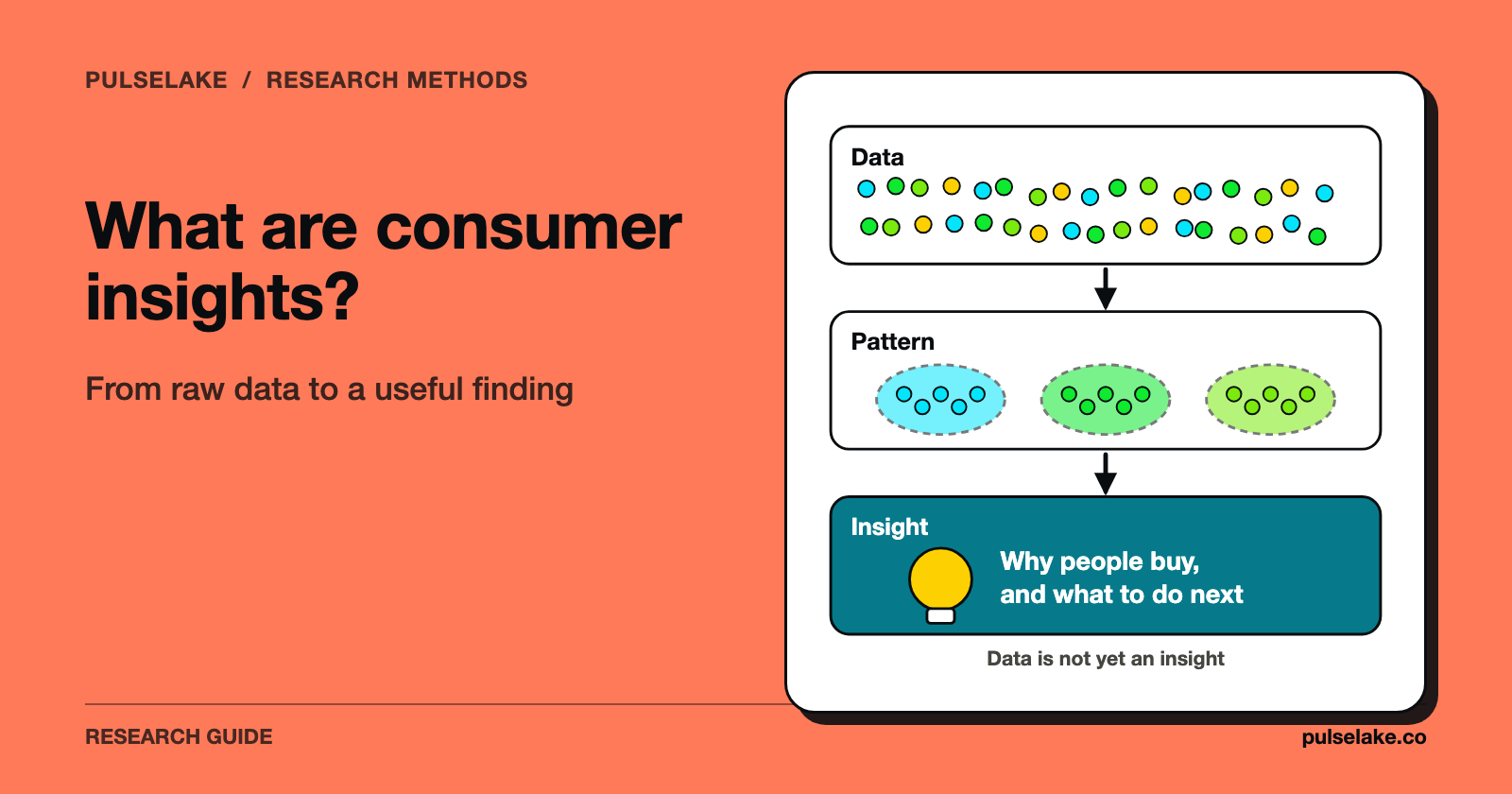
Consumer insights are evidence-based explanations of why people think, choose and behave as they do, stated clearly enough to change a decision. Data tells you what happened (sales dropped, carts were abandoned). An insight explains why, and points to something you can do about it. Surveys, interviews, behavioral data and social conversations feed insights, but the data itself isn't the insight.
We make PulseLake, a research platform. It's mentioned once in this article, near the end.

What are consumer insights?
Think of a consumer insight as an interpretation. A measurement alone doesn't qualify. SurveyMonkey describes consumer insights as the "why" behind consumer behavior: the motivations, barriers and perceptions that explain what people do (SurveyMonkey). GWI draws the same line. Data shows what's happening and insights explain why, and its example is a traffic drop (the data) and messaging that has stopped resonating (a possible insight) (GWI). Meltwater defines them as data-driven observations that help a business understand its customers and make better decisions (Meltwater).
The emphasis varies. Still, a useful insight has three parts:
- An observation grounded in evidence, meaning what you actually saw in the data.
- An explanation of the motive, barrier or belief behind it.
- An implication: a decision or change it supports.
Miss the third part and you've usually got a finding. "Forty percent of visitors leave at checkout" is a finding. "Visitors leave at checkout because shipping costs appear only on the last screen, so showing them earlier is worth testing" is an insight.
How are consumer insights different from market research and customer insights?
- Market research is the activity of collecting data about a market, category or customers. SurveyMonkey frames consumer insights as the interpretation that follows: gather the data, interpret the patterns, then act (SurveyMonkey). Meltwater draws a slightly different line, calling market research broad and mostly quantitative and consumer insights more qualitative (Meltwater). In practice they overlap, and most insight work uses both kinds of evidence. See qualitative vs quantitative research.
- Customer insights focus on people who already buy from you, covering things like satisfaction and loyalty. SurveyMonkey contrasts these with consumer insights, which cover the wider market including non-buyers (SurveyMonkey). Related practices include voice of the customer programs.
- Analytics and dashboards report behavior. They feed an insight but are rarely the insight itself.
Where do consumer insights come from?
The three sources we opened for this article list overlapping inputs:
| Source type | Examples | What it is good for |
|---|---|---|
| Asked directly | Surveys, interviews, focus groups, diary studies | Motives, attitudes, reactions to ideas |
| Observed behavior | Purchase history, website analytics, experiments | What people actually do |
| Conversations | Reviews, social media, support interactions | Unprompted language and complaints |
| Third-party | Panels, competitor data | Reach into groups you cannot easily contact |
Meltwater lists market research, online reviews, purchasing data, website analytics, social media data, consumer sentiment, customer service data and competitor data (Meltwater). GWI lists surveys, behavioral data, social listening, third-party panels and AI-powered tools (GWI). SurveyMonkey names interviews, focus groups, experiments and surveys, plus methods such as diary studies, usage and attitude surveys, concept tests and message checks (SurveyMonkey).
Every source has blind spots. Reviews can include fake ones, a point Meltwater makes itself. People also misreport their own behavior in surveys, which is why asked and observed evidence work best side by side. For choosing methods, see customer research methods.
How do you analyze consumer data to find insights?
Here's a practical sequence. It's our own synthesis, not any one source's list:
- Start with a decision. Write down the choice the insight has to support (change the checkout, pick a message, enter a segment). See designing research that produces actionable answers.
- Collect or gather evidence from at least two source types.
- Organize what you have. SurveyMonkey's analysis steps include grouping responses, segmenting and filtering data and using crosstabs (SurveyMonkey). Open-ended comments need coding into themes (finding themes in thousands of responses).
- Compare segments, because averages hide differences. SurveyMonkey's segmentation type combines demographic, psychographic and behavioral data to find meaningful differences between groups.
- Ask why. Pair the numbers with interviews or open questions to find the explanation. Key driver analysis can help show which factors move an outcome.
- State the insight as observation, explanation, implication.
- Check it against a second source or a small test before acting.
- Share it where the decision actually gets made (operationalizing insights).
Step seven is the one teams skip. We'd argue it's the one that matters most.
What are real-world examples of consumer insights?
Examples from published sources
- On feature preference, SurveyMonkey's illustrative examples include new customers valuing ease of use while long-term customers value advanced functionality, and consumers paying more for a version with faster support (SurveyMonkey). Those illustrate the type. They aren't named studies.
- On unmet needs, the same page notes that diary studies can uncover workarounds consumers create, which may point to unmet needs.
- Social listening can shape content. Meltwater's page says Domino's Pizza France uses Meltwater research to narrow its content to what fans want to see, and that Pernod Ricard uses Meltwater to identify rising communities and trends to drive product innovation. These are vendor-reported case summaries (Meltwater).
- Behavior can inform a product. Meltwater says Wayfair added 3D augmented reality to its app after discovering that half of its customers were ordering through it; the page gives no source for that, so treat it as the vendor's account.
- For personalization, GWI says Sephora's website recommendation engine uses machine learning and purchase behavior to personalize suggestions (GWI).
We haven't verified these company stories beyond the pages that report them.
A worked example (hypothetical)
The numbers below are invented to show the process. They aren't market data.
An online shop sees 1,000 checkout sessions in a month, and 400 end without a purchase. That's the data: a 40% abandonment rate (400 / 1,000). The team surveys 200 of the people who left and asks what stopped them.
| Reason given | Respondents | Share of 200 |
|---|---|---|
| Shipping cost surprised me | 90 | 45% |
| Checkout was slow | 50 | 25% |
| Other reasons | 60 | 30% |
| Total | 200 | 100% |
Check: 90 + 50 + 60 = 200, and 45% + 25% + 30% = 100%.
The finding is that 45% of surveyed leavers cite surprise shipping costs. The insight goes further: people abandon because the cost shows up late, so showing shipping earlier is the first change to test. The survey only covers people willing to answer, though. So the team should confirm the result with an A/B test of the earlier shipping display instead of assuming it.
What makes a consumer insight good?
- It's specific, naming a group, a behavior and a reason.
- It explains why, not only what.
- It's actionable, implying a decision someone can make.
- It's evidenced. You can trace it back to data, ideally from more than one source.
- It's honest about limits, saying who was and wasn't included. See avoiding sampling bias.
Should you run consumer insights yourself or with an agency?
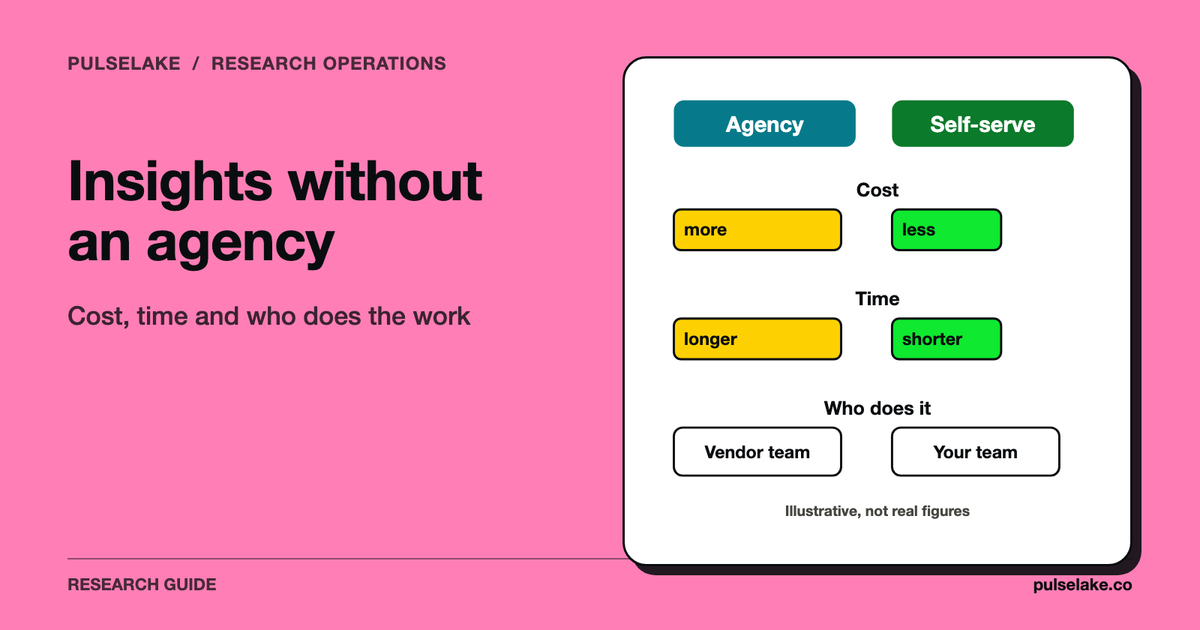
That depends on who's available to design studies and interpret results. Cost is only part of it. We compare the trade-offs in consumer insights without an agency (a companion article we're preparing). PulseLake is a platform for market research and insight teams, covering survey and interview studies and the analysis of the evidence they produce. It doesn't supply third-party market data, so sources like those above stay separate.
Frequently asked questions
What is the definition of consumer insights?
Consumer insights are evidence-based explanations of why consumers think and act as they do, put in a way that supports a decision. They interpret data. Simply reporting it isn't enough.
What is the difference between a consumer insight and data?
Data records what happened, such as a drop in traffic. An insight explains why it happened and what to do next, for example that messaging no longer resonates (GWI's example).
What are the main sources of consumer insights?
The usual ones are surveys, interviews, focus groups, behavioral data like purchases and web analytics, social conversations and reviews, customer service interactions, and third-party panels. Most strong insights draw on more than one.
How do you generate actionable consumer insights from market research?
Begin with a decision, gather evidence from more than one source, segment the results, find the reason behind the pattern, and write the insight as observation, explanation and implication. Then check it with a second source or a small test.
What are some consumer insight examples?
A few: customers leaving checkout because shipping costs appear late (the hypothetical case above), new and long-term customers valuing different features, and diary-study workarounds that point to unmet needs.
Are consumer insights qualitative or quantitative?
Both. Meltwater describes consumer insights as more qualitative than market research, but surveys, behavioral data and experiments are quantitative, and most good insights combine the two.